Do You Need a Whole-Home Air Purifier?
Whole home air purifier vs. portable HEPA: a straight take for Long Island allergy sufferers on what actually works, what it costs, and when it's worth it.
The call we get every May
Pollen counts on the South Shore start climbing in late April and don't really back off until July. By the second week of May the calls start coming in. Somebody's been waking up congested for ten days straight, their HVAC tech mentioned an air purifier on the last service call, and they're staring at a $129 Honeywell on Amazon trying to figure out if it's enough or if they should be looking at the $1,400 ducted media cleaner the contractor pitched. It's a fair question and the answer isn't obvious.
Both kinds of air purifier are trying to do the same job. Pull air through a filter, trap the particles, push cleaner air back out. What changes is how much air they can move, how small a particle they catch, and whether they treat one room or the whole house. For an allergy sufferer those distinctions matter a lot more than the marketing copy suggests.
What a portable air purifier actually does
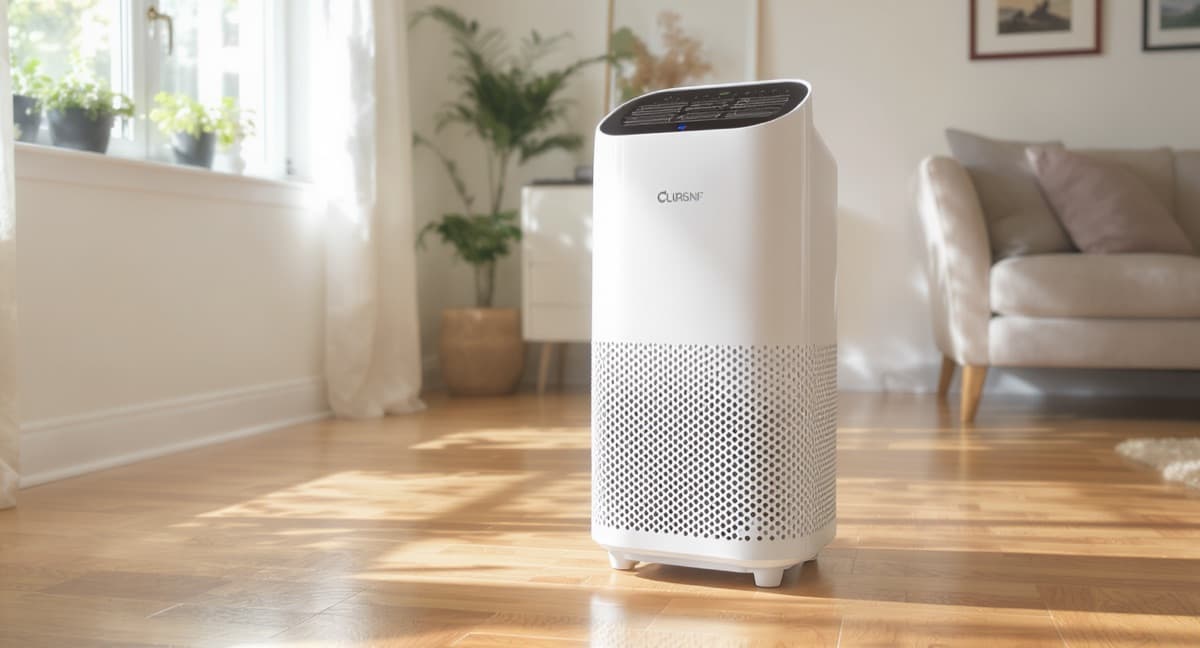
A portable air purifier is a self-contained box that sits on the floor or a shelf, runs on a regular outlet, and pulls room air through a HEPA filter. A true HEPA filter catches 99.97% of particles down to 0.3 microns, which covers most of what bothers allergy sufferers: pollen, dust mite debris, pet dander, mold spores, and a chunk of the bacterial and viral particulate floating around.
The number that actually tells you whether a portable will do anything useful is CADR, the Clean Air Delivery Rate, measured in cubic feet per minute. A unit with a CADR of 250 for pollen can effectively clean about a 400 square foot room if you want roughly 4 to 5 air changes per hour, which is the threshold where allergy sufferers usually start feeling a difference. Anything less than 4 ACH and you're mostly just running a fan.
Good portable units from Coway, Levoit, Blueair, and IQAir run $150 to $800 depending on coverage and how serious the filter stack is. Replacement HEPA filters run $30 to $100 a year per unit. They're quiet enough to sleep next to on the low setting, loud enough to notice on high. The honest case for a portable is one or two specific rooms, usually the primary bedroom and maybe a living room or home office, where someone with seasonal allergies is spending most of their time.
Where portables stop being enough
Where they fall apart is whole house coverage. A 400 square foot CADR rating in a 2,200 square foot Patchogue colonial means you're moving clean air in one room and ignoring the rest of the house. The pollen that comes in through the windows on a breezy May afternoon, the dander that gets tracked in by the dog, the mold spores cycling out of a damp basement, none of that gets touched by a unit sitting in the bedroom. So you buy a second portable, then a third, and you've spent $1,200 and you're still emptying and changing filters in three different machines.
The other issue is what they don't catch. HEPA is excellent at particulate but does basically nothing for gases, VOCs, or odors unless the unit also has a meaningful activated carbon stage. A lot of the cheaper portables put a token carbon sheet in front of the HEPA and call it filtration. It's not really. For VOC reduction you need a pound or two of carbon, not three ounces.
What a whole-home air purifier is
A whole house air purifier is part of the HVAC system, not a standalone appliance. It installs in the return ductwork, treats every cubic foot of air that gets cycled through the air handler, and runs whenever the system is moving air. There are three main flavors worth knowing about.
The first is a deep media filter, sometimes called a media air cleaner. Honeywell, Aprilaire, and Trane all make versions. It's a five-inch-thick pleated filter that lives in a cabinet bolted to the return, traps particles down to the MERV 13 to 16 range, and gets changed once or twice a year. Installed cost in Suffolk County runs roughly $700 to $1,400 depending on ductwork modifications.
The second is an electronic air cleaner. Same idea as a media filter but it uses an electrically charged grid to attract particles instead of (or in addition to) a pleated filter. They're efficient but they need cleaning on a schedule and they can produce trace amounts of ozone if not maintained, which is the opposite of what an allergy sufferer wants in their air.
The third is UV plus filtration, which adds a UV-C lamp inside the air handler downstream of the coil. The UV doesn't really filter anything but it kills mold growth on the coil and reduces biological particulate cycling back into the duct system. Most allergy sufferers don't need it by itself but it pairs well with a good media filter.
A real whole home air purifier setup for most Long Island houses ends up being a MERV 13 to 16 media filter, maybe a UV lamp on the coil, and a cabinet sized to the air handler's CFM. The installed cost lands between $900 and $2,500 depending on the brand, the MERV level, whether UV is included, and how much ductwork has to be cut.
What MERV ratings actually mean for allergy sufferers
The MERV rating system runs from 1 to 20 and measures what size particles a filter catches and how efficiently. MERV 8, which is what most standard 1-inch filters are, catches dust and lint but lets pollen and dander through. MERV 11 catches a lot more pollen and pet dander. MERV 13 starts catching mold spores, bacteria, and finer dust. MERV 16 catches almost everything except gases.
For allergy sufferers the realistic floor is MERV 11 and the better target is MERV 13 if your air handler can pull air through it. That last part matters more than people realize. A high-MERV filter in a system that wasn't designed for it restricts airflow, makes the blower work harder, and can cause the AC coil to ice up in cooling mode. That's why you can't just shove a MERV 16 filter into a slot built for MERV 8 and call it done. The right approach is usually a four to five-inch media cabinet sized for low pressure drop at the MERV level you want.
We covered the broader picture of pollutants and what to actually worry about in our indoor air quality guide for Long Island, and that's worth reading if you're trying to figure out whether your problem is particulate, humidity, VOCs, or something else entirely. Filter selection only matters if you're solving the right problem.
The energy and maintenance reality
A whole house air purifier only treats air when the system is moving air. If your thermostat fan is set to "auto," the air handler runs maybe 30% to 50% of the time during cooling season, less in spring and fall. That cuts the effective runtime of your purifier in half or more. For allergy sufferers this is one of the few cases where running the fan on "circulate" or "on" actually makes sense, at least during peak pollen season. Most modern variable-speed blowers can run the fan low almost continuously for not much money, which keeps air cycling through the filter even when the AC isn't calling for cooling.
Maintenance is straightforward. A 4 to 5-inch media filter gets changed every 6 to 12 months at $50 to $80 a filter. A UV lamp gets replaced annually at around $80 to $150. Compare that to keeping up with three portable units, each with $40 to $100 a year in filters, and the whole-home solution starts looking like less of a hassle, not more.
When a portable still makes more sense
I'm not anti-portable. There are real cases where one good portable beats a ducted setup.
If you rent, you can't install a media cabinet, period. A couple of high-CADR portables in the rooms you actually use is the right call.
If your HVAC system is old, undersized, or doesn't have ductwork that reaches the spaces with the worst air, a media cabinet won't help you because the system can't move air to the rooms that need it. Treat the problem rooms directly with portables until you replace the system.
If only one person in the house has serious allergies and they spend 90% of their time in two rooms, you don't need to clean the air in all 2,400 square feet. Targeted treatment is fine and cheaper.
And if you're trying to test whether better air actually helps before committing to a real install, a $300 portable in the bedroom for a few weeks is a perfectly reasonable experiment.
What to actually look at in the first week of pollen season
Before you buy anything, do a few things this week.
Check your existing filter. Pull it out. If it's gray or visibly clogged, you're losing airflow and your AC coil is probably caked too. Replace it with a fresh MERV 8 or MERV 11 right now, even if you plan a bigger upgrade later. We wrote about why filter changes matter more than people think and that piece walks through what to look for.
Look at where pollen and dander are getting in. Are windows open at night? Is there a dog sleeping on the bed? Is the basement musty? An air purifier can only catch what reaches its filter. Cutting sources matters more than filtration.
Check the humidity. If your house is running 60%+ RH, mold and dust mites are thriving regardless of what filter you put in. Humidity control and air purification are different problems with different solutions.
Then, and only then, look at the purifier question.
The honest recommendation for Long Island allergy sufferers
If you have central air and ductwork that's in reasonable shape, a 5-inch MERV 13 media cabinet on the return is the highest leverage move you can make for allergies. It runs you $900 to $1,500 installed, treats every room in the house, and pays back in lower symptom days through May, June, September, and October. Add a UV lamp on the coil if you've got mold or coil issues, otherwise skip it. A ducted media cabinet plus optional UV is where we start on indoor air quality for Long Island homes, and keeping that media clean is one of the things covered on every maintenance plan visit.
If your ductwork is bad or you only need to treat one or two rooms, two good portables (Coway Mighty for a bedroom, Blueair Blue Pure or IQAir for a living room) are the answer. Total cost around $500 to $1,000 with the right CADR for your room sizes.
If you're not sure which camp you're in, that's what a walkthrough is for. Sometimes the problem is the AC coil, sometimes it's a damp crawl space, sometimes it's that the ductwork has gaps and pollen is being pulled in from the attic. Putting a filter on top of an unsolved source problem is a $1,500 way to learn that you needed something else.
When to call us
If you want a straight take on whether a whole house air purifier makes sense for your home, what MERV your system can actually handle, and what an install would run, we'll come look at it. No pressure, no pitch deck. Most walkthroughs take about 20 minutes and you'll walk away knowing whether you need a media cabinet, a portable or two, or to fix something else first.
Call or text us at 631-209-7090.
Related Articles
Indoor Air Quality on Long Island: A Homeowner Guide
Indoor air quality affects your health more than most people think. What Long Island homeowners should know about IAQ and the practical ways to improve it.
Whole-Home vs Portable Dehumidifier: Which Is Best?
Whole home dehumidifier or a portable unit? Here is how Long Island homeowners should pick the right dehumidifier setup for a muggy Suffolk County summer.
Why Humidity Control Matters in Long Island Homes
Long Island summers get sticky fast. Why humidity control matters as much as cooling, and what you can do to keep your Suffolk County home comfortable.