Whole-Home vs Portable Dehumidifier: Which Is Best?
Whole home dehumidifier or a portable unit? Here is how Long Island homeowners should pick the right dehumidifier setup for a muggy Suffolk County summer.
The question that comes up every June
Every year around this time we start fielding the same call. The basement smells musty, the upstairs bedrooms feel sticky even with the AC running, and somebody just walked out of Home Depot staring at a $299 portable dehumidifier wondering if that's going to solve it, or if they need the $2,500 ducted unit somebody on Nextdoor mentioned. The short answer is it depends on what's wrong and where in the house.
Both kinds of dehumidifiers do the same thing mechanically. They pull humid air across a cold coil, condense moisture out of it, and push drier air back into the room. What separates them is capacity, coverage, energy efficiency, how they drain, and whether they can actually move the humidity needle across a whole Long Island house that's dealing with high humidity from June through September.
What a portable dehumidifier actually does
A portable unit is a single-room appliance. You plug it in, it sits on the floor, it has a bucket or a hose that drains water, and it runs until you tell it to stop. The good ones from Frigidaire, GE, or LG are rated around 20 to 50 pints per day under current DOE test conditions, which roughly translates to covering 500 to 1,500 square feet of reasonably well-sealed space.
For a finished basement that runs 60% to 65% RH in July, one well-placed 50-pint unit with a hose run to a floor drain or a condensate pump can do real work. Expect to pay $250 to $400 for a decent unit, plus maybe $30 for a pump if your drain isn't gravity-friendly. They're loud. They give off heat, which is counterproductive in living spaces during summer. And the coil ices up in cooler basements below about 65 degrees, which is why most of them have a defrost cycle that cuts into their real-world capacity.
The honest case for a portable is simple. You have one specific problem area, usually a basement or a finished attic space, and the rest of the house is fine. Treat that one spot, call it a day.
Where portables fall short
Where portables fail is trying to treat a whole house with them. A 50-pint portable sitting in the basement can't dehumidify the second-floor bedrooms. The moisture doesn't migrate that way, and the air in those upstairs rooms is being supplied by the AC, not by the basement. So you buy a second unit for the main floor, then a third for the primary bedroom, and now you have three noisy machines you're emptying or draining, drawing maybe 1,500 watts combined, and your house still doesn't feel right.
The other issue is reliability over the long haul. Portables are cheap appliances. They're built to a price point, the compressors aren't serviceable, and five or six years is a pretty typical lifespan before one starts short-cycling or failing to pull down to setpoint. That's fine at $300. Less fine if you've bought three of them.
What a whole-home dehumidifier is
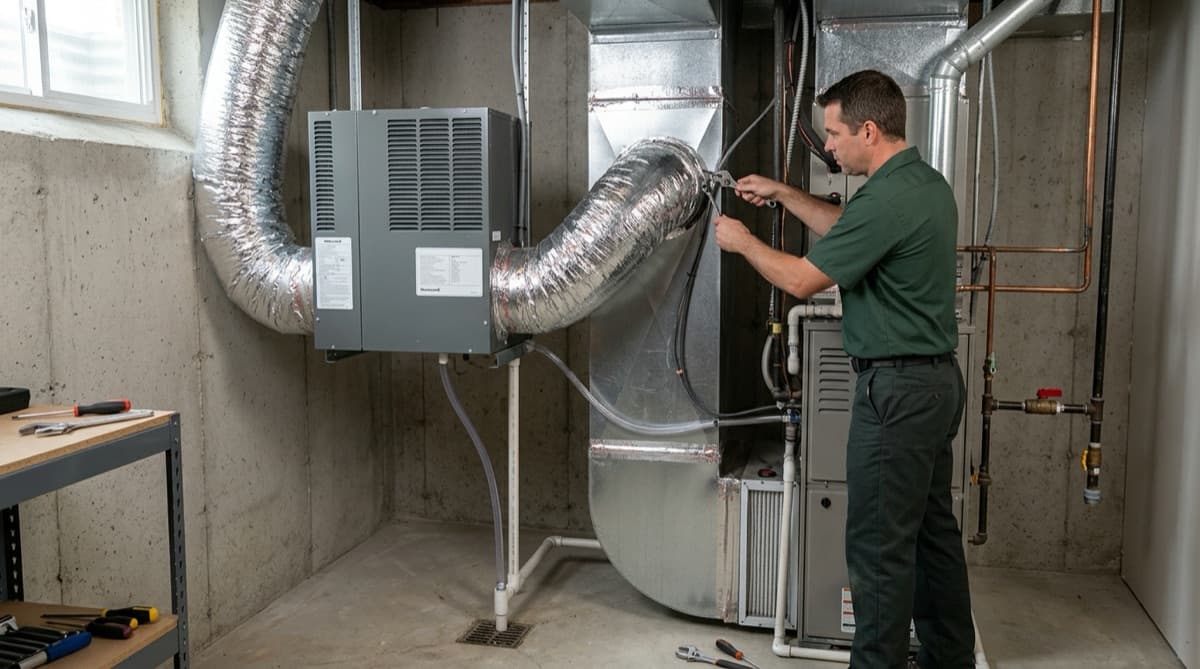
A whole house dehumidifier (also sold as a whole-home or whole-house unit) is an HVAC component, not an appliance. It ties into your existing ductwork, runs on its own dedicated circuit, and is sized to remove 70 to 130 pints per day across the entire conditioned envelope of the house. Aprilaire, Ultra-Aire, Santa Fe, and Honeywell all make solid whole-house dehumidifier models. Most are Energy Star rated, which matters over a long cooling season because these things can run a lot of hours. They drain continuously to a condensate pump or floor drain. They run quietly (the cabinet is usually installed in the basement or a mechanical closet, not a living space). And they have their own humidistat control, so they operate independently of whether the AC is calling for cooling.
That last part matters more than people think. On a cool, rainy July morning where your AC isn't running much because the outdoor temperature is only 72, indoor humidity still climbs. A whole house dehumidifier handles that shoulder-season moisture on its own. A portable can too, but only in the one room it's sitting in.
Installed cost in the Suffolk County market generally runs $1,800 to $3,500 depending on the model, the ducting configuration, and whether any electrical work or ventilation tie-in is needed. The units themselves usually last 10 to 15 years with minimal maintenance beyond a filter change once or twice a year. Energy efficiency is meaningfully better than running multiple portable units because you're only operating one compressor instead of two or three, and it cycles on a humidistat rather than grinding at full tilt in every room.
What healthy humidity levels actually look like
The EPA and ASHRAE both recommend keeping indoor relative humidity between 30% and 50%, with somewhere around 45% to 50% being the sweet spot for a Long Island home in summer. Below 30% you'll start noticing dry skin, static, cracked wood floors, and that scratchy winter throat. Above 60% and you're handing mold spores and dust mites everything they need to multiply. A cheap digital hygrometer from the hardware store or a smart thermostat with humidity sensing will tell you where you actually sit.
Most homes we walk into during July are running 55% to 70% RH even with the AC on. That's the problem band. Fixing humidity levels with either a whole house dehumidifier or a well-placed portable dehumidifier usually pulls those numbers down into the healthy range within a day or two of continuous operation.
Why humidity control matters beyond comfort
Comfort is the reason people call us, but it's not the only reason to fix high humidity. Keeping indoor humidity levels under 55% cuts mold growth in carpets, closets, and behind drywall. Mold spores are always in the air; they only become a problem when they find a damp surface to grow on. It reduces dust mite populations too, which are one of the most common household triggers for allergies and asthma on Long Island. Indoor air quality improves across the board when humidity is under control because damp materials stop shedding microbial volatile compounds. It also protects hardwood floors, trim, and cabinetry from seasonal swelling. Better ventilation helps on the margins, but ventilation alone won't dry a house out during a humid Long Island July. You need active moisture removal with a real dehumidifier to get indoor air quality where it should be.
How to actually decide between them
Ask yourself three questions before you buy anything.
First, is the humidity problem localized or everywhere? Walk the house with a cheap digital hygrometer. Check the basement, the main living area, and at least one upstairs bedroom. If the basement reads 65% and the rest of the house is 48%, that's a one-room problem and a portable probably solves it. If you're reading 58% to 65% on every floor, it's a whole-house problem and a portable isn't going to catch up.
Second, is your AC actually doing its part? A properly sized and maintained central AC should pull the main living space down to 50% to 55% RH on its own in typical summer operation. If it's not, the issue might not be that you need a dehumidifier at all. Could be an oversized system short-cycling, a dirty coil, low refrigerant, or the fan set to "on" instead of "auto." We wrote more about diagnosing this in our piece on why humidity control matters in Long Island homes. Fix the AC first, then see what's left.
Third, what's your tolerance for ongoing hassle? Portables need attention. You're emptying buckets, checking drains, moving them seasonally. Whole-home units are set-and-forget. If you want to deal with it once and never think about it again, that points you toward ducted.
The cases we see most often on service calls
Ranch with a finished basement in Bellport, dry upstairs, swampy basement: one good 50-pint portable with a hose drain. Done.
Two-story colonial in Patchogue, oversized AC, 60%+ RH on both floors, musty closets: whole-home dehumidifier, plus a hard conversation about right-sizing the AC next time it gets replaced.
Older cape in Sayville with a damp crawl space: start with a vapor barrier and crawl space encapsulation before spending anything on dehumidification equipment. A wet crawl space will feed moisture into the living space faster than almost any dehumidifier can pull it out. Cut the source first.
For the bigger picture on what high indoor humidity does to a house and the people in it, our indoor air quality guide covers the health side in more detail.
A quick word on installation and sizing
A whole house dehumidifier has to be sized to the conditioned square footage, the envelope leakiness, and how much latent load the house actually produces. A 1,800 square foot ranch with a tight envelope doesn't need the same unit as a 3,200 square foot colonial with a fieldstone basement. Undersize it and it runs constantly without catching up. Oversize it and you pay for capacity you never use. Most manufacturers publish straightforward sizing tables, and any HVAC contractor who's installed more than a few should be able to walk you through the math.
Installation generally takes half a day to a full day depending on where the unit lands in the HVAC system, whether a new dedicated return is needed, and what the condensate drain situation looks like. If your ductwork is in rough shape, it's worth addressing that at the same time since the dehumidifier is only as effective as the air movement it's tied into. A ducted dehumidifier is one of the bigger levers you have on indoor air quality in a Long Island home, and we usually plan the install around what your existing ductwork can actually handle. If the ductwork turns out to be the real problem, that is a conversation for a central air installation quote, not a dehumidifier.
What the best whole house dehumidifier actually looks like
"Best" depends on the house. For most mid-sized Long Island homes, a 90-pint Aprilaire or a Santa Fe Compact2 sized correctly is the sweet spot for energy efficiency and longevity. For bigger or leakier homes, stepping up to a 130-pint Ultra-Aire or Aprilaire E130 is worth the extra money. Energy Star ratings matter because a dehumidifier in a humid climate can easily log 1,500+ run hours a year. Shaving 20% off energy draw over a decade is real cost savings.
Beyond capacity and Energy Star rating, look at MERV-rated filtration, a control that's easy to set a target RH on, and a reasonable warranty (five to ten years on the sealed system is standard). The best dehumidifier is the one that's correctly sized, correctly installed, and tied into ductwork that actually moves air through the living spaces. A cheap portable and a poorly installed whole house dehumidifier will both disappoint you. Matching the equipment to the problem is the whole game.
When to call us
If you've got a hygrometer, a clear picture of which rooms are wet, and you want a straight opinion on whether a portable is enough or whether it makes sense to price out a ducted whole house dehumidifier, that's a quick conversation. We can usually tell in a 20-minute walkthrough whether the problem is AC performance, envelope sealing, crawl space moisture, or genuine need for dedicated dehumidification. No pressure, no upsell.
Call or text us at 631-209-7090 and we'll come take a look before the real heat rolls in.
Related Articles
Why Humidity Control Matters in Long Island Homes
Long Island summers get sticky fast. Why humidity control matters as much as cooling, and what you can do to keep your Suffolk County home comfortable.
Do You Need a Whole-Home Air Purifier?
Whole home air purifier vs. portable HEPA: a straight take for Long Island allergy sufferers on what actually works, what it costs, and when it's worth it.
Indoor Air Quality on Long Island: A Homeowner Guide
Indoor air quality affects your health more than most people think. What Long Island homeowners should know about IAQ and the practical ways to improve it.