How to Change Your AC Filter (And Why It Matters)
Learn how to change your AC filter the right way. Long Island homeowners who skip this simple step pay more on energy bills and repair costs all summer.
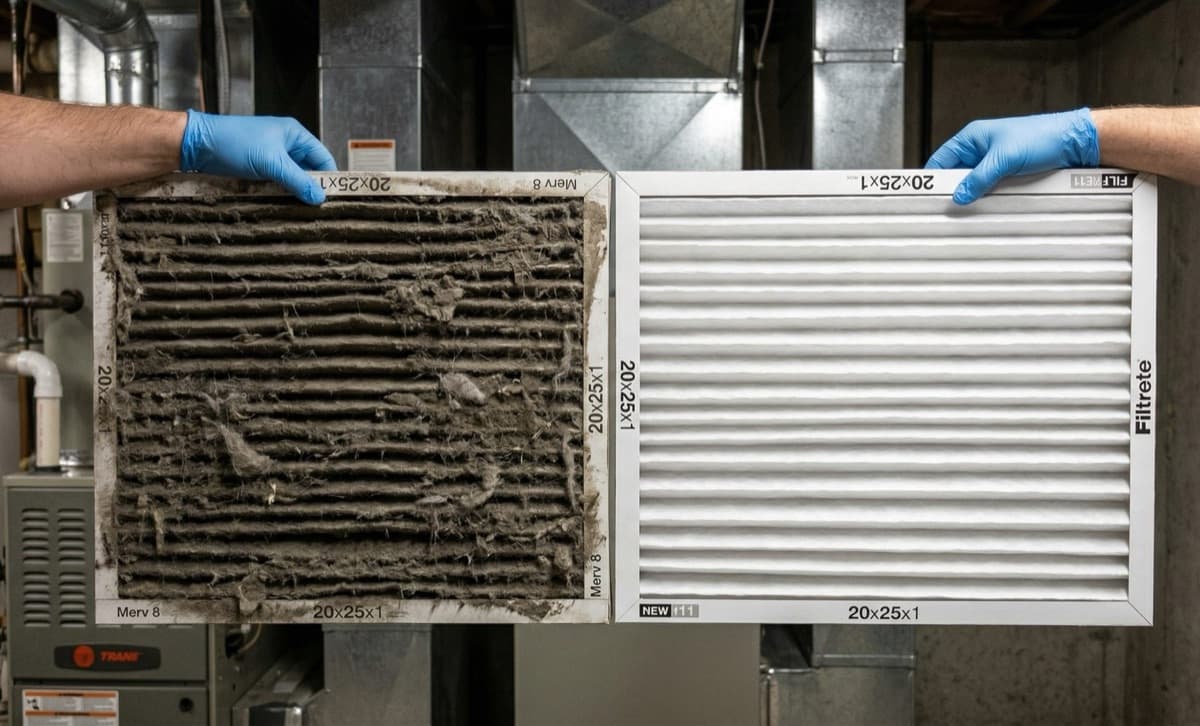
Most homeowners on Long Island think about their AC filter twice a year: once when they can't remember the last time they changed it, and once when their AC stops working. Those two moments are more connected than you might think.
Changing your AC filter is the single easiest thing you can do to keep your system running well this summer. It takes five minutes and costs a few dollars. Skipping it can cost you a few hundred on your energy bill or a few thousand on a repair. Here's what you need to know.
Why the Filter Actually Matters
Your AC filter's job is to catch dust, pollen, pet dander, mold spores, and debris before they get pulled into the system. On Long Island, especially in spring when everything is blooming and older homes are throwing off insulation dust and pet hair, filters get clogged faster than homeowners expect.
When the filter clogs, airflow drops. Your air handler has to work harder to push air through the system. That extra strain shows up as higher electricity bills and more wear on your blower motor. In bad cases, a clogged filter causes the evaporator coil to freeze over, which shuts your AC down completely until the ice melts and you figure out why it stopped cooling. That's a service call you don't want to be making in July when every HVAC company in Suffolk County is booked out two weeks.
A dirty filter also means more of that debris makes it past the filter and onto the coil itself. Coil cleaning is not cheap. Expect to pay $200 to $400 if we have to do it as part of a service call. (For a full breakdown of what AC repairs cost on Long Island, we put together a guide.)
How Often You Should Change It
The standard advice is every 90 days. That's a reasonable baseline for a home without pets and without allergies. In reality, most Long Island homes should be changing their filter every 30 to 60 days during peak season.
Here's why. Homes in Patchogue, Medford, Bellport, and most of Suffolk County are running their AC hard from late May through September. If you have a dog or a cat, the filter fills up faster. If anyone in the house has allergies or asthma, you want the filter doing its job properly, not struggling. And if your home is older, especially if it was built in the 1960s or 70s, there's more dust and fibers coming off the insulation and ductwork.
A quick rule we use: pull the filter out and hold it up to a light. If you can't see light through it, it needs to be replaced. Don't try to vacuum it clean and put it back in. Most fiberglass and pleated filters aren't designed for that.
Choosing the Right Filter
This is where a lot of homeowners get tripped up. You walk into Home Depot and there's a whole wall of filters with MERV ratings from 4 to 16 and prices ranging from $2 to $30. What do you actually buy?
MERV stands for Minimum Efficiency Reporting Value. Higher MERV means finer filtration, which sounds like it's always better. It's not.
A MERV 13 filter captures more particles than a MERV 8, and it also has a higher pressure drop, meaning the blower has to work harder to pull air through the denser media. Whether that's a problem in your house depends entirely on your system: how much static pressure it has to spare and whether the ductwork was sized generously in the first place. A lot of modern systems handle MERV 11 to 13 without breaking a sweat. Older or undersized ductwork, which we see plenty of in Suffolk County homes, often can't, and in those houses a high-MERV filter causes the same starved airflow as a clogged one. ASHRAE treats it the same way, as a system-by-system question rather than a single right answer.
So don't guess. The honest move is to have your static pressure measured, then run the highest MERV your system can actually breathe through. If nobody has ever measured it, a MERV 8 to 11 pleated filter is a safe starting point that gives you solid filtration for dust, pollen, and pet dander. If someone in your home has severe allergies or respiratory issues, it's worth having us check the static pressure so you can go higher with confidence instead of hoping for the best. Whatever rating you land on, change it every 30 days during heavy pollen season.
Stick to the size printed on your current filter. Width, height, and thickness all matter. A filter that's even slightly too small will let unfiltered air bypass it around the edges.
How to Actually Change It
Pull the old filter out and note which way the airflow arrow is pointing before you throw it away. That arrow needs to point toward the air handler, away from the return duct. This is the most common mistake we see when homeowners change their own filters.
With the old filter out, take a look at the slot before you put the new one in. If there's a visible buildup of dust around the edges of the housing, wipe it down with a dry cloth. Then slide the new filter in with the arrow pointing the right direction, close the panel, and you're done.
If your filter is in a hard-to-reach spot, like a return duct up in the ceiling or inside the air handler itself in the basement, it's worth taking two minutes to set a phone reminder for the next change. "Out of sight, out of mind" is exactly how filters get forgotten for two years.
What Happens When You Keep Up With It
We see the difference constantly when we do maintenance calls across Long Island. Homes where the filter gets changed regularly run their AC at noticeably lower utility costs, have cleaner evaporator coils, and rarely need emergency service calls. The blower motor doesn't have to work as hard, so it lasts longer.
During an AC tune-up, one of the first things we check is the filter and the coil condition. If the filter has been neglected, the coil is usually dirty too, and that's where the bill goes up. Keeping the filter clean keeps the coil clean, which keeps everything else running the way it should.
We offer maintenance plans that keep your system on a consistent schedule. Essential includes one tune-up a year, and Comfort and Premier include two. but even if you're handling it yourself, just staying on top of the filter goes a long way. If you want help beyond filter changes, see our indoor air quality services for whole-house purifiers, UV lights, and humidifiers.
Spring is the right time to start fresh. If you can't remember the last time you changed your filter, go do it today before you fire up the AC for the first time this season. And while you're at it, run through the rest of our spring HVAC maintenance checklist so you're not calling us in July for something you could have caught in April.
If you want someone to take a look at the whole system before summer, give us a call or text at 631-209-7090. A spring tune-up covers the filter, the coil, the refrigerant charge, and everything else that determines whether your AC performs all season or leaves you sweating in August.
Related Articles
What Does an AC Tune-Up Actually Include?
What's actually included in an AC tune-up and is it worth the cost? Here's what Long Island HVAC techs check, clean, and test during a proper visit.
How to Clear Your AC Condensate Drain Line
How to clear a clogged AC condensate drain line yourself, and how to keep it clear. Prevent water damage, mold, and shutdowns in your Long Island home.
Fall Furnace Tune-Up: Why September Is the Best Time to Schedule
Schedule a furnace tune-up in September for first pick of dates and time to fix what we find. What the checklist covers and what it costs on Long Island.