Is Your AC Too Small? Signs of an Undersized Unit
If your central air runs constantly and still cannot keep up, it may be undersized. The signs of an undersized AC on Long Island, and what to do next.
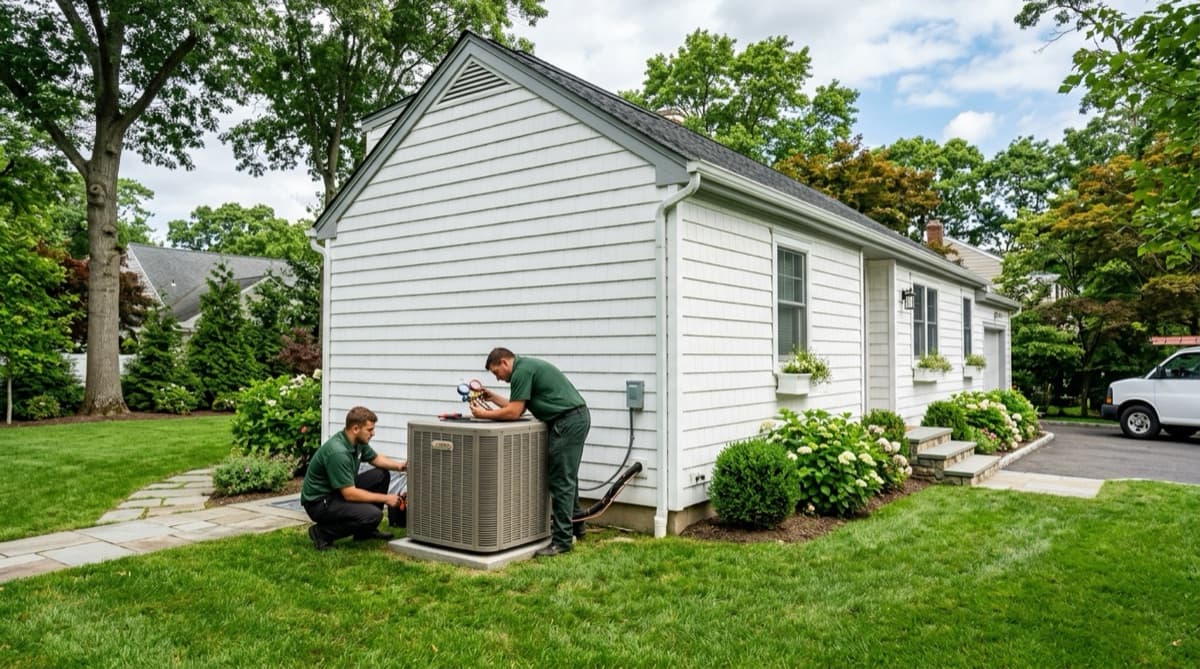
When the central ac just can't catch up
It's the middle of July, the thermostat is set to 72, and the living room is sitting at 78 with the ac running nonstop. The outdoor unit has been humming for four straight hours and the house still feels warm. You check the filter, it's clean. You check the vents, they're open. The air coming out of the registers feels cold, but the rooms just won't drop.
That's what an undersized central ac system feels like. It's not broken, it's not leaking, it's not low on refrigerant. It just doesn't have enough cooling capacity to pull the heat out of your house as fast as the summer is putting it in. And on Long Island, where a lot of homes had their central air conditioning sized by guesswork twenty years ago, we see this constantly.
Central air conditioners (the whole system, meaning the outdoor condenser, the indoor air handler or coil sitting on the gas furnace, and the ductwork that carries cool air to every room) only work right when the cooling capacity is matched to the heat load of the house. When it isn't, you get the symptoms below.
Here's how to tell if your central air conditioner is too small for your home and what your options are if it is.
1. It runs constantly and never cycles off
A properly sized central air conditioner should cycle. On a design-day hot afternoon (think 91 degrees, sunny, humid, the hottest handful of days each summer on Long Island), even the right-sized system will run close to all the time. That's normal. But on an average 85-degree day in July? The unit should cool the house down, hit the setpoint, shut off, sit quiet for 10 or 15 minutes, then kick back on. That cycle, on and off, is how central air conditioning systems are designed to work.
If yours has been running without a break from noon to 8 pm, day after day, and the thermostat still reads higher than the setpoint, you're either looking at an undersized system or a system that's lost capacity. The difference matters. A unit that used to cycle fine and suddenly can't keep up is probably a repair issue, and we walked through the usual suspects in our why is my ac running but not cooling piece. A unit that has never been able to hold setpoint on a hot day, since the day it was installed, is almost certainly undersized.
A good quick sanity check: put a programmable thermostat or even just a plain room thermometer next to your thermostat, then watch the indoor temperature relative to setpoint over a couple of hot afternoons. If the indoor temperature drifts up more than 2 to 3 degrees above setpoint and never recovers, capacity is the issue, not airflow.
2. Some rooms stay hot no matter what
Undersized central air conditioning systems tend to leave the rooms farthest from the air handler warm. Second floors are the classic example. The first floor will sit at 74, the bedrooms upstairs will be at 80, and no amount of thermostat fiddling fixes it.
This can also be a ductwork issue (undersized trunk lines, no return on the second floor, leaky rigid duct in the attic), or a balancing issue, or an insulation issue. But if you've already had the ducts looked at and balanced and it still happens, capacity is the likely culprit. The system physically can't move enough cool air into the far rooms fast enough to overcome the heat gain. It's a whole-home cooling problem, and you can't duct your way out of too few BTUs.
Big windows facing west, poorly insulated attic, dormer bedrooms, finished basements, three-season rooms that got converted to year-round. These all add load the original ac sizing probably didn't account for. A 2.5 ton central ac system that was fine when the house was 1,600 square feet and one story is not going to handle the same house after a dormer and a 400 square foot addition.
3. Humidity stays high even when the central ac is running
This one surprises people. An air conditioner that's running all the time should be dehumidifying aggressively, right? Not exactly. The central air conditioner pulls moisture out of the air when warm humid air passes over the cold evaporator coil and water condenses out. That process takes time. If your central ac system is oversized, it cools the thermostat's air fast and shuts off before it's had time to dry the rest of the house. That's a different problem (short cycling, which we'll get to).
But an undersized system runs long cycles (good for dehumidification in theory) while simultaneously failing to cool enough of the house. What ends up happening is the air handler and blower keep recirculating the same already-cooled air in one zone while the rest of the house stays warm and humid. The result is a clammy, sticky house that feels colder in one room and tropical in another. Some homeowners end up adding a whole-home dehumidifier as a workaround, which helps with comfort but doesn't fix the real issue of undersized cooling capacity.
If your house feels muggy at 74 degrees in August, something's off, and an undersized central ac is one real possibility. Proper humidity levels in a Long Island home sit around 45 to 55 percent relative humidity in the summer. Anything north of 60 and you're going to feel it.
4. Your electric bill is absurd for the cooling you're getting
A central ac that runs 14 hours a day and still doesn't cool the house is going to cost you. Your PSEG bill goes up and your comfort doesn't. That ratio (dollars in, comfort out) is the real tell. A homeowner paying $400 a month in July to keep a 1,800 square foot house at 76 degrees is either running a badly undersized central air conditioner, a badly oversized one, or a dying one.
The energy efficiency penalty on an undersized system is real. The unit's compressor is working at 100 percent capacity 100 percent of the time, which is the least efficient operating point for most single-stage central air conditioners. Two-stage and variable-speed equipment (including higher SEER2 rated systems and newer Energy Star models) gets around this, but single-stage units (which is what most Long Island homes still have) really suffer when they can't cycle. An Energy Star rated split system matched to the right load will almost always run fewer hours and pull less current than an undersized older unit trying to do more than it can.
5. The unit freezes up on hot days
Frozen evaporator coils get blamed on a lot of things. Low refrigerant. Dirty filter. Blocked return. All real causes. But an undersized central air conditioning system that's asked to do more than it can also freeze, because the airflow across the indoor coil isn't enough to keep the temperature above 32 degrees when the system is running flat out for hours.
If your evaporator coil freezes on the hottest days and the repair tech has checked filters, refrigerant charge, and airflow on the blower and everything looks fine, size could be what's wrong. Worth mentioning when you talk to your hvac technician.
Why undersized central air conditioning systems happen in the first place
Most of the time, ac sizing on Long Island follows what the industry calls the rule of thumb: 400 to 600 square feet per ton of cooling, depending on who's doing the math and how optimistic they are. It's fast, it's easy, and it's frequently wrong.
Proper central ac sizing uses something called a Manual J load calculation. Manual J is the ACCA (Air Conditioning Contractors of America) standard for residential load calculations, and it actually accounts for things that matter: window orientation, glazing type, ceiling height, insulation R-values in the walls and attic, air infiltration, occupancy, internal heat gains from appliances, and the local design temperature (for Long Island, cooling design is usually around 87 degrees outdoor with an indoor target of 75). The Department of Energy and ACCA both point to Manual J as the standard for a reason: square footage alone doesn't tell you how much BTU output a house actually needs.
A real Manual J takes an hour or two per house for an experienced person, and spits out a British Thermal Units (BTUs) number for the cooling and heating load. Divide the cooling number by 12,000 and you have your tons of central ac. That's how ac unit size is supposed to be picked. What happens in practice is a rushed installer walks in, counts bedrooms, eyeballs the square footage, and calls the distributor for whatever packaged unit or split system is on the truck.
Here's the kicker. The most common installer mistake is not undersizing, it's oversizing, because undersized central air conditioning systems generate callbacks and angry customers, and oversized units just quietly waste energy and run short cycles that don't dehumidify well. Installers learn to err big to avoid complaints. So if you have an undersized unit, it usually means one of three things happened: your house changed (addition, dormer, conversion), your insulation degraded, or the installer truly got it wrong.
How much cooling capacity do you actually need?
The rule-of-thumb ranges are rough but useful for ballparking your central air conditioning cooling needs. For a tight, well-insulated modern Long Island home, figure around 600 to 700 square feet per ton. For an older ranch or cape with average insulation, 500 to 600. For a leaky, poorly insulated old house with single-pane windows, you might be down to 400 to 450 per ton. Add capacity if you've got big west-facing glass, a finished attic, or a lot of sun exposure.
One ton of cooling equals 12,000 BTUs per hour. Most Long Island homes end up somewhere between 2 and 5 tons of central air conditioning, with the majority in the 2.5 to 3.5 range.
Some quick examples of the central ac sizing that typically comes out of a real Manual J on Long Island:
A 1,500 square foot ranch in Patchogue built in 1965 with original windows and R-19 attic insulation: usually 2.5 tons (30,000 BTU).
A 2,400 square foot colonial in Sayville built in 1995 with vinyl windows and R-38 attic: usually 3 to 3.5 tons (36,000 to 42,000 BTU).
A 3,200 square foot newer build in Medford with tight construction and R-49 attic: usually 3.5 to 4 tons (42,000 to 48,000 BTU).
A 1,200 square foot cape with a full finished second floor in East Patchogue: usually 2 to 2.5 tons (24,000 to 30,000 BTU).
These are starting points, not final answers. Every house is different, and a real load calc will move you up or down from the rule of thumb. What I'd avoid is any installer who tells you "you're a 3 ton house" without asking about your insulation, your windows, or how many people live there.
But oversizing is also a real problem
While we're on the subject, an oversized unit is almost as bad as an undersized one. A central air conditioner that's too big cools the house fast, shuts off, sits idle, and starts again twenty minutes later when the thermostat drifts. That's called short-cycling, and it's hard on the compressor, lousy for humidity control, and usually sticker-shock expensive on the electric bill because starting up a compressor repeatedly draws more power than steady-state running.
Oversizing also kills the comfort equation for whole-home cooling. The thermostat room gets cold fast while the rooms at the end of the ductwork never quite catch up, because the system just doesn't run long enough to equalize. You end up with the same room-to-room temperature swings you'd see on an undersized system, just for different reasons.
So the answer isn't "just size up to be safe." The answer is size it right. Which is why a real load calc matters for any new central air conditioning install.
What to do if you think yours is undersized
First, rule out the easy stuff. Change the filter, make sure all the return vents are unblocked, get the outdoor unit's condenser coil washed off, and book an annual ac tune up if you haven't had one this year. A lot of what looks like undersizing is actually reduced cooling capacity from a dirty coil, a low refrigerant charge, or a restriction somewhere in the duct and airflow path.
If it still can't keep up after all that, ask your hvac company to run an actual Manual J load calculation on your house. Any installer worth their salt will do this, and any installer who refuses or says "we don't need to" on a central air conditioner replacement quote is a red flag.
If the load calc says you need 3.5 tons and you've got 2.5, you have options. The most common is a straight central air conditioner replacement with properly sized equipment, typically a split system with a new outdoor condenser, indoor evaporator coil, and a matching blower or air handler. Another option, especially if the issue is upstairs or in an addition, is to add a ductless mini split to pick up the rooms that are struggling while leaving the existing central air system alone for the rest of the house. A lot of homeowners also use the moment to look at a right-sized heat pump installation so they get one matched system covering both summer cooling and winter heat instead of just patching the AC side. Which way to go depends on your budget, your ductwork, and whether the existing system has any useful life left in it.
Consider a heat pump while you're shopping
If you're replacing an undersized central air conditioner anyway, this is the moment to think about a heat pump instead of a like-for-like ac swap. An air source heat pump is effectively a central air conditioner that can also run in reverse to heat the house in winter, and modern cold-climate heat pump systems are sized the same way as a central ac (Manual J, cooling load) with the added benefit of replacing or supplementing your heating system. For a lot of Long Island homeowners sitting on oil heat and an undersized ac, going heat pump on replacement is cheaper over the life of the equipment, and the PSEG Long Island heat pump rebate can knock thousands off the install price. It is one flat program, $4,000 at market rate up to $7,500 income-qualified, and on Long Island the NYS Clean Heat money is that same rebate rather than a second one.
You don't have to do this. A straight central air conditioner replacement with properly sized new equipment is a perfectly fine answer. Just worth knowing that the heat pump option exists and that the sizing math is essentially the same. Either way, you want a matched split system where the outdoor unit, the indoor evaporator coil, and the air handler or blower are all designed to work together. Mix-and-match equipment usually loses efficiency, and sometimes voids warranty.
When replacement makes more sense than living with it
An undersized central ac isn't just a comfort problem, it's an energy efficiency problem and a lifespan problem. Running a single-stage compressor at 100 percent for 14 hours a day ages it faster than a unit that cycles normally. So even if you're willing to live with the hot upstairs bedroom, the air conditioner itself is going to wear out faster.
If your system is already 12+ years old and undersized, replacement is almost always the right call. If it's newer than that, you might be able to supplement with a ductless mini split and get another five or ten years out of the existing central system. The math on repair versus replace gets tricky when size is part of the equation, and we laid out the general decision framework in our when to replace your ac unit piece. And if you're still leaning on window units to patch the rooms a small central system can't reach, our window AC vs. central air guide walks through when it's time to upgrade.
A quick note on SEER and efficiency ratings
When you're comparing new central air conditioners, you'll see SEER2 numbers on the spec sheet. SEER2 (the current efficiency rating, which replaced the old SEER ratings in 2023) tells you how efficient the unit is over a season. The federal minimum here in the North region, which is where New York sits, is 13.4 SEER2 for a split-system central air conditioner. The 14.3 number you may have read about applies to the South and Southwest, not to us. Most of what actually gets installed on Long Island sits above the federal floor anyway. A 17 or 18 SEER2 unit costs more upfront but uses less electricity. One thing worth knowing before you shop on efficiency alone: PSEG Long Island's rebate money goes to heat pumps, not to straight air conditioners, so a high-SEER2 cooling-only system does not come with a rebate to help close the price gap.
But here's the thing. A high SEER2 air conditioner that's the wrong size for your house will still underperform. The SEER ratings assume the equipment is matched to the heating and cooling load of the home. Oversized high-efficiency units short cycle and dehumidify poorly. Undersized high-efficiency units never reach the steady-state operating point where those efficiency numbers actually apply. Which is all to say: size first, then efficiency. Don't let a salesperson talk you into an 18 SEER2 unit that's still the wrong tonnage for your house.
What to ask an installer when you're getting a new quote
If you're already shopping for central ac replacement and you want to avoid ending up with the wrong size again, three questions get you most of the way there.
Are you running a Manual J on my house, and can I see the output? The answer should be yes, and the output should be a report with BTU numbers for heating and cooling loads.
How did you arrive at the tonnage you're quoting? They should reference the load calc, not square footage alone.
What's your plan for the upstairs (or addition, or whatever room is struggling)? If the answer is just "the new unit will handle it," push for specifics. Different distribution, an added return, supplemental ductless, something concrete.
Installers who can answer these questions clearly are the ones to trust. The ones who wave them off are the ones who installed your current too-small system in the first place.
Ducted vs ductless and what it means for sizing
Worth saying out loud because it comes up a lot. A traditional ducted central air conditioner moves cooled air through the existing ductwork of the house. A ductless mini split skips the ducts and has an indoor head in each room it serves. For whole-home cooling in a house that already has ductwork in good shape, ducted central air is almost always the simpler answer. For additions, finished attics, or homes that never had ducts, ductless is the cleaner install.
Either way, the sizing question is the same. The hvac system (central ac, ducted heat pump, or ductless mini split) has to produce enough BTUs per hour to cover the design cooling load of the space it's serving. The only difference is how the cool air gets from the indoor unit to the rooms that need it.
Central air conditioner brands worth looking at on Long Island
We've done a whole piece comparing the big names, but the short version for central air conditioners on Long Island in 2026: Carrier, Trane, Lennox, Goodman, Rheem, and Daikin all make solid equipment. The best central air for your house is the one that is sized correctly, installed correctly, and comes from a dealer who will actually show up for warranty work. Brand matters less than install quality, and install quality is what you're really paying for when you pick an hvac company.
The bottom line
An undersized central ac is a fixable problem, but it usually means either a replacement or a significant modification to your existing system. Don't just crank the thermostat down further and hope (that makes it worse). Get a real load calculation done, find out what your house actually needs, and get the equipment sized to match.
If you want an honest read on whether your current system is too small, we do free in-home consults across Patchogue, Bayport, Blue Point, Sayville, East Patchogue, Holbrook, Holtsville, Medford, Farmingville, and the surrounding Suffolk County area. We'll run the Manual J, tell you what we see, and let you make the call from there.
Call or text 631-209-7090. Text is usually fastest.
Related Articles
Heat Pump vs Gas Furnace on Long Island: Pros, Cons, and Which Is Right for You
Heat pump vs gas furnace on Long Island: operating cost, comfort, cold-weather performance, and rebates compared, plus when a gas furnace still makes sense.
Best Pool Heat Pumps for Long Island (2026): Hayward vs Pentair vs AquaCal vs Raypak
The best pool heat pump brands for Long Island in 2026, compared by techs who service all four: Hayward, Pentair, AquaCal, and Raypak. Match the brand to your pool.
Ductless Mini Split vs Central Heat Pump: Your Next System Probably Is Not Ductless
Ductless mini split vs central air heat pump on Long Island? If your Suffolk County home has radiators, there is a third option most contractors never quote.