Ductless Mini Splits for Long Island Home Additions
Planning a home addition on Long Island? A ductless mini-split is the simplest way to heat and cool the new space without running new ductwork to it.
The HVAC problem nobody thinks about until it's too late
You've been planning your home addition for months. You've got the architect drawings, the contractor lined up, maybe even the permits in hand. And then someone asks: how are you going to heat and cool that new space?
It happens all the time on Long Island. Homeowners pour their budget into the build and treat HVAC as an afterthought. Then they find out that extending their existing ductwork into a new room isn't as simple as running a few extra feet of flex duct. In a lot of cases, their current system doesn't even have the capacity to handle the added square footage.
That's where a ductless mini split installation makes a lot of sense. And honestly, for most home additions on Long Island, it's the best option by a wide margin.
Why extending your existing air conditioning system is harder than you think
The first instinct most homeowners have is to just connect the addition to whatever HVAC system they already have. Makes sense on the surface. You've got central air conditioning, you're adding a room, just run the ducts over there.
Here's the problem. Your existing air conditioner or furnace was sized for the original footprint of your house. When an HVAC contractor sizes a system, they calculate the load based on square footage, insulation, window count, ceiling height, and a bunch of other factors. Adding 300 to 500 square feet throws that calculation off.
If you force your existing system to cover the new space, you'll probably notice it struggling during peak summer and winter months. The addition won't get cool enough in July, or the rest of the house will feel uneven because the system is working overtime trying to push conditioned air further than it was designed to go.
The alternative is replacing your entire system with a larger unit and extending the ductwork. That works, but now you're looking at $10,000 to $20,000 on top of your construction costs just for the HVAC side. For most families, that's not in the budget.
How ductless mini-split installation solves the problem
A ductless mini-split system gives the new space its own independent heating and cooling system. One outdoor unit with a compressor connects to a wall-mounted indoor unit through a small refrigerant line that runs through a three-inch hole in the wall. That's it. No ductwork, no plumbing new ducts, no tapping into your existing air conditioning system.
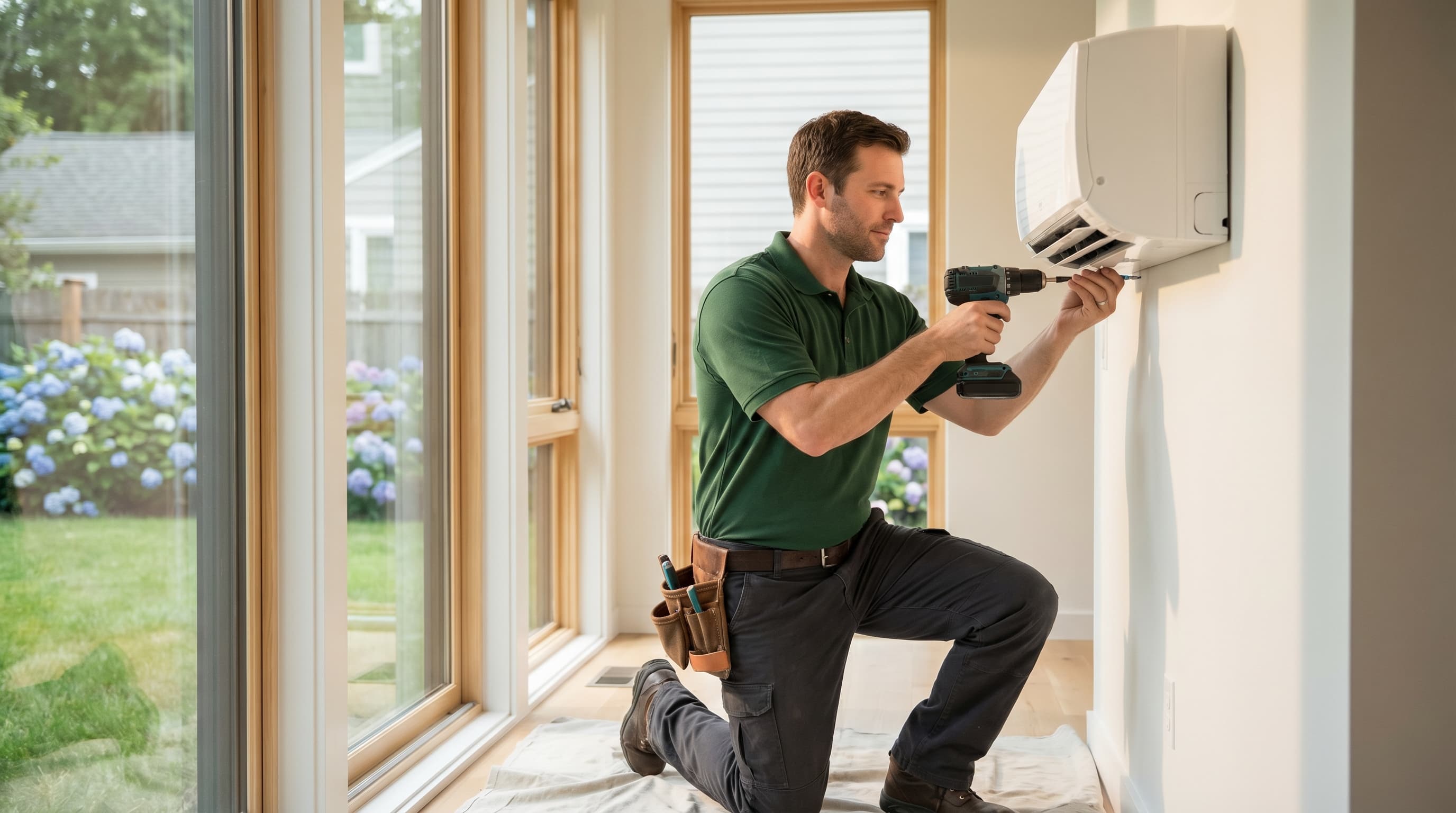
The installation is fast. A single-zone mini split can be fully installed in four to six hours. Your contractor doesn't need to coordinate with ductwork installers or worry about fitting ducts into the framing of the new addition. The mini split goes in at the end of the build, once the walls are up and the electrical is done.
On Long Island, a single-zone ductless mini split installation for a home addition typically runs $5,000 to $8,000 depending on the brand, the size of the unit, and how the lineset needs to be routed. Compare that to the cost of extending ductwork and upsizing your existing system, and the math isn't even close.
The types of additions where ductless systems make the most sense
Pretty much any addition benefits from a dedicated mini split, but there are a few scenarios where it's really the obvious choice.
Finished attics and bonus rooms are probably the most common one we see. These spaces sit right under the roof and get hammered by direct sun in the summer. A mini split with its own thermostat keeps the attic comfortable without overworking the rest of your system.
Garage conversions are another big one. Whether you're turning a detached garage into a home office or converting an attached garage into a playroom, there's no ductwork out there to tap into. A ductless mini-split is the only practical way to condition that space without a major renovation.
Sunrooms and three-season rooms are a classic use case too. A lot of homeowners on Long Island build a sunroom and then realize it's usable for about five months of the year. A heat pump mini split turns it into a year-round room, since it handles both heating and cooling from a single unit.
In-law suites and accessory dwelling units are getting more popular across Suffolk County and Nassau County, especially with recent zoning changes. These spaces need their own climate control anyway, and a ductless air conditioning system gives the occupant independent temperature control without affecting the main house.
Heat pump mini splits handle winter too
This is the part that surprises a lot of people. Modern mini splits aren't just air conditioners. They're heat pumps, which means they heat in the winter and cool in the summer using the same equipment.
The cold-climate models from Mitsubishi, Daikin, and Fujitsu are rated to produce full heat output down to 5 degrees Fahrenheit. Long Island doesn't see many days that cold. Our average January low is around 25 to 28 degrees, which is well within the comfort zone for any quality heat pump mini split.
That means your addition gets year-round home comfort from a single system. No baseboard heaters, no space heaters, no extension cords running across the floor in January. Just one wall unit that quietly handles everything, with energy efficiency that beats most traditional air conditioning setups.
If you're thinking about a broader switch away from oil heat, the addition is a good place to start and see how you feel about heat pump technology before committing to a whole-house conversion. We wrote a full breakdown of oil-to-heat-pump conversions if you want to dig deeper into that.
What about rebates?
Here's where it gets interesting. Because mini splits are heat pumps, they qualify for some significant incentive programs right now.
PSEG Long Island offers rebates on qualifying heat pump installations, and because PSEG administers the NYS Clean Heat program out here, that comes through as one rebate rather than a PSEG amount plus a separate Clean Heat amount. The rebate of $4,000 to $7,500 requires a whole-home, NEEP-listed cold-climate system that becomes your primary heat. A single-zone unit for one addition does not meet that on its own, so it does not qualify. If you are converting the whole house and the addition is part of that project, it can. We'll tell you straight which one your setup is. The federal 25C credit expired at the end of 2025.
Any rebate you do qualify for comes straight off the $5,000 to $8,000 cost of a single-zone mini split installation, and for a lot of homeowners the remaining out-of-pocket is less than they spend on the flooring in the addition.
Choosing the right size and placement for your ductless AC
Getting the sizing right matters. Too small and the unit will run constantly without reaching the set temperature. Too big and it'll short cycle, turning on and off frequently, which wastes energy and wears out the compressor faster.
A qualified HVAC technician will do a Manual J load calculation for the new space. This accounts for square footage, insulation values, window area and orientation, ceiling height, and whether the room gets direct sun exposure. On Long Island, south-facing rooms with lots of glass need more cooling capacity than a north-facing bedroom of the same size.
Placement of the indoor unit also matters. You want it mounted high on a wall where it can distribute air evenly across the room. Avoid putting it directly above a bed or a couch where the airflow will blow right on someone sitting there. Most units have adjustable louvers, but starting with good placement makes a difference.
What to expect during mini-split installation on Long Island
Mini-split installation is one of the least disruptive HVAC services there is. Here's what the process looks like.
The installer mounts the indoor unit on the wall, usually about seven feet up. They drill a small hole through the exterior wall for the refrigerant lines, condensate drain, and electrical connection. The outdoor unit gets placed on a pad or wall bracket outside. Lines are connected, the system is charged with refrigerant and tested, and you're done. A licensed technician handles the whole job.
Most single-zone installations take half a day. There's no drywall to patch, no soffits to build, no days of construction noise. If your Long Island home addition is already framed and drywalled, the mini split install can happen the same week you're finishing up the build.
The bottom line for Long Island homeowners
If you're building an addition, converting a garage, finishing an attic, or adding any new livable space to your home, a ductless mini split installation is almost always the smartest HVAC move. It's less expensive than extending ductwork, it gives the new space independent temperature control, and the heat pump technology means you're covered year-round. For full pricing, including single-zone versus multi-zone, see our ductless mini-split cost guide.
Give us a call or text at 631-209-7090 if you want to talk through what makes sense for your project. We'll help you pick the right equipment and size it correctly so you're comfortable from day one.
Related Articles
What Size Heat Pump Do You Need for a Long Island Winter?
Heat pump size on Long Island: what size heat pump do you need for your home, and why BTUs at 17 degrees matter far more than the ton printed on the label.
Your Heat Pump Is Rated at 47 Degrees. Long Island Winters Are Not.
A cold climate heat pump loses heating capacity as it gets colder. What Long Island homeowners should check at 17 degrees before signing any proposal.
17 Degrees in Patchogue, 10 in Westhampton: The Long Island Heating Design Temperature
The Long Island heating design temperature is not one number. Brookhaven 16F, Farmingdale 17F, Gabreski 10F, and Suffolk County HVAC design conditions differ.