Central Air vs Ductless Mini Split: Which Is Right?
Comparing central air and ductless mini-split installation for Long Island homes. Costs, efficiency, and which cooling system fits your Suffolk County house.
Two good options, very different situations
We get this question all the time: should I go with central air or a ductless mini split? The honest answer is that both are solid heating and cooling systems, but one is almost always a better fit depending on your house, your budget, and what you're actually trying to solve.
If you're building new or already have ductwork, central air conditioning is usually the straightforward play. If you're adding cooling to a space that doesn't have ducts, or you want room-by-room control without tearing open walls, a ductless mini-split installation is probably the smarter move. But there's more to it than that, so let's break it down.
How central air conditioning works (and where it shines)
A central air conditioner uses a single outdoor unit with a compressor and condenser connected to an indoor air handler that pushes cooled air through your home's duct system. One thermostat controls the whole house. It's the standard HVAC system in most Suffolk County and Nassau County homes built after the 1980s.
The biggest advantage is whole-house cooling with one system. You set it and forget it. The air is distributed evenly (assuming your ducts are in good shape), and the indoor components are hidden in a closet or basement. From a home comfort standpoint, there's nothing to complain about.
Where central air falls short is when your ductwork is old, leaky, or nonexistent. A lot of the homes we work on in Patchogue, Sayville, and Medford were built in the 1950s through 1970s with hot water baseboard heat and no ductwork at all. Adding ducts to those homes means opening up walls, building soffits, and spending $3,000 to $7,000 just on the ductwork before you even get to the air conditioning equipment. That changes the math pretty quickly.
A central air system on Long Island typically runs $4,500 to $8,000 for professional installation if you already have ducts, and $8,000 to $15,000 if ductwork needs to be added.
How ductless mini-split installation works (and why it's getting popular)
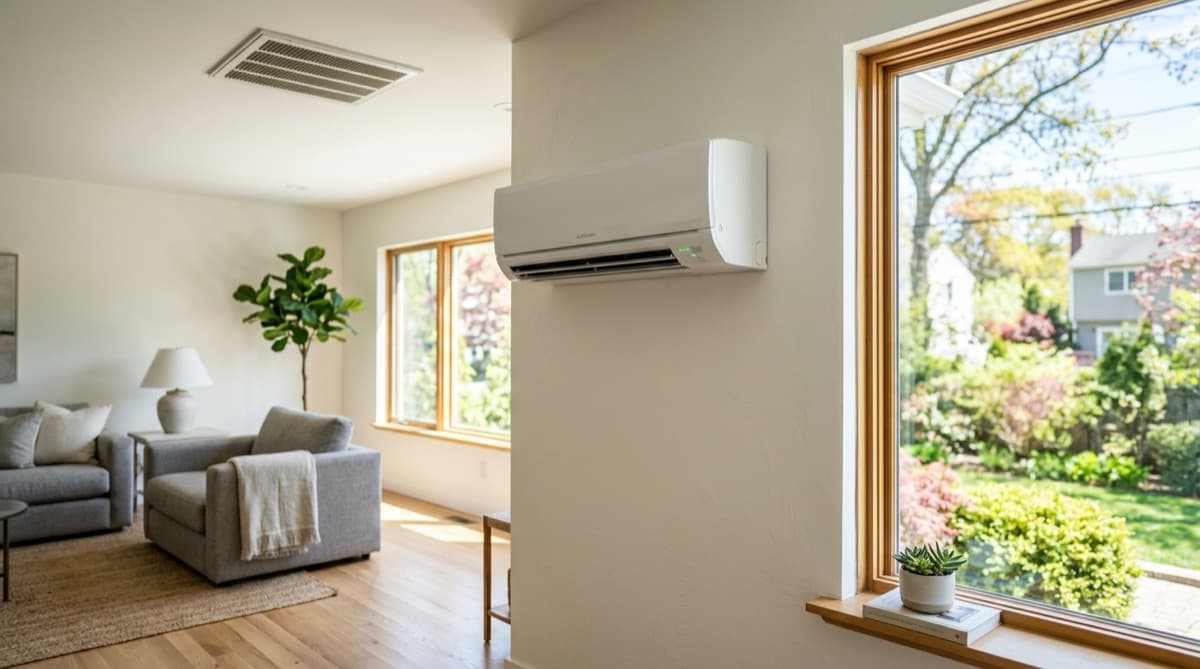
A ductless mini split uses an outdoor unit connected to one or more wall-mounted indoor units. Each indoor unit cools its own zone, and each zone has its own thermostat. No ducts required. The refrigerant lines run through a small hole in the wall connecting the indoor and outdoor units, which is why installation on Long Island homes is so much less disruptive than adding traditional HVAC ductwork.
Ductless mini-split systems have been standard in Europe and Asia for decades, but they've really taken off on Long Island in the last five or six years, especially as more homeowners look at heat pump options that handle both heating and cooling.
The big draw is flexibility. You can put an indoor unit in the bedroom, one in the living room, and one in the home office, and control the temperature of individual rooms independently. No ductwork to install, no major renovation. A single-zone ductless mini split can be up and running in half a day.
Mini-split systems are also significantly more energy efficient than most central air conditioners. A good ductless air conditioning unit runs at 20-30 SEER, compared to 14-18 SEER for a typical central air setup. That translates to real savings on your PSEG energy bills over a full summer.
A single-zone ductless mini-split installation on Long Island runs about $5,000 to $8,000. A multi-zone system (three to four indoor units) is more like $10,000 to $20,000 depending on the brand and layout.
The cost comparison isn't apples to apples
Here's where Long Island families get tripped up. They see that a single mini split head is cheaper than a central air system and assume ductless ac is the budget option. But if you're trying to cool an entire house with mini splits, you're looking at a multi-zone ductless mini-split system and the price gets comparable or even higher than central air conditioning. Our ductless mini-split cost guide breaks down the single-zone and multi-zone pricing in detail.
The real savings with ductless systems come in specific scenarios. Adding cooling to a finished attic, a garage conversion, a sunroom, or a home addition where running ducts would be expensive and disruptive. In those cases, a ductless ac installation is usually half the cost and a tenth of the hassle.
Also worth mentioning: if you go with a heat pump mini split (which most are these days), you get a complete heating and cooling system in one unit. That matters a lot if you're thinking about moving off oil. The PSEG Long Island heat pump rebate is one flat program set by income tier, $4,000 at market rate up to $7,500 income-qualified. On Long Island the NYS Clean Heat money is that same rebate, not a second one to add on top. It only applies when the heat pump becomes your home's primary heat, so a single-zone comfort install does not qualify on its own.
Energy efficiency and operating costs
Central air systems sold today are typically rated between 14 and 18 SEER. That's fine. It's a big improvement over the 8-10 SEER ac units from the 1990s that are still running in a lot of Long Island homes.
Mini splits blow past that. Most Mitsubishi and Daikin units our HVAC technicians install are rated 20 SEER or higher, with some hitting 30+ SEER in ideal conditions. You'll notice the difference on your electric bill, especially during those weeks in July and August when the system is running all day.
One thing to keep in mind: central air cools the whole house regardless of which rooms you're using. With a ductless mini-split system and zone control, you only heat and cool the rooms you're actually in. That alone can cut your cooling costs by 20-30% compared to a central system running full blast. Better energy efficiency means lower energy bills and less strain on your HVAC system over time.
Mini splits also tend to improve indoor air quality since each indoor unit has its own built-in filter and there are no ducts collecting dust and allergens. That's a nice bonus for Long Island residents dealing with seasonal allergies.
Which one should you pick?
Go with central air if your Long Island home already has ductwork in good condition and you want simple, whole-house cooling from a single thermostat. If you're keeping up with maintenance and your ducts are sealed, a central air conditioning system is hard to beat for convenience.
Go with a ductless mini split if any of these sound like you: your home doesn't have ductwork (common in older Suffolk County homes), you're adding an addition or converting a space, you want zone-by-zone temperature control, or you're looking at a heat pump system that handles both heating or cooling year-round.
There's also a middle ground we set up fairly often: keep your existing central air for the main living areas and add a mini-split head or two for problem spots like a hot upstairs bedroom or a bonus room over the garage. You get the best of both systems without replacing everything.
The bottom line
There's no single right answer here. The best system depends on your home's layout, whether you have ducts, your budget, and what you're trying to solve. We look at ductless mini split and central air installs the same way every time, and the recommendation changes from house to house.
If you're not sure which direction makes sense, give us a call or text at 631-209-7090. We'll take a look at what you've got and give you an honest recommendation.
Related Articles
What Size Heat Pump Do You Need for a Long Island Winter?
Heat pump size on Long Island: what size heat pump do you need for your home, and why BTUs at 17 degrees matter far more than the ton printed on the label.
Your Heat Pump Is Rated at 47 Degrees. Long Island Winters Are Not.
A cold climate heat pump loses heating capacity as it gets colder. What Long Island homeowners should check at 17 degrees before signing any proposal.
17 Degrees in Patchogue, 10 in Westhampton: The Long Island Heating Design Temperature
The Long Island heating design temperature is not one number. Brookhaven 16F, Farmingdale 17F, Gabreski 10F, and Suffolk County HVAC design conditions differ.