How to Fix a Heat Pump (Long Island Guide)
How to fix a heat pump on Long Island. Common problems, simple troubleshooting steps, and when to call a Suffolk County HVAC pro for the real repair.
The short answer most homeowners want first
About a third of the heat pump service calls we run on Long Island turn out to be something the homeowner could have fixed themselves in five minutes: a clogged air filter, a tripped breaker, or a thermostat that got bumped into the wrong mode. The other two-thirds need an HVAC technician, parts, and sometimes a refrigerant recharge.
This guide walks you through how to fix a heat pump when the issue is simple, and how to spot the problems where DIY heat pump troubleshooting will only waste your time. Long Island heat pump systems take a beating: salt air on the South Shore, hard February freezes, and the brutal humidity swing from May through September. Knowing which problem you have before anyone gets to your house saves you the diagnostic fee and gets the right part on the truck the first visit.
A quick framing note. If your heat pump is making grinding noises, smoking, or smells like burning electrical, shut the system off at the breaker and call us. Some problems shouldn't be diagnosed off a YouTube video. The same troubleshooting flow below also applies to pool heat pump service calls, since the underlying refrigerant cycle is identical.
The most common heat pump problems we see on Long Island
After running enough Suffolk County service calls, the same six issues come up over and over. Knowing which one you're dealing with shapes whether the fix is DIY, a $200 part, or the harder repair-or-replace conversation.
Dirty air filter. This is the most common problem with heat pumps, full stop. A clogged hvac air filter chokes airflow across the indoor coil, which causes the system to ice up in cooling mode or short-cycle in heat mode. Most homeowners haven't checked their filter in 6 to 18 months by the time we get the call.
Frozen or buried outdoor unit. Long Island winters dump 4 to 18 inches of snow at a time. If your outdoor unit gets buried or the defrost cycle stops working, the coil freezes solid and the heat pump can't pull heat from outside air. The defrost board is the usual culprit when the cycle fails.
Low refrigerant from a leak. Refrigerant doesn't get used up. If your refrigerant levels are low, you have a refrigerant leak somewhere in the system. Symptoms include weak heating output, longer run times, and ice forming on the small copper line at the outdoor unit.
Stuck reversing valve. This is the part that makes a heat pump a heat pump. It flips the refrigerant flow between heat mode and cool mode. When it sticks, you get cold air in winter or warm air in summer. Costs $1,200 to $2,200 to replace on most residential heat pump systems.
Failing capacitor. A capacitor is the small electrical part that helps the compressor and fan motor start. When it weakens, you'll hear humming without the system actually starting, or the outdoor unit will trip the breaker. Cheap fix at $200 to $400 if a technician catches it early.
Bad defrost control board. When the outdoor unit stays iced over even after the system runs, the defrost board has usually failed. Affordable repair, but the symptom looks scary. Don't try to chip the ice off with a screwdriver. We see that more than we should.
Five things you can troubleshoot yourself before calling anyone
These are the five checks any Long Island homeowner can run in 10 minutes. If none of them solve the problem, that's when you call. Real troubleshooting tips, not filler.
1. Check the air filter. Pull it out and hold it up to a light. If you can't see light through it, replace it. Use a 1-inch pleated filter rated MERV 8 to 11 for most homes, MERV 13 if anyone has allergies. Cheaper filters do less, and the fanciest hospital-grade filters can actually choke airflow on residential heat pump systems. Mark your calendar to check it every 90 days.
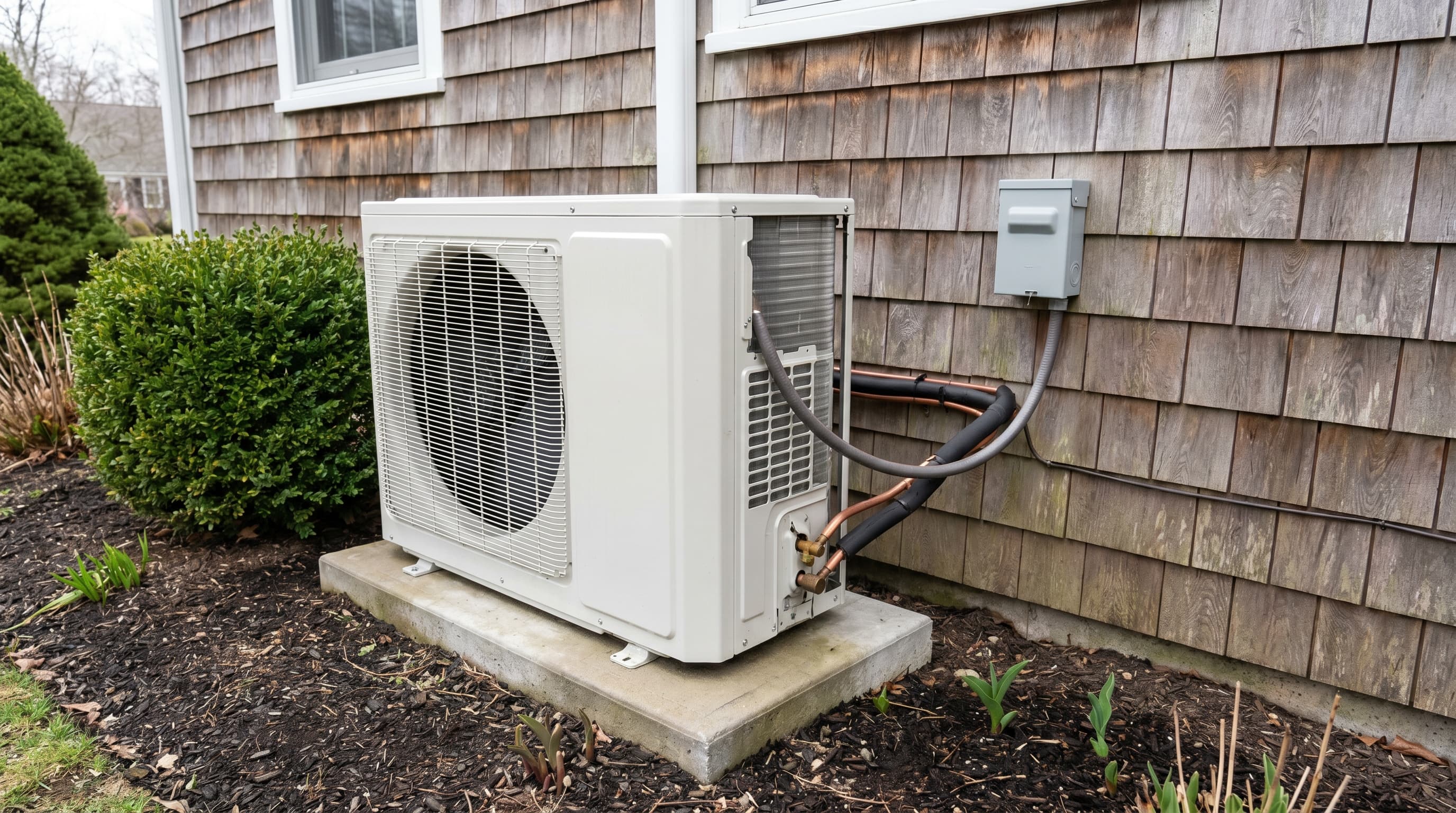
2. Check the breaker and disconnect. Heat pumps usually have two breakers in your main panel, one for the indoor unit and one for the outdoor unit. There's also a disconnect box mounted on the side of your house next to the outdoor unit. If any of these are tripped or pulled, flip them back on. If a breaker trips again immediately, stop and call us. That's an electrical short, not a reset issue.
3. Verify thermostat mode and batteries. Sounds dumb. Saves a service call about once a week. Make sure the thermostat is set to "heat" in winter or "cool" in summer, not "auto" or "off." If you have a smart thermostat like an Ecobee or Nest, swap the batteries even if the screen looks fine. Low batteries cause weird intermittent behavior before the screen goes dark.
4. Clear the outdoor unit. Snow, leaves, mulch, even tall grass within 18 inches of the outdoor unit kills performance. In winter, brush off snow and check that the unit isn't frozen into a block of ice. In summer, trim back vegetation. Salt-corroded coil fins on South Shore homes need a pro to clean, but loose debris you can handle yourself.
5. Reset the system. Turn the thermostat to off. Flip the indoor and outdoor breakers off. Wait 5 minutes. Turn breakers back on, set the thermostat to your desired mode. Modern heat pump systems have logic boards that occasionally lock up. A clean reset clears half the weird intermittent issues we see.
If you've run all five and the problem isn't fixed, the issue is mechanical or electrical, and you need an HVAC technician. Save yourself the time and pick up the phone.
Why your heat pump is blowing cold air in heat mode
This is the most common winter complaint we get from Suffolk County homeowners. The system runs, air comes out, but it's not warm. Three things to check before you panic.
Defrost cycle. A heat pump in cold weather periodically reverses to cooling mode for 5 to 10 minutes to melt frost off the outdoor coil. The indoor unit blows cool air during this cycle. This is normal. If your system is doing this every couple of hours and otherwise heating fine, that's the defrost cycle working.
Stuck reversing valve. If the system is blowing cold air constantly, not just during a brief defrost, the reversing valve may be stuck in cooling mode. You can verify by switching the thermostat to cooling and seeing if you suddenly get warm air out. If yes, the valve solenoid is stuck. This is a $1,200 to $2,200 repair on most residential systems and requires a technician with refrigerant recovery equipment.
Auxiliary heat not engaging. Most cold-climate heat pumps installed on Long Island have a backup electric heat strip in the air handler that kicks in when outdoor temps drop below 25°F or 30°F, depending on the system. If the heat strip relay or contactor fails, the heat pump tries to heat your home with just compressor heat on a 15°F day, and the air coming out feels lukewarm at best. A technician can test and replace the contactor in under an hour.
If you've ruled out defrost and you're still getting cold air, it's a service call for heat pump repair. Don't keep running the system if it's clearly not heating: that just runs up your electric bill and stresses the compressor.
Why your heat pump is short-cycling, frozen, or running constantly
Three more failure patterns we see all the time on Long Island, each pointing to different parts and different repair costs.
Short-cycling. The compressor kicks on for 60 seconds, kicks off, kicks on again. Usually means low refrigerant levels (which means a leak) or an oversized heat pump installed without a proper Manual J load calculation. If the unit is less than 5 years old and short-cycling, get a technician out to check refrigerant pressures and look for the leak. If it's been doing this since installation, the system was sized wrong and that's a harder conversation.
Frozen outdoor unit in winter. Some frost is normal. A solid block of ice covering the entire outdoor coil is not. Causes include a failed defrost board, a stuck defrost relay, or a low charge that prevents the heat pump system from generating enough heat to defrost itself. Don't pour hot water on it. Shut the system off at the breaker, let it thaw naturally, and call us.
Heat pump running constantly without heating well. Two main causes: a refrigerant leak that's left the system undercharged, or a compressor that's losing efficiency from age. A 12 to 15 year old heat pump that runs constantly and barely heats is a candidate for replacement, not repair. Any honest hvac professional should put gauges on it before they sell you anything.
Iced indoor coil in cooling mode. Sounds counterintuitive, but it's common in summer. A dirty air filter or a frozen evaporator coil from low refrigerant turns into a block of ice in your air handler, which then drips water everywhere when it thaws. Replace the filter, run fan-only mode for a few hours to thaw the coil, then call us if it freezes again.
How much does it cost to fix a heat pump on Long Island?
We get asked this on every call. Pricing for heat pump repair on Long Island in 2026 breaks down into four parts: diagnostic fee, parts, labor, and refrigerant if the system needs it.
Diagnostic fee. Ours is a flat $129 with no trip charge on top, and it gets credited toward the repair if you move forward with us.
Common heat pump repair costs, cheapest to most expensive:
- Capacitor replacement: $200 to $400
- Contactor replacement: $250 to $450
- Defrost control board: $400 to $800
- Refrigerant leak detection and recharge: $400 to $1,200 depending on leak location
- Fan motor replacement: $500 to $900
- Reversing valve replacement: $1,200 to $2,200
- Compressor replacement: $2,500 to $4,500
Labor rates. Long Island HVAC labor runs $185 to $250 per technician hour. Most heat pump repairs take 1 to 3 hours, including diagnostic and warranty paperwork. We quote heat pump repairs flat rate, so you get the whole price up front instead of watching a clock.
Refrigerant. R-410A pricing has been climbing as the industry phases out toward R-32 and R-454B. Expect $80 to $150 per pound installed, and a typical 3-ton residential heat pump holds 6 to 10 pounds.
The hard number to remember: most real heat pump repairs on Long Island land between $400 and $1,500. Anything significantly above $2,000 is when the repair-or-replace conversation starts.
What is the $5,000 rule and when does repair stop making sense?
The $5,000 rule is a formula you'll see online: multiply the age of your heat pump in years by the estimated repair cost, and if the result clears $5,000, replace. It's fine as far as it goes, but the rule we actually use is simpler and holds up better. If the repair costs more than half of what replacement would cost, replace. That's the 50 percent rule, and you can run it in your head.
Two examples from Long Island service calls:
8-year-old heat pump, $400 capacitor repair, roughly $14,000 to replace. The repair is about 3 percent of replacement, nowhere near half. Repair it. The system has another 8 to 12 years of useful life and the capacitor is unrelated to overall system condition.
14-year-old heat pump, $2,200 reversing valve, and a compressor that may not be far behind. By itself $2,200 isn't half of a $14,000 replacement, but a reversing valve on a system this age rarely travels alone, and once you add the compressor you're past the line. Sinking $2,200 into a system that's already past the average residential lifespan rarely makes sense. You're one compressor failure away from a much bigger bill. (Same logic applies on the heating side too: a 20-year-old furnace eating $1,500 in furnace repair work is usually a replacement candidate.)
The rule isn't perfect. It misses two things.
Rebates on a replacement. A new cold-climate heat pump installation qualifies for the PSEG Long Island rebate, a flat $4,000 to $7,500 depending on your income tier. That is one rebate, not a PSEG amount plus a separate NYSERDA Clean Heat amount, since PSEG administers Clean Heat out here. The federal 25C credit expired at the end of 2025. Even so, on a $14,000 install the rebate can bring out-of-pocket down to roughly $6,500 to $10,000, which changes the math against pouring $2,500 into a 14-year-old system. Current numbers are on our rebates and savings page.
Energy bills. A 12 to 15 year old heat pump runs at maybe 70% of its original efficiency. A new SEER2 18 or HSPF2 9.5 cold-climate system will cut your PSEG bill by 20% to 35% versus an aging heat pump. That's $400 to $900 a year in lower energy bills, which pays back the heat pump replacement faster than people expect.
If a repair quote is creeping toward half of replacement, or your heat pump is leaking refrigerant for the second time in 18 months, ask for a replacement quote alongside the repair quote. We give both whenever a homeowner is on the fence, and the rebate-aware comparison usually makes the decision obvious.
How to prevent the most common heat pump problems
The cheapest heat pump repair is the one you don't need. Five habits prevent most of the calls we run on Long Island.
Change the air filter every 90 days. This single habit prevents about a third of the heat pump service calls we run. Mark the calendar. Stick filters in your Amazon Subscribe & Save. Whatever it takes.
Annual professional heat pump maintenance. A real tune-up checks refrigerant pressures, cleans the indoor coil and outdoor coil, tests capacitor microfarads, verifies the defrost cycle, calibrates the thermostat, and tightens electrical connections. Catches small problems while they're cheap. Costs a flat $149 a la carte, included on our maintenance plans starting at $19 a month.
Keep the outdoor unit clear. 18 inches of clearance on all sides. Trim shrubs. Don't pile lawn furniture, mulch, or holiday inflatables against it. In winter, brush snow off after big storms.
Don't ignore weird sounds or smells. Squealing, grinding, hissing, or ozone-like electrical smells are early warnings. The repair when you call early is almost always cheaper than the repair after the part fails completely.
Smart thermostat. An Ecobee or comparable thermostat keeps a run-time history, so a system that starts running longer or cycling more often shows up there before you'd notice it on your energy bill. Our Premier maintenance plan includes an Ecobee, one per home.
If you've worked through this guide and your heat pump still isn't running right, give us a call or text at 631-209-7090. Diagnostic visits are $129 and get credited back if you move forward with the repair, and we'll give you a real number on parts, labor, and timeline before any work starts. If the smarter move turns out to be replacement instead of repair, we'll show you what the PSEG Long Island rebate looks like for your address before you decide either way.
Related Articles
Pool Heat Pump Error Codes on Long Island
Pool heat pump error codes explained for Long Island homeowners: the AquaCal OTA alarm, low water flow lockouts, pressure trips, and when to call for repair.
AC Short Cycling: Why Your AC Keeps Shutting Off
AC short cycling on Long Island? The common causes of a short-cycling air conditioner, how to stop it, what the repairs cost, and when to call a pro.
Commercial HVAC Repair on Long Island
Commercial HVAC repair on Long Island can shut a business down fast. What Suffolk County owners should know about cost, timing, and avoiding trouble.