AC Down on Long Island: What to Do When It Dies
Your central air just quit on a hot day. Here's what to check yourself, how to keep the house livable, and how to get on the schedule for the next business day.
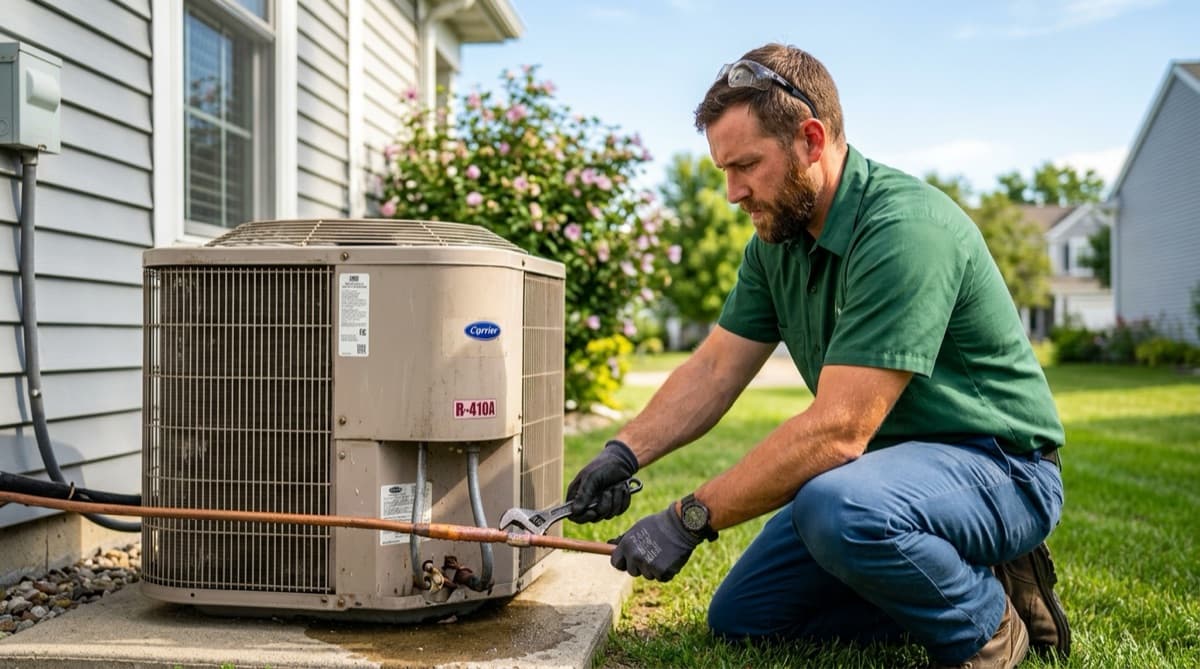
It's 92 degrees and your air conditioning just quit
Someone comes home from work, the house is 88 inside, and the thermostat is doing nothing. Or worse, the cooling system is running but pushing warm air. It's Friday at 5pm and the kids are melting.
Before you panic or call the first company that shows up on Google, there are a few things worth checking. Some of them will save you a service call entirely. The rest will at least help us fix the problem faster once we get there.
One thing up front so you can plan: a real person answers our phone 24 hours a day, but our technicians go out 7am to 7pm. We do not run after-hours emergency calls. So the goal of this post is to get you through tonight and get you on the schedule for the next day.
Check the obvious stuff first
Plenty of AC calls in Suffolk County turn out to be a thirty second fix. A tripped breaker. A thermostat set to heat instead of cool. Fresh batteries needed. A float switch full of water because the condensate drain backed up. No point paying anybody to flip a switch.
Before you call anyone, walk through this list. Check your breaker panel, especially the double-pole breaker labeled AC or condenser. If it's tripped, flip it all the way off, wait ten seconds, then flip it back on. Check your thermostat, batteries included. Pull the filter out of the return and look at it. If it's gray and fuzzy, swap it out. Look at your outdoor unit and see if the fan is spinning when the system is calling for cool. No spinning fan but you hear a hum usually means a capacitor, which we wrote about in more detail in our guide on AC capacitor warning signs and costs.
If none of that gets it running, it needs a technician. Text us and we'll get you on the books.
Turn the system off while you wait
This is the one thing most people miss. If your unit is running but not cooling, you might be tempted to leave it running because at least something is moving air. Don't.
When a system runs without properly exchanging heat, a few bad things happen. The evaporator coil in your air handler can freeze into a solid block of ice, which means a two-hour delay waiting for it to thaw before any technician can work on it. The compressor can overheat and trip on its internal overload. Worst case, you cook a compressor that otherwise just needed a pound of refrigerant and a capacitor. That turns a $400 repair into a replacement conversation.
Shut the system down at the thermostat. Set it to off, not just up a few degrees. If you want to move some air, run the fan-only setting so the air handler keeps the indoor air from going stagnant, or open some windows once it cools down outside.
Keep the house livable tonight
On a 90-plus day, an 1,800 square foot Long Island house climbs a degree every 15 to 20 minutes once the air conditioning stops pulling heat out. You can slow that down a lot.
Close every blind and curtain on the south and west sides of the house. Those windows are where most of your solar gain comes from. Turn off anything that makes heat inside. Oven, dishwasher, dryer, desktop computers, even incandescent bulbs. Pull a fan out of the closet and point it at people, not the ceiling. Move everyone to the lowest floor, because hot air rises and the basement or first floor will stay five to ten degrees cooler than the bedrooms upstairs.
A window unit or a portable air conditioner in one bedroom will keep that room sleepable overnight, which is usually all you need to get to the morning.
If you have elderly family or young kids and the inside temp is climbing past 85, don't tough it out. Drive to the mall, a library, or a friend's house. Heat is a real medical risk for anyone vulnerable, and that is not something to wait out. If there's a safety issue like burning smells or sparks, shut the system off at the breaker and call your utility or the fire department, not an HVAC company.
What to have ready when the technician arrives
Every minute a technician spends hunting for information is a minute they're not fixing your system. Have this ready.
The age of the unit, if you know it. The brand, usually on a label on the outdoor condenser. What refrigerant it uses. R-22 is the old stuff, phased out in 2020, and any repair involving it is expensive. R-410A is what most systems installed in the last fifteen years use, and it has been phasing down since January 2025, so it is getting pricier too. New equipment is shipping with R-32 or R-454B. Then: what happened right before it quit. Did it start making a noise? Did you lose power first? Is it blowing warm, or not blowing at all?
Clear a path to your outdoor condenser. Move the grill, the bikes, the trash cans. Same with the indoor air handler, usually in a closet, attic, or basement. If it's buried behind holiday decorations, that's a delay.
If your AC is running but not cooling, take a look at our breakdown of the most common causes before the tech shows up. It'll help you describe what's actually happening.
What the repair costs
Our diagnostic is a flat $129 with no separate trip charge, and it gets credited toward the repair if you move forward with us. You get the price for the actual work in writing before we touch anything.
For the common failures: a capacitor replacement runs $250 to $450. A fan motor replacement runs $500 to $900. A refrigerant recharge on an R-410A system is $400 to $700, and R-22 is more like $800 to $1,500 because the refrigerant itself is getting harder to source every year.
If the compressor is gone on a system that's over 10 years old, you're looking at a replacement conversation, not a repair. A compressor replacement runs $1,800 to $3,500. On a 15-year-old unit that rarely makes financial sense, and we'll tell you so rather than take the work.
Maintenance is the real lever here. Most of the calls that come in as a dead system would have been caught in a tune-up. Ours are a flat $149, no trip fee, and they catch weak capacitors, low refrigerant, and clogged drains before they strand you on the hottest day of the year. If you're already past that point and the system is down, here's how we approach AC repair on Long Island homes and what to expect when a tech rolls up.
Getting on the schedule
Text or call 631-209-7090. Text is usually the fastest way to reach us in the summer, and it lets you send a photo of the unit and the model label, which helps more than you'd think.
We book service visits during the day and we don't do after-hours emergency calls, so the honest answer in July is that you may be waiting a day or two, same as everyone else on the island. Reaching out earlier in the day gives us the best shot at getting you in sooner. And if your system has been making noises or running weak since spring, that's the time to have it looked at, not the week of the first heat wave.
Related Articles
AC Short Cycling: Why Your AC Keeps Shutting Off
AC short cycling on Long Island? The common causes of a short-cycling air conditioner, how to stop it, what the repairs cost, and when to call a pro.
Why Is My Air Conditioner Running Constantly?
AC running constantly and won't shut off? Why it happens, what you can check yourself in ten minutes, and when an AC that never stops means a real repair.
AC Repair Cost on Long Island (2026 Guide)
What AC repair actually costs on Long Island in 2026. Real price ranges for common fixes, when to repair vs replace, and how to avoid overpaying.