Strange AC Noises? What Your AC Is Telling You
A Long Island guide to AC unit noises, what each one means, and when a repair can wait versus when it is time to call an HVAC pro out to the house.
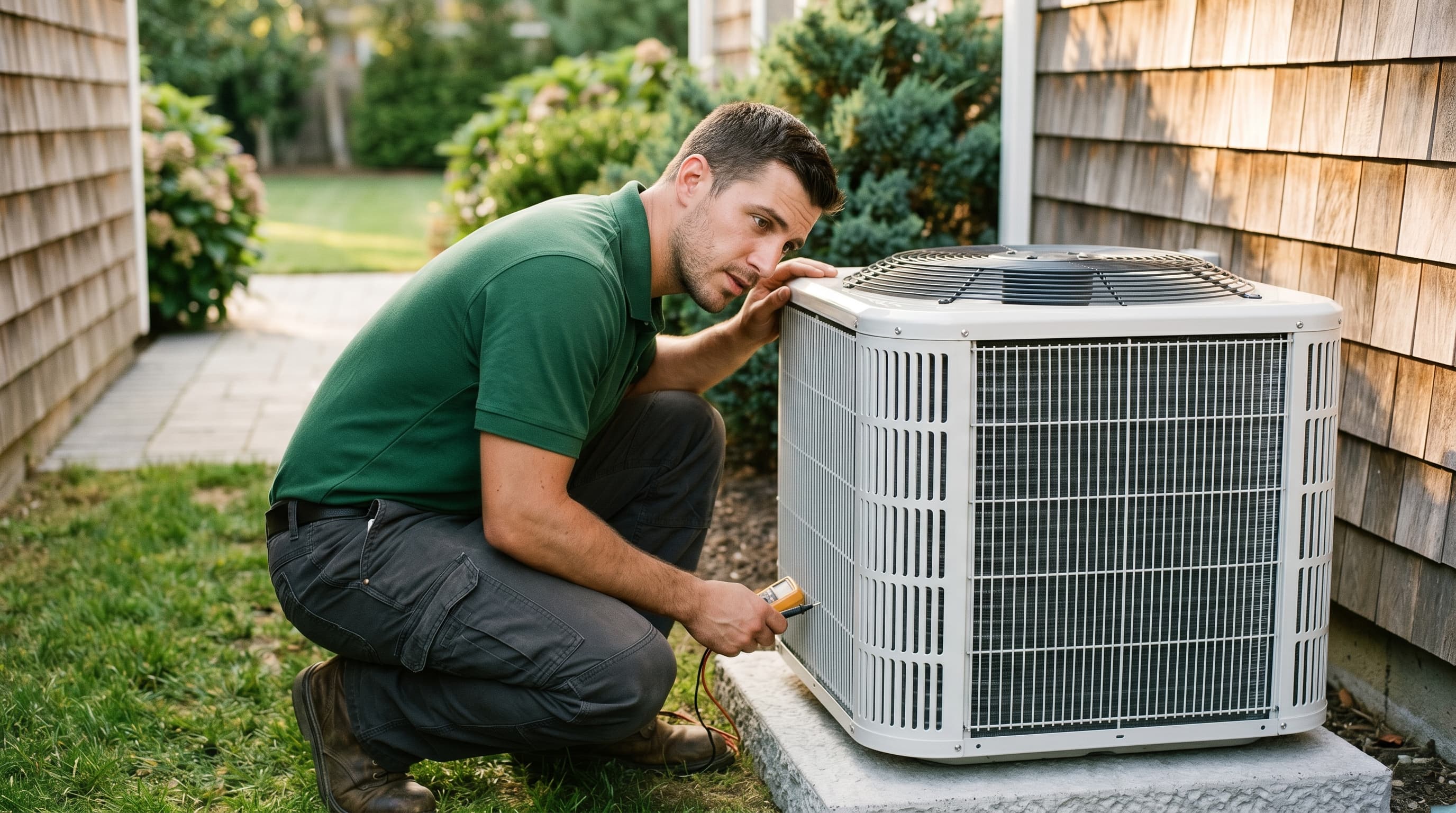
A healthy central air conditioner is mostly boring. You hear the click of the thermostat, a soft whoosh of cool air from the vents, and a steady hum from the outdoor condenser unit. That's it. So when your air conditioning system suddenly starts banging, hissing, or screeching mid-cycle, it's worth paying attention. Some of these noises are nothing. Others are your ac unit telling you it's about to leave you sweating in the middle of cooling season.
Here's a rundown of the sounds we get called about most often out here in Suffolk County, what they usually mean for your HVAC system, and how urgent each one really is when it comes to repairing the ac unit before the issue snowballs into a full new system replacement.
Banging or clanging from the outdoor condenser unit
This one almost always points to something loose inside the compressor or the fan assembly. Could be a broken connecting rod, a piston that's come out of position, or a fan blade that's bent and hitting the housing. We see this a lot on older central air conditioners, especially the 15-plus year old condenser units tucked behind houses in Patchogue and Medford that haven't had regular maintenance in years.
Don't keep the air conditioning running if you hear hard banging. That noise means metal is hitting metal, and every minute it runs you're risking a compressor replacement, which on most residential cooling systems runs $1,500 to $2,800 installed. Shut it off, kill the breaker, and call a professional. If you're still hearing it after a quick visual check (sometimes a stick or chunk of mulch ends up in the outdoor unit), you need an hvac repair tech out the same day. This isn't a do it yourself job once the noise gets that loud.
Buzzing from the outdoor unit
Buzzing is the most common service call we get during the first few hot days of the cooling season. Nine times out of ten on Long Island it's electrical: a failing capacitor, a contactor that's stuck, or a relay that's struggling. Sometimes the compressor itself is trying to start and can't, which is usually a capacitor problem. We covered the full breakdown in our writeup on AC capacitor replacement signs and costs if you want the deeper dive on parts replacement and pricing.
A loud, steady buzz with the outdoor fan not spinning is a textbook bad capacitor. Quick fix on most ac units, usually $150 to $300 depending on the part. A buzz that comes with the breaker tripping is a different story and means there's a short somewhere in the wire or the air conditioner unit itself, and the electricity load is spiking. That one needs same-day AC repair before you fry the control board or melt the contactor.
Hissing or bubbling
Hissing usually means refrigerant is escaping. Could be a pinhole leak in the evaporator coil, a bad valve, a corroded line set running between the indoor and outdoor unit, or a Schrader valve weeping under pressure. Bubbling or gurgling points at the same underlying issue from the other direction. Refrigerant is supposed to arrive at the metering device as a solid column of liquid. When the system is undercharged or something is restricting flow, that liquid starts flashing to vapor early, and the mix of liquid and gas moving through the line is what you hear as bubbling.
This isn't a wait and see issue. A leak means your air conditioning system is undercharged, which kills cooling efficiency, ices up the evaporator coil, and eventually burns out the compressor. On older R-22 systems the freon alone runs $80 to $150 per pound and is getting harder to source every year. R-410A, which is what most systems installed over the last twenty years use, started its own federal phasedown on January 1, 2025, so new equipment now ships with R-454B or R-32 instead. R-410A is still available for servicing existing systems, but it is no longer the cheap easy option it used to be and the price trend is only going one way. Whatever your system takes, the leak still has to be found and sealed. Don't keep topping it off, find the leak. Each top-off is just throwing money at a system that's leaking it back into your yard, and the repair costs only get bigger when the compressor finally fails.
Screeching or squealing at startup
A high pitched screech the second the system kicks on usually means a bad blower motor bearing or, on older air handlers with belt-driven blowers, a slipping or worn belt. Most newer residential cooling units are direct drive, so it's almost always a bearing in the blower assembly.
If the screech only lasts a second or two and then goes away, it's the early start of bearing wear. You've got time, but get it scoped at your next ac maintenance visit. If it goes on the entire run cycle, the motor is on its way out and the bearing is going to seize. Blower motor parts replacement typically runs $400 to $700 on a residential air handler, and skipping it usually means losing airflow entirely once the motor finally gives up. Same deal applies on a furnace or heat pump repair job since the blower assembly is the same hardware.
Clicking that won't stop
A single click when the system kicks on or off is normal, that's the relay. Repeated or rapid fire clicking is not. It usually means the thermostat is calling for cooling but the air conditioner can't start, which sends it into a short cycle of trying and failing. Could be a failing control board, a bad thermostat, low refrigerant, a clogged air filter starving the system of airflow, or a frozen evaporator coil.
This is one where it pays to look first before scheduling a service call. Pull the cover off the air handler and check if the evaporator coil is iced over. If it is, shut the system off, clean or replace the dirty air conditioner filter, and let it thaw for a few hours. Then run it on fan-only mode. If it ices up again, you've got a refrigerant or airflow problem and need a tech out. If it doesn't, a clean filter and a thermostat replacement might be all you need to get the unit running smoothly again.
Gurgling from the indoor unit
Gurgling near the air handler is almost always the condensate drain. Either the drain line is partially clogged with algae and dirt, or there's an air gap causing condensation water to back up. Easy fix most of the time, and we walked through it step by step in our condensate drain line cleaning guide. Condensate drains are one of the most ignored parts of any hvac system and one of the leading causes of water damage we see on summer service calls. If the gurgling is paired with water on the floor near the unit, shut the system off before more water finds its way into your ceiling.
Rattling, humming, or vibration
A new rattle from the cabinet or refrigerant lines is usually loose hardware, missing isolator pads under the condenser unit, or debris caught in the outdoor fan grille. Five minutes with a screwdriver and a flashlight will tell you if it's something you can tighten or pull out yourself. A persistent low hum from the indoor unit when nothing should be running is usually the transformer on the control board going bad. Not urgent, but worth flagging at the next visit.
When repair or replacement makes more sense
Sometimes the noise is the last straw on a system that's already on borrowed time. If your air conditioner is past 12 to 15 years old, you've already had a couple of major repair or replacement decisions, and now there's a new noise plus higher energy bills, it might be time to price out a new unit. A modern central air conditioner with a higher SEER (seasonal energy efficiency ratio) rating can cut your cooling costs 20 to 40 percent versus a 15 year old system, and a new air conditioning install comes with a fresh warranty on the compressor and parts. We'll always give you the estimated repair number side by side with a replacement quote so you can decide which way the math points for your current system. There's no reason to throw $1,500 at a tired ac unit that's going to need another $1,500 in parts replacement six months later.
When to call versus when to wait
Quick rule of thumb. Banging, screeching, hissing, or anything that comes with the breaker tripping or water on the floor, call a professional same day. Buzzing, clicking, or gurgling, you've usually got a few days but don't put it off past a week. A faint hum or the occasional click on startup, that's just the air conditioning system doing its job.
A lot of these noises trace back to the same root cause: a system that hasn't had regular maintenance in a while. Evaporator and condenser coils get dirty, capacitors weaken, drain lines clog, air conditioner filters get loaded up with dirt and debris. Catching it during an annual ac maintenance visit means lower repair costs, better cooling efficiency, lower energy bills all summer, and an air conditioner unit that hits its full lifespan instead of giving up at year ten. Same goes for room air conditioners and heat pumps, regular upkeep keeps the system efficient and stretches the time before you're shopping for a new air conditioning system.
If you're already hearing one of the bad ones, don't let the cooling system keep running hoping the noise works itself out. It won't, and the longer the air conditioner runs in that condition the bigger the repair gets. Give us a call or text at 631-209-7090 and we'll get a tech out. Most of these calls turn into a one-hour visit with a parts replacement and you're back up and cool before dinner.
Related Articles
Why Is My AC Running But Not Cooling?
Your AC is running but not cooling your Long Island home? Here are the most common causes Suffolk County homeowners run into, and what to do about each one.
Pool Heat Pump Error Codes on Long Island
Pool heat pump error codes explained for Long Island homeowners: the AquaCal OTA alarm, low water flow lockouts, pressure trips, and when to call for repair.
AC Short Cycling: Why Your AC Keeps Shutting Off
AC short cycling on Long Island? The common causes of a short-cycling air conditioner, how to stop it, what the repairs cost, and when to call a pro.