R-410A vs R-32 Refrigerant: 2026 LI Homeowner Guide
R-410A is being phased down and new Long Island AC systems ship with R-32 or R-454B. What that means for repair, replacement, and buying in 2026.
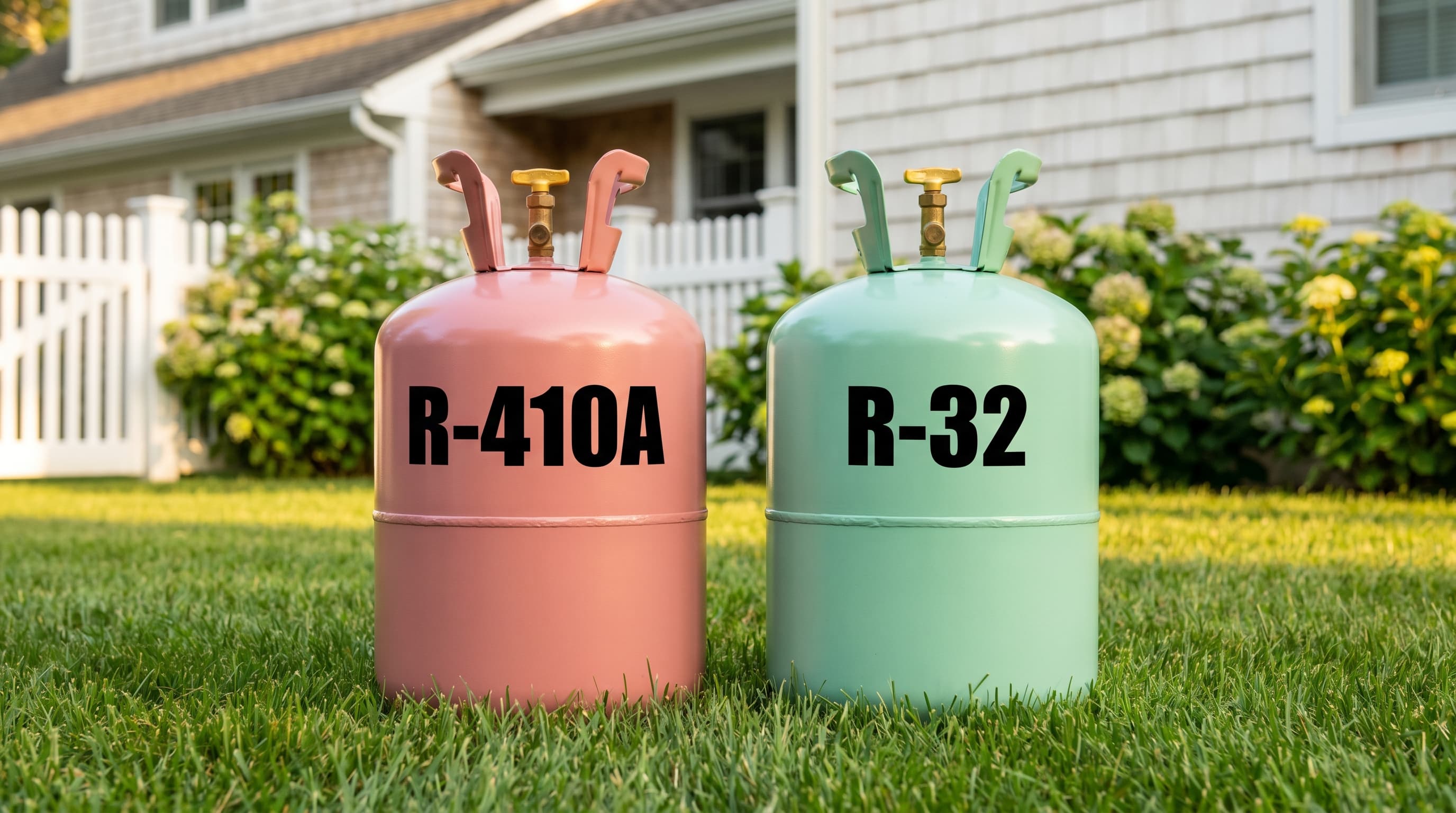
The refrigerant question nobody was asking two years ago
Most homeowners find out about refrigerant the bad way. Something breaks, a tech shows up, and there's a line item on the invoice that says "refrigerant, 3 lbs" with a price next to it that's higher than you expected. You nod, pay the bill, and move on.
That's been the playbook for about fifteen years, ever since R-410A (sometimes written R410A, often sold as Puron) took over from the older R-22. R-410A was the answer. Then starting January 1, 2025, the rules changed. New residential air conditioning and HVAC systems in the US are being built with different refrigerants now, mostly R-32 (also written R32) and R-454B. If you're repairing an existing HVAC system, shopping for a new air conditioner, or just trying to understand why the quote looks different than it did two summers ago, here's what's actually going on with HVAC refrigerants in 2026.
Why R-410A is on the way out
R-410A did its job. It doesn't deplete ozone, it runs at higher pressures than R-22 (often written R22) which allowed for more efficient HVAC equipment, and it became the default for almost every residential central air conditioner and heat pump sold from around 2010 through 2024. What R-410A does have is a fairly high Global Warming Potential (GWP) of about 2,088 (often written as 2088 in spec sheets). That number means a pound of this hydrofluorocarbon leaked into the atmosphere has roughly 2,088 times the warming impact of a pound of CO2 over a century, which makes it a meaningful greenhouse gas when it escapes.
R-410A refrigerant is a hydrofluorocarbon, or HFC refrigerant, and HFCs with a high GWP are exactly what environmental regulations are now targeting. Cut greenhouse gas emissions from HVAC equipment and you meaningfully reduce the carbon footprint of residential cooling, which is what the new rules are really about. The AIM Act, which passed in 2020, tells the EPA to phase down the production and import of high-GWP HFC refrigerants on a set schedule. The first big step for residential HVAC was January 1, 2025. From that date forward, new central air conditioners, heat pumps, and variable refrigerant flow systems manufactured for the US market have to use refrigerants with a GWP under 700.
R-410A doesn't meet that bar. The two low GWP refrigerants that do, and that the HVAC industry settled on for 2025 and beyond, are R-32 (GWP of 675) and R-454B (GWP of 466). Both are designed to replace R-410A in residential HVAC systems without a full equipment redesign, and both are now widely used in new air conditioning equipment shipping to Long Island dealers. Switching to R-32 or R-454B is basically the new default for the industry, not an upgrade you ask for.
What R-32 actually is
R-32 refrigerant (sometimes written R32) is a single-component HFC refrigerant, which is part of what makes it interesting. R-410A is a 50/50 blend of R-32 and another refrigerant called R-125. When a blend leaks, the two components can escape at different rates, which means you typically can't just top off an R-410A system after a leak, you're supposed to recover the whole charge and recharge from scratch. R-32 being a single component means a topoff is actually valid if the system leaks. That's a small thing but it matters for long-term service cost.
Compared to R410A, R-32 is also more efficient per pound, which means HVAC systems need roughly 20 to 30 percent less R-32 refrigerant to deliver the same cooling. Paired with high efficiency compressor and coil designs, this is where the real performance gain shows up. Smaller charge, smaller lineset requirements in some cases, less material moving through the system, faster heat transfer. That higher efficiency per pound carries through to operation too, meaning lower energy consumption for the same cooling load. On paper this is a better, more energy efficient refrigerant in almost every measurable way, with a lower environmental impact on top of it.
Daikin owned the patents on R-32 for years and has been shipping R-32 residential equipment overseas since about 2012. If you've seen a Daikin mini split go in on Long Island in the last few years, that HVAC system was likely running R-32. The global install base is in the tens of millions, which makes R-32 a widely used refrigerant already, not some experimental thing.
What R-454B is (because you'll hear about it too)
Worth mentioning because R-454B (sometimes written R454B, brand name Opteon XL41) is the other refrigerant you're going to see on Long Island in 2026. R-454B is what Carrier, Trane, Lennox, Goodman, and most of the big domestic manufacturers picked for their new North American air conditioning equipment. It's a blend that includes R-32, it has an even lower global warming potential than pure R-32, and performance is close enough to R-410A that existing HVAC system designs didn't need a total redesign.
Daikin and Fujitsu went R-32. Most of the rest of the HVAC industry went R-454B. You're likely to see both refrigerants on Long Island this season, and which one you end up with depends on which brand you buy.
For the homeowner, the practical difference between R-32 and R-454B is small. Both are A2L refrigerants. Both are low-GWP refrigerants that meet the new environmental regulations. Both will have similar service costs. Both will be supported long-term. The real choice you're making when you pick between them is really which equipment brand you trust and which installer you want doing the work.
The A2L flammability thing
This is the part that freaks some people out when they read about it, so let me clear it up. Both R-32 and R-454B are classified as A2L, which means "lower toxicity, mildly flammable." R-410A was A1, meaning non-flammable.
A2L refrigerants will ignite, but only under specific conditions: a high concentration of refrigerant in a small sealed space plus a strong ignition source. In a residential installation with normal charge sizes and proper line routing, those conditions don't occur. The HVAC industry did a lot of testing on this. Manufacturers added leak detection requirements, charge limit calculations by room size, and installation standards that didn't exist for R-410A. All of those safety measures are baked into the UL and ASHRAE standards your installer is supposed to follow.
What that means in practice: HVAC professionals certified on A2L refrigerants know how to size refrigerant lines, how to calculate room volume for charge limits, and how to place equipment so leak dispersion isn't a problem. You should not let an installer put an A2L system in if they can't explain those things. That's the one real gotcha for 2026 buyers.
What this means if your system is R-410A right now
Good news, you're fine. R-410A is not going away tomorrow. Production is being phased down, but reclaimed and existing stock are going to cover the service needs of the installed base for many years. A 2015 or 2020 R-410A system on your Long Island home is not a stranded asset.
The trend you will see is refrigerant pricing for R-410A starting to climb. It's been reasonably cheap (think $30 to $60 per pound wholesale, $50 to $100 per pound on an invoice). Over the next five to seven years, as domestic production ramps down, that price is going to drift upward. It's not going to hit the stupid numbers R-22 saw, but don't be surprised if a recharge on an R-410A system is 20 to 40 percent more expensive in 2030 than it is today.
If your R-410A system is leaking right now, same rule we've always used applies. Find the leak, fix it, recharge. Don't just top off year after year. For the full breakdown of what different kinds of ac repair run on Long Island, our repair cost guide has the numbers, and here's how we handle AC repair calls when refrigerant is involved.
What this means if you're buying new in 2026
Your new system is almost certainly going to be R-32 or R-454B. The manufacturer decides, not you, not the installer. If you're looking at Daikin, Fujitsu, or Mitsubishi mini splits, assume R-32. If you're looking at Carrier, Trane, Lennox, Goodman, or Rheem central air, assume R-454B.
Don't let anyone sell you a new R-410A system in 2026 unless it's old stock they're trying to move and the price reflects that. There's a narrow case for buying a 2024 leftover R-410A unit if the install cost is deeply discounted and you're confident in service availability. But for most homeowners, taking the new-refrigerant unit is the smarter play.
Make sure your installer is certified on A2L equipment and can walk you through the leak detection and charge-limit pieces. Ask who in their shop is EPA 608 certified for the new refrigerants. Any installer who waves the question off or tells you "it's the same as R-410A" doesn't know the job well enough. That's not me being dramatic, that's what the actual training covers.
Can you retrofit an R-410A system to R-32?
No, and don't try. This is the same story as R-22 retrofits ten years ago. The pressure characteristics, compressor oil, metering devices, and safety requirements are different enough that trying to run R-32 in an R-410A system will either break things or create an actual safety issue.
If your R-410A system is at end of life anyway, the decision isn't "retrofit or don't." It's "keep running R-410A or replace with a new A2L system." Most of the time replacement is the right call when you're looking at a big repair on older equipment. Similar logic we walked through in our piece on when it makes sense to replace your AC versus keep repairing it.
The rebate angle worth knowing
Federal rebates and NYSERDA programs right now are pretty aggressive on heat pumps, and heat pumps are where a lot of the R-32 and R-454B equipment is going in residential. If you're weighing a new central AC versus a heat pump, the refrigerant transition is not a reason to pick one over the other, but the rebate math is. A new R-32 heat pump with available rebates can end up costing less out of pocket than a new central AC in the same capacity. Worth running the numbers on both.
R-32 vs R-410A: quick comparison
A few things worth spelling out plainly for R-32 vs R-410A:
GWP: R-410A is 2,088 (or 2088 without the comma). R-32 is 675. Lower is better for the environment and for long-term availability. R-32 has a roughly three times lower global warming potential, which is the core reason environmental regulations are pushing the switch.
Charge size: R-32 systems typically use 20 to 30 percent less refrigerant for the same cooling capacity. Smaller charge, less cost at service time, less material in play if there ever is a leak.
Single component vs blend: R-32 is single component, so a partial recharge is valid after a minor leak. R-410A is a blend and technically requires a full recovery and recharge after any significant leak to maintain the correct composition.
Flammability: R-410A is A1 (non-flammable). R-32 is A2L (mildly flammable). In a residential install with correct practices, this is not a practical concern. It does mean your installer needs A2L training and has to follow new safety measures on charge limits and leak detection.
Efficiency: R-32 HVAC systems tend to run slightly higher SEER2 numbers at the same price point as R-410A units. Part of that is the refrigerant's better heat transfer, part of that is manufacturers redesigning the equipment around the new refrigerant and getting to optimize some things. The net is better system efficiency and lower energy consumption over the life of the system.
Environmental impact: R-32 has a lower environmental impact, end to end. Lower GWP, less refrigerant per system, and in most cases better energy efficiency that reduces indirect emissions from the grid too. Calling it more environmentally friendly is not marketing, it's the regulatory intent.
Availability of service: R-410A is everywhere today and will be serviceable for years. R-32 availability is ramping fast and will be on par by 2027. Either way, service is not a real concern for a homeowner.
Choosing the right refrigerant for your HVAC system
For most Long Island homeowners, you don't actually pick the refrigerant yourself. The HVAC system you buy comes pre-charged with whichever low GWP refrigerant the manufacturer picked for that model. R-32 is now the go-to refrigerant for Daikin and Fujitsu. R-454B is the go-to refrigerant for Carrier, Trane, Lennox, Goodman, and Rheem. Both are A2L refrigerants, both meet the new environmental regulations, and both will be supported for installation and maintenance by qualified HVAC professionals on Long Island for the long haul.
What you should care about when choosing the right refrigerant for your HVAC system is less about R-32 vs R-454B (or R-32 vs R-410A, now that R-410A is being phased down) and more about who's installing it. A Daikin mini split installed right is a great system. A Carrier R-454B air conditioner installed right is a great system. The refrigerant is a spec. The install, and the HVAC technology behind the equipment, is where the value lives.
What we'd tell our own family
If the system is R-410A and working, run it until it doesn't make sense to run it anymore. If the system is R-410A and leaking, fix the leak, don't just top off. If the system is at end of life and you're replacing it, take the A2L unit (R-32 or R-454B depending on the brand you pick) and make sure your installer is actually qualified. Don't panic, don't let anyone pressure you into replacement over refrigerant regulations alone, and run the rebate math before you pick AC vs heat pump.
If you want a straight read on what your specific system is and what your options look like, we do free in-home consultations across Patchogue, Bayport, Blue Point, Sayville, East Patchogue, Holbrook, Holtsville, Medford, Farmingville, and the surrounding Suffolk County area.
Call or text 631-209-7090. Text is usually fastest.
Related Articles
Pool Heat Pump Error Codes on Long Island
Pool heat pump error codes explained for Long Island homeowners: the AquaCal OTA alarm, low water flow lockouts, pressure trips, and when to call for repair.
AC Short Cycling: Why Your AC Keeps Shutting Off
AC short cycling on Long Island? The common causes of a short-cycling air conditioner, how to stop it, what the repairs cost, and when to call a pro.
Commercial HVAC Repair on Long Island
Commercial HVAC repair on Long Island can shut a business down fast. What Suffolk County owners should know about cost, timing, and avoiding trouble.