Pool Heat Pump Won't Heat? 7 Things to Check
Pool heat pump not heating? Work through these seven checks first. Common causes on Long Island, what you can fix yourself, and when to call for service.
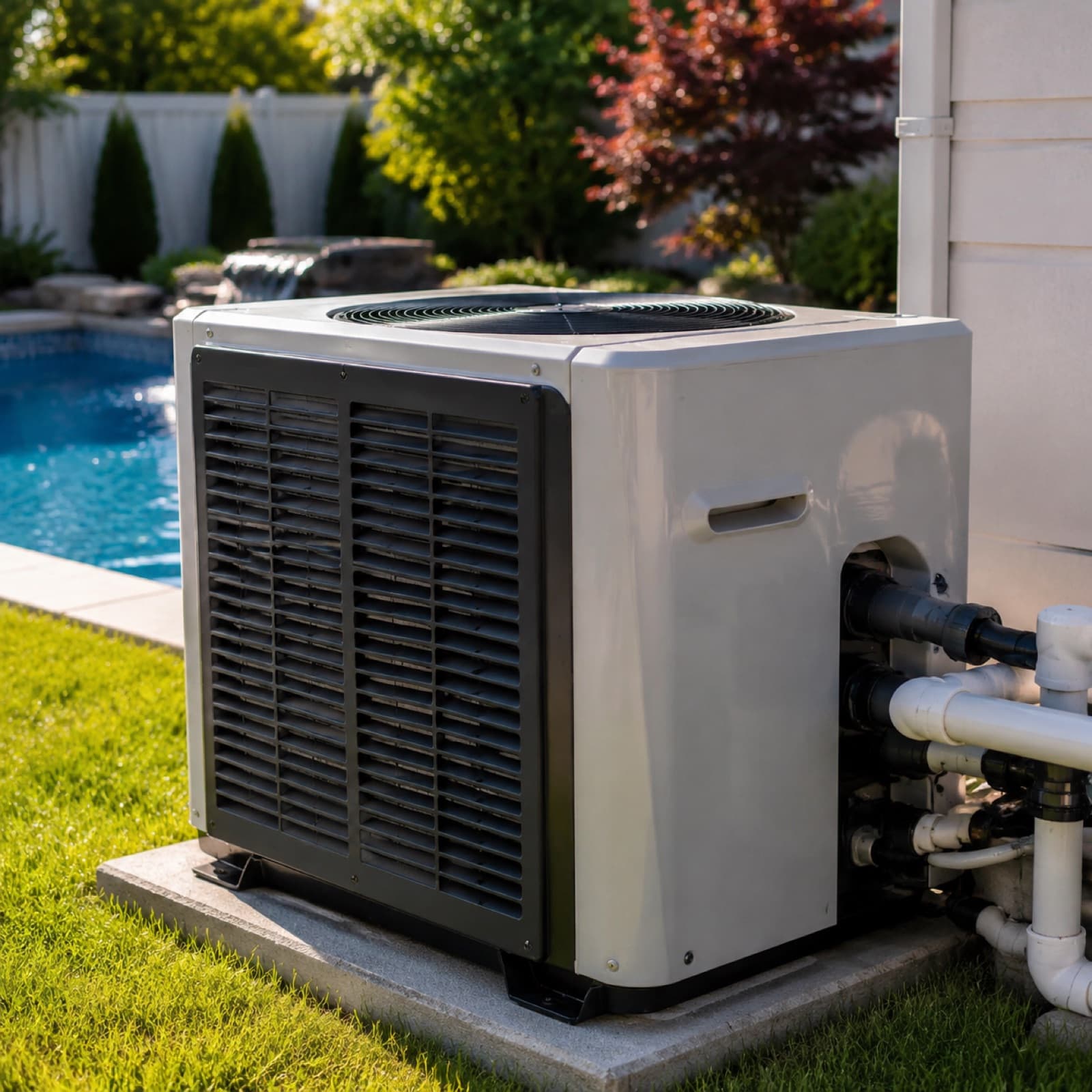
Your pool is open and the heater isn't working
It's a Saturday in May, the cover is finally off your inground swimming pool, and your pool heat pump is either silent, throwing an error code, or running but doing nothing for the water temperature. This is the most common pool heater repair call we see on Long Island, and it almost always shows up the first warm weekend after opening, especially after a stretch of cool weather has the water still in the low 60s.
The good news is that about half of the time, you can diagnose the malfunction in fifteen minutes and either fix it yourself or know exactly what to tell a pool company when you call. The other half is a real pool heat pump repair, but you'll save yourself a service charge if you've already ruled out the easy stuff. Pool heating is one of those parts of pool operation that nobody thinks about until it stops working. Here's the troubleshooting guide we run through on every pool equipment repair call before we get the tools out.
First: is the unit actually getting power and water?
Before anything else, walk through the two things every pool heat pump needs to operate.
Power: open the panel feeding the heat pump and confirm the circuit breaker isn't tripped. If it is, reset it once and watch what happens. If it trips again immediately, stop. Something is shorted and you need a tech. Don't keep flipping it.
Water flow: turn on your pool pump and confirm pool water is actually circulating through the heat pump. Most pool heat pumps have a flow switch or pressure switch that locks the unit out if water isn't moving. If the pool pump is off, or the valves are closed, or the filter is so clogged that flow drops below the cutoff, the heat pump will refuse to fire. Run your hand on the pipes going in and out of the unit. If the inlet feels different from the outlet temperature once it's running, water is moving.
If you've confirmed power and flow and the unit still won't fire, keep going.
Pool heat pump troubleshooting step 1: read the error code
Almost every modern pool heat pump has a digital display that throws a code when it locks out. Hayward, Pentair, AquaCal, and Raypak all use their own code schemes, but they all point to the same handful of common issues.
The most common codes you'll see at pool opening:
LO or FS code (Hayward, Raypak): low water flow or flow switch fault. Means the unit doesn't see enough water moving through it. Could be a real flow problem (closed valve, dirty filter, slow pool pump) or a failed flow switch.
HP or HPL code (Pentair, AquaCal): high refrigerant pressure. Often a dirty air-side coil or a fan that isn't running. Sometimes a refrigerant overcharge from past service.
LP or LPL code (most brands): low refrigerant pressure. Usually means a refrigerant leak that developed over winter. This one is not a DIY fix. You need an EPA-certified tech with leak detection and recovery equipment.
FREEZE or AS code: freeze protection lockout. Cool spring pool water or a cold ambient sensor reading is triggering the safety. Sometimes recoverable by waiting until the day warms up, sometimes a sensor that needs replacement.
EE, ER, or SE codes: control board or sensor fault. The board is telling you it's getting bad data somewhere. Needs a tech with manufacturer service tools.
Write the code down. Take a photo of the display. If you call us, that one piece of information cuts our diagnostic time roughly in half.
Pool heat pump troubleshooting step 2: check your filter and water flow
If your code points to a flow problem, or you have no error code but the unit is running without heating, water flow is the next thing to check. Filtration is the most common cause of low flow at opening.
A clogged pool filter starves the heat pump of water the same way a dirty air filter starves a furnace of airflow. Backwash a sand or DE filter, or hose down a cartridge filter. Then check the pressure gauge on the filter. If it's still high after cleaning, the filter media itself may need replacement. Routine pool care and regular maintenance catches this before it becomes a heater problem.
Check that every valve in the pool plumbing is open the way it should be. If you closed certain valves over winter and forgot to reopen them, your pool heater may be getting reduced flow.
Look at your pool pump itself. If it's running but the basket is mostly air, or you hear it surging, you've got a suction-side air leak that's killing flow. That's a pool pump repair call, not an HVAC one, but it explains why the heater won't fire.
If your filter is clean, valves are open, the pool pump is moving water normally and the unit still throws a flow fault, the flow switch on the heat pump itself has probably failed. That's a part swap we do all the time.
Pool heat pump troubleshooting step 3: clean the outdoor coil
Pool heat pumps sit outdoors year-round and the air-side coil collects leaves, grass clippings, dryer lint, and whatever else blows through. A coil that can't breathe will trip the unit on high pressure (HP code) on the first warm day of the season, because the system can't reject heat without airflow.
Shut the unit off at the disconnect. Hose the coil down from the inside out if you can get a panel off, otherwise from the outside in. Don't use a pressure washer. The fins are aluminum and they bend if you look at them sideways. A garden hose with a gentle spray is fine.
Long Island salt air also does slow corrosion damage to pool heat pump coils over the years, especially within a few miles of the water. If your fins look matted, blackened, or eaten away rather than just dirty, that's a longevity issue worth knowing about even if it isn't the root cause of this season's problem.
If your coil is matted with cottonwood seed or visible debris, this single step solves a surprising number of pool heat pump problems. Restart the unit and see what happens.
Pool heat pump troubleshooting step 4: confirm the thermostat setpoint and run mode
This sounds obvious but we see it more than you'd think. Pool heat pumps have a heat mode, a cool mode (on some models), and an off or pool-pump-only mode. After winter, it's not unusual to find the unit set to off, or set to a thermostat setpoint below the current water temperature so it never fires.
Walk through the control panel. Confirm the unit is in heat mode. Confirm the setpoint is higher than the current water temperature by at least a few degrees. Some units have a separate switch on the side that needs to be in the right position too.
While you're there, check the LED status indicators. Most units have small green or red lights that tell you whether they're calling for heat, in standby, or in lockout. If everything reads normal but the compressor never fires, that's a tech call. Could be a contactor, a capacitor, or a control board issue.
Pool heat pump troubleshooting step 5: listen for the compressor
If you've cleared error codes and made sure the unit is calling for heat, stand next to the heat pump and listen. The compressor should start within about thirty seconds of the call for heat, after a brief delay where the fan starts first.
If the fan spins but the compressor never starts, you've got a capacitor or contactor problem. These are common, cheap, and a real HVAC tech can swap them in under an hour. We see this constantly on pool heat pumps because the units sit unused for six months and the capacitor often gives up the first time it's asked to start.
If nothing runs at all, even the fan, you're likely looking at a control board, a transformer, or a wiring issue. Call for a diagnosis and repair visit.
If everything runs but the air coming out of the top of the unit feels barely different from the air going in, the unit is running but not transferring heat. That's usually a refrigerant problem. Could be a slow leak from over the winter, could be the metering device, could be the heat exchanger. Needs a refrigerant gauge set and an EPA-certified tech.
Why pool heat pumps beat gas heaters (and why that matters for repair)
If you're weighing the cost of pool heater repair against replacement, the comparison usually comes down to pool heat pumps versus gas heaters or propane. Gas pool heaters are cheaper to install, but they cost three to four times more to operate over a swimming season because they're not energy-efficient at the BTU per dollar level. Pool heat pumps use ambient heat from the air to do the work, so they put out three to five units of heat for every unit of electricity. The energy efficiency gap is real money over a Long Island summer.
The repair angle: most homeowners who already own a pool heat pump are not going to want to switch to gas. The operating cost difference is too big. That means when your existing unit fails, repair almost always wins on the math unless the unit is past 10 years old and the old equipment is no longer operating efficiently. At that point, multiple costly repairs in a row usually signal it's time to replace rather than keep patching.
If you do end up replacing, a modern pool heat pump is significantly more energy-efficient than one made even five years ago. Better refrigerants, smarter controls, quieter operation, and warranties that account for the harsher outdoor weather these units sit through.
When to call for pool heat pump repair
There's no shame in calling early if you don't want to mess with this stuff. But here's where it stops being DIY and starts being a real pool heat pump service call.
The error code points to refrigerant pressure (HP, HPL, LP, LPL) and you've already cleaned the coil and confirmed water flow. Refrigerant work is not legal without EPA Section 608 certification.
The breaker trips immediately on reset. Something is shorted and you need a tech with a meter.
The compressor hums but won't start, or starts and trips out within a few seconds. That's almost always a capacitor or hard-start issue. Fast fix for a tech, dangerous to mess with yourself because of the stored capacitor charge.
You see refrigerant oil staining around the heat exchanger, the service ports, or the line set. That's a leak signature. Recover, repair, evacuate, recharge.
The unit is more than 10 years old, this is the third or fourth repair in three seasons, and the repair quote is at or above roughly $2,000. Time to have a real repair-and-replace conversation. If you are weighing that, our breakdown of what it costs to heat a pool with a heat pump on Long Island covers new-unit pricing and running costs so the math is clear.
What makes pool heat pump repair different from regular pool heater repair
Worth saying out loud because most homeowners don't know this. A pool heat pump is fundamentally a refrigerant-based machine. Same compressor, same refrigerant, same diagnostic process as the heat pump that heats a house or the AC that cools one. The water-side heat exchanger on the back is a different shape than an indoor air coil, but the rest of the machine is HVAC.
Most pool service companies are great with chemistry (chlorine balance, salt cells, filtration), plumbing, and pool pump repair and replacement, but they don't carry refrigerant gauges, don't have EPA 608 certification, and don't do board-level diagnostics. When a pool heat pump goes down they typically call the manufacturer's service hotline and wait, or they swap parts in hopes of getting lucky.
A real heating, ventilation, and air conditioning tech does this work every day on home heat pumps and ductless mini splits. That's why we offer pool heat pump service on Long Island as a dedicated line of HVAC equipment repair services. It's the same machine we already know, with a different load on the back of it. If you've got a leaky service port, a dead capacitor, or a coil that needs cleaning, that's what we do every day.
For comparison, our home heat pump repair service covers the same kinds of fault modes (capacitor, contactor, refrigerant, board, sensor) on indoor air heat pumps. The diagnostic discipline transfers cleanly across.
Pool heat pump brands we service
We service every common pool heat pump brand on Long Island: Hayward, Pentair, AquaCal, and Raypak. Each brand has its quirks (Hayward's diagnostic codes are well-documented, Pentair's pool equipment runs proprietary communication between the heater and the IntelliFlo pump, AquaCal favors titanium heat exchangers that handle salt water well, Raypak builds for harsh outdoor environments) but the core diagnostics are the same across all of them.
If you have a less common brand and you're not sure if we cover it, just text us with the brand and model and we'll let you know.
Frequently asked questions about pool heat pump repair
How long should a pool heat pump last on Long Island? Ten to fifteen years if it's been winterized properly and the water chemistry has been kept in line. Salt-system pools and lots near the bay tend toward the lower end of that range because of corrosion. Regular pool maintenance and addressing small repairs promptly both help a lot. If you want to keep your pool swimming-ready for the longest possible run, an annual check-up before opening day is the cheapest thing you can do.
Can a homeowner do their own pool heater repair? The basic troubleshooting walked through here, yes. Anything involving refrigerant, electrical work past flipping the breaker, or removing covers from the high-voltage side, no. Pool equipment repair done wrong is dangerous and often voids the warranty.
Will my pool heat pump be working properly all season after a tune up? Mostly. A pre-season check catches the predictable failures (capacitor, flow switch, fouled coil, low charge) before they become a no-heat call mid-summer. Refrigerant leaks that develop suddenly or freak board failures aren't preventable, but they're rare.
Do you also repair pool pumps and other pool equipment? We focus on the pool heat pump itself. For pool pump repair, pool filter repair, chlorine or salt-system service, and general pool repair, we'll point you to a good pool company. We stick to what we do every day, which is refrigerant-based equipment repair.
What to expect on a pool heat pump service call
When you call or text 631-209-7090, we'll ask for the brand, model, the error code on the display (if any), and a quick description of what the unit is doing. We bring the diagnostic gear and the most common replacement parts on the truck. Most pool heat pump repairs finish in one visit if the part is on the truck or we can get it overnight.
You'll get a flat-rate repair quote before any work begins. If we get into the unit and find that repair doesn't make sense (heat exchanger leak, compressor failure on an older unit, multiple stacked problems), we'll tell you what replacement would cost too, so you have both numbers.
Pool opening is when most pool heat pump problems show up, so the sooner you call after you find the issue, the sooner you're swimming in a warm pool. Text us first: 631-209-7090.
Frequently Asked Questions
Ten to fifteen years if it has been winterized properly and the water chemistry has been kept in line. Salt-system pools and lots near the bay tend toward the lower end of that range because of corrosion. Regular pool maintenance and addressing small repairs promptly both help a lot. If you want to keep your pool swimming-ready for the longest possible run, an annual check-up before opening day is the cheapest thing you can do.
The basic troubleshooting walked through here, yes. Anything involving refrigerant, electrical work past flipping the breaker, or removing covers from the high-voltage side, no. Pool equipment repair done wrong is dangerous and often voids the warranty.
Mostly. A pre-season check catches the predictable failures (capacitor, flow switch, fouled coil, low charge) before they become a no-heat call mid-summer. Refrigerant leaks that develop suddenly or freak board failures are not preventable, but they are rare.
We focus on the pool heat pump itself. For pool pump repair, pool filter repair, chlorine or salt-system service, and general pool repair, we will point you to a good pool company. We stick to what we do every day, which is refrigerant-based equipment repair.
Related Articles
Pool Heat Pump Error Codes on Long Island
Pool heat pump error codes explained for Long Island homeowners: the AquaCal OTA alarm, low water flow lockouts, pressure trips, and when to call for repair.
AC Short Cycling: Why Your AC Keeps Shutting Off
AC short cycling on Long Island? The common causes of a short-cycling air conditioner, how to stop it, what the repairs cost, and when to call a pro.
Commercial HVAC Repair on Long Island
Commercial HVAC repair on Long Island can shut a business down fast. What Suffolk County owners should know about cost, timing, and avoiding trouble.