What Is a Heat Pump? A Simple Long Island Guide
Learn how heat pumps work and why Long Island homeowners are choosing them. A plain-English guide to heat pump installation for Suffolk County homes.
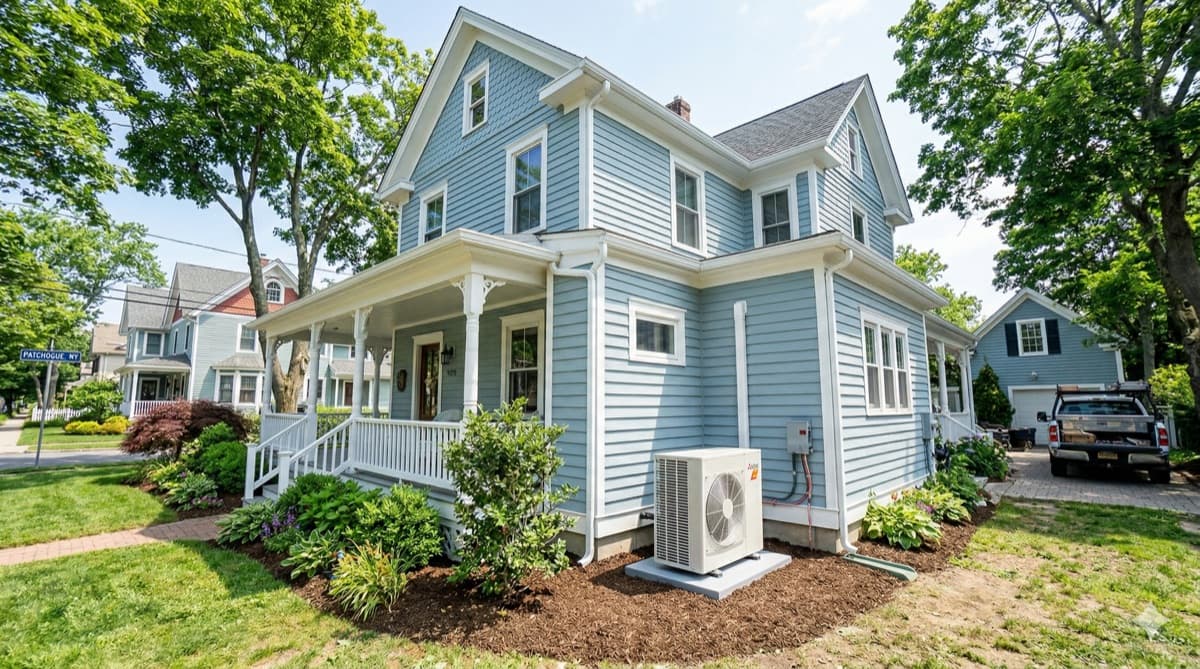
You keep hearing about heat pumps. Your neighbor got one. Your coworker won't stop talking about theirs. PSEG keeps running ads about rebates. But when you actually try to figure out what a heat pump is and how it works, you get hit with a wall of jargon about refrigerant cycles and coefficients of performance. So let's cut through all that and explain it in plain English.
If you're a homeowner on Long Island thinking about heat pump installation, this is the guide that'll actually make sense of it.
The Basic Idea Behind a Heat Pump
A heat pump moves heat from one place to another. That's it. That's the core concept.
In winter, it pulls heat from the outside air and moves it into your home. In summer, it reverses direction and pulls heat out of your home, exactly like an air conditioner. One system, two jobs. Heating and cooling in a single piece of equipment.
The part that trips people up is the winter side. How can you pull heat from cold air? The answer is that even when it's 20 degrees outside, there's still thermal energy in the air. A heat pump captures that energy using refrigerant, compresses it to raise the temperature, and delivers it inside. It's the same basic technology your refrigerator uses, just running in reverse.
This is why heat pumps are so energy efficient. They're not generating heat by burning oil or gas. They're just moving heat that already exists. For every unit of electricity a heat pump consumes, it delivers about 2.5 to 3.5 units of heating. That kind of efficiency is why HVAC contractors across Long Island are recommending them to customers who want to cut their heating bills.
The Parts of a Heat Pump System
A standard air-source heat pump has two main components. The outdoor unit sits next to your house, and it looks a lot like a central air conditioner condenser. Inside it there's a compressor, a fan, and a coil filled with refrigerant.
The indoor unit connects to your home's ductwork if you have it. If you don't have ducts, you go with a ductless mini split setup, which uses wall-mounted or ceiling-mounted air handlers in each room or zone. Either way, refrigerant lines connect the outdoor and indoor units, carrying heat back and forth depending on the season.
There's also a reversing valve, which is the part that lets the system switch between heating and cooling mode. Same hardware, just running the other direction depending on the season. When that valve sticks or fails, that's one of the most common reasons we get called out for heat pump repair.
For most Suffolk County homes, especially the ranch and Cape Cod style houses from the 50s through the 70s, a heat pump fits without major structural changes. If you already have central air ductwork, installation is even more straightforward.
Do Heat Pumps Actually Work in Long Island Winters?
This is the question we get more than any other, and it's a fair one. Older heat pumps did struggle when temperatures dropped below freezing. They'd lose efficiency and need backup electric resistance heat to keep up, which drove electricity costs through the roof.
That was 10 years ago. Modern cold climate heat pumps are a completely different animal, and our cold-climate vs regular heat pump guide explains exactly what changed. The efficiency improvements have been dramatic.
Systems like the Mitsubishi Hyper-Heat and Daikin Fit hold their rated heating capacity down to roughly 5 degrees, and they keep running below that, just with less output as it gets colder. That is the honest version. No heat pump makes full rated capacity at 20 below, and you should be skeptical of anyone who tells you otherwise. What matters is that these units are still producing usable heat at temperatures where the old generation simply gave up. These qualify as Energy Star certified cold climate heat pumps. Long Island winters typically bottom out in the teens, occasionally dipping into the single digits during a cold snap in January or February. A properly sized cold climate heat pump handles that without any trouble.
The key phrase there is "properly sized." A heat pump that's too small for your home will run constantly and struggle to keep up when it's really cold. That's not a heater problem, it's a bad installation problem. Any certified HVAC contractor should run a Manual J load calculation on your home before recommending a specific system size. If they skip that step, that's a red flag. A pro who knows what they're doing will get you a free estimate based on your home's actual heating and cooling needs.
We've installed heat pumps in homes across Patchogue, Medford, Sayville, and Bellport that keep homeowners comfortable through the worst Long Island has to offer. The technology is there. It just needs to be done right.
Heat Pump vs. Your Current System
If you're heating with oil right now, you're probably spending $2,400 to $5,400 a year on heating fuel depending on your home size and oil prices. We did a full cost comparison of heat pumps vs. oil furnaces if you want to see the detailed numbers. A heat pump typically cuts that in half or better, especially if you qualify for PSEG's Rate 580, which takes 45% off your electric usage above 400 kWh a month, October through May. It is a rate discount, not a rebate.
If you have a gas furnace or an old electric heater, the savings are smaller but still real. Heat pumps are about 2 to 3 times more efficient than even high-efficiency gas furnaces when you compare energy input to heat output. Learn more about our heat pump installation service and what's included.
If you're cooling with central air or window units, a heat pump replaces that too. You're not adding a system on top of what you have. You're replacing both your heating and cooling with one unit. That's where the value really shows up for Long Island homeowners who need a new AC and are tired of paying for oil at the same time. The same refrigerant-cycle technology shows up in pool heat pump service too, just with a water heat exchanger instead of an air coil.
The installed cost for a heat pump system on Long Island runs $12,000 to $25,000 depending on whether you're going ducted or ductless and how many zones you need. Most manufacturers offer 10 years on the compressor and 10 years on parts when the equipment is registered, and some registered Daikin equipment carries 12. Registration usually has a deadline after installation, so ask your contractor to confirm it was done. That price sounds steep, but once you factor in the rebates and energy savings, the math looks very different.
What About Rebates and Incentives?
The incentive picture on Long Island is still good in 2026, but it works differently than a lot of homeowners expect.
The main one is the PSEG Long Island heat pump rebate: a flat $4,000, $5,000, or $7,500 depending on your household income tier. It is not a per-ton rebate that scales with system size. It requires a whole-home, NEEP-listed cold-climate heat pump sized with a Manual J load calculation.
Here is the part that trips people up. PSEG administers the NYS Clean Heat program on Long Island, so the Clean Heat money is paid out as that single PSEG rebate. It is not a PSEG rebate plus a separate Clean Heat rebate added on top. If a proposal shows both, the math is double-counting.
The federal 25C tax credit that used to cover up to $2,000 expired on December 31, 2025, and is not available for systems installed in 2026 or later.
What does genuinely stack alongside the rebate is NYSERDA EmPower+, which pays for weatherization for income-qualified households, and PSEG Rate 580, which takes 45% off your electric usage above 400 kWh a month, October through May, for homes heating with a heat pump. It is a rate discount, not a rebate. One caveat on EmPower+: if you take IRA HEAR funding through it, you cannot also take the PSEG rebate, since that is the same Clean Heat money.
We keep the current numbers on our rebates and savings page, and the full program-by-program detail is in our 2026 PSEG heat pump rebate guide. If you're not sure how the project actually goes, here's what to expect from a heat pump installation start to finish.
How to Know if a Heat Pump Is Right for Your Home
A heat pump makes sense for most homes in Suffolk County. But there are a few things that affect how well it'll work for you specifically.
Your home's insulation matters a lot. A drafty house with single-pane windows and no attic insulation will make any heating system work harder than it should. Sometimes the best first investment is insulation, not new equipment.
Your existing ductwork matters too. If you have ducts in decent condition, a ducted heat pump is the most cost-effective option. If you don't have ducts or they're in bad shape, a ductless mini split system works great but costs a bit more. Either way, make sure you're working with a contractor who's certified to install the brand you're considering.
And your electrical panel matters. Heat pumps run on electricity, and some older Long Island homes still have 100-amp panels. You may need an upgrade to 200 amps to support the system, which adds $1,500 to $3,500 to the project.
If you want to find out whether a heat pump is the right fit for your home, give us a call or text at 631-209-7090. We'll walk through your setup, check your insulation and ductwork, and give you a straight answer on whether it makes sense or if you're better off going a different route. No pressure, just an honest estimate from a local HVAC contractor who does this every day.
For everything else you need to know about heat pumps on Long Island, including costs, rebates, brands, and cold weather performance, check out our complete heat pump guide.
Related Articles
Heat Pump Installation: What to Expect
Here's what to expect during a heat pump installation on Long Island, from initial walkthrough through commissioning. Timeline, rebates, install day details.
What Size Heat Pump Do You Need for a Long Island Winter?
Heat pump size on Long Island: what size heat pump do you need for your home, and why BTUs at 17 degrees matter far more than the ton printed on the label.
Your Heat Pump Is Rated at 47 Degrees. Long Island Winters Are Not.
A cold climate heat pump loses heating capacity as it gets colder. What Long Island homeowners should check at 17 degrees before signing any proposal.