AC Capacitor Replacement: Signs and Costs
AC capacitor replacement on Long Island: signs your capacitor is failing, real Suffolk County repair costs, and when you should call a pro instead of DIY.
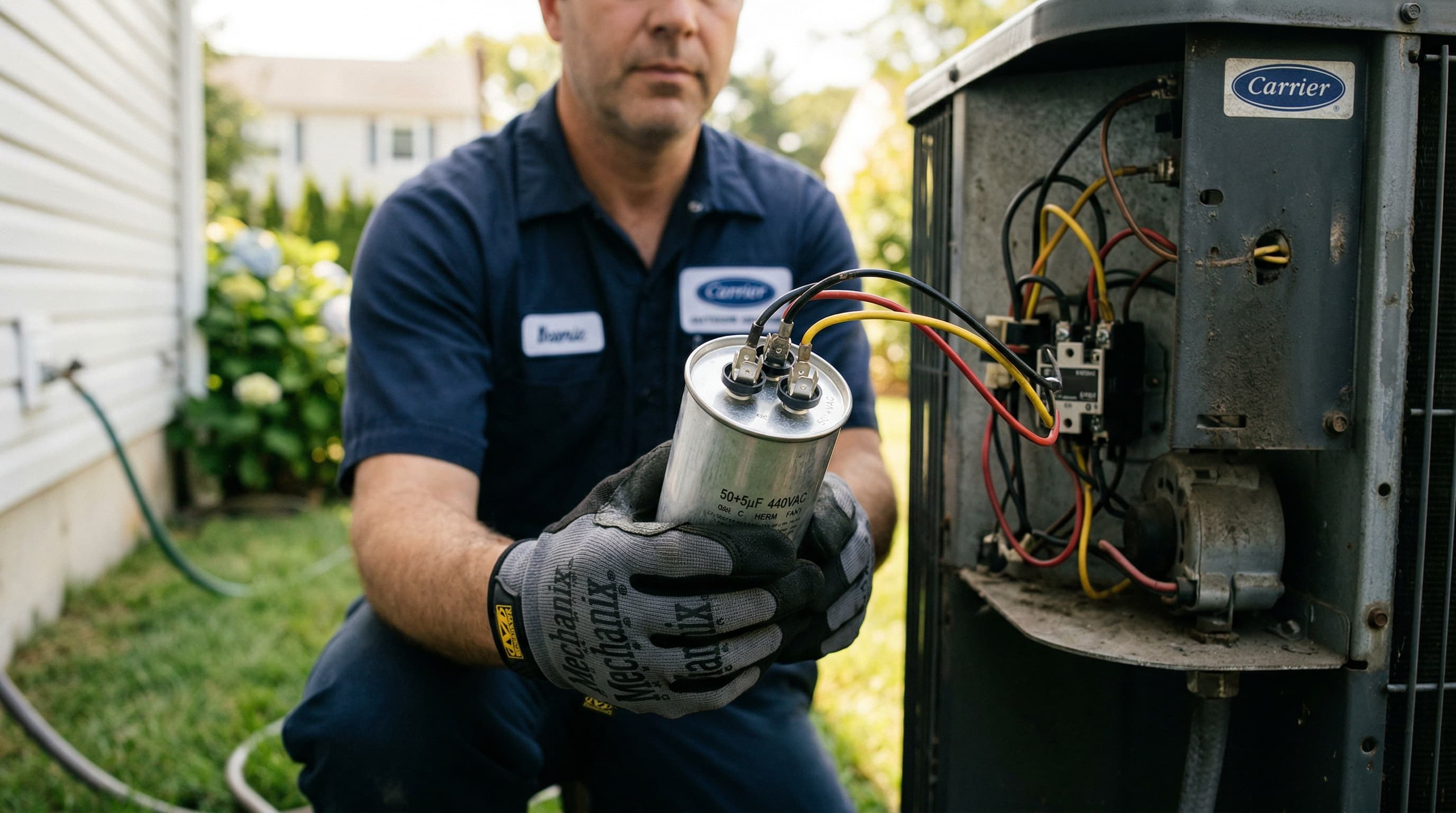
The cheapest part in your AC that can shut the whole thing down
The capacitor is a small cylinder inside your outdoor condenser. It costs us maybe twenty bucks at the supply house. And when it fails, your entire air conditioning system stops cooling. We probably replace more capacitors than any other single part during a Long Island summer, and it's almost always the first thing we check when a homeowner calls to say their AC is running but not cold.
Here's what you need to know about AC capacitor replacement before you call anyone.
What a capacitor actually does
Think of an AC capacitor as a jump-starter for your air conditioner motors. Your outdoor unit has two motors that need a big burst of energy to get spinning: the compressor and the condenser fan motor. The capacitor is an electrical component that holds stored energy and delivers it the instant the hvac system calls for cooling. Without that stored energy, the compressor and fan motors hum, struggle, and either trip a breaker or just sit there overheating.
Most central air conditioning systems on Long Island use a dual run capacitor, a single capacitor that handles both the compressor and the fan in one part. Mini splits, heat pumps, and even the indoor blower motor use capacitors too. They're rated in microfarads (uF, also written as mfd) and voltage, and the replacement capacitor has to match the original exactly or the ac unit won't run right. There are start capacitors, run capacitors, and dual run types, so knowing the right type of capacitor for your system matters.
Warning signs your AC capacitor is failing
The warning signs of a bad capacitor are pretty specific once you know what to look for. The classic one is a humming sound from the outdoor unit with no fan spinning. You'll hear the compressor trying to start, a low electrical buzz, and then nothing. Sometimes if you give the fan blade a push with a stick through the grille it'll start spinning on its own. That's a dead giveaway the capacitor is shot and the air conditioner may fail to start on the next cycle.
Other signs your capacitor needs attention include the ac unit shutting off on its own a few minutes after starting, the system taking longer and longer to kick on, a burning smell near the outdoor unit, or visible bulging on the top of the old capacitor itself. If you pop the service panel and the cylinder looks domed or leaking, it's done. A healthy capacitor is flat on top. A failing capacitor is one of the most common reasons an air conditioner unit stops cooling, and our guide to why your AC is running but not cooling walks through the other common culprits.
AC capacitor replacement cost on Long Island
AC capacitor replacement is one of the cheapest AC repair jobs you can get. On Long Island, most local hvac shops charge somewhere between $180 and $350 for the whole job, parts and labor included. The replacement part itself runs $15 to $40 depending on the rating and type of capacitor. The rest is the service call, the diagnosis, and the twenty minutes of actual work replacing the capacitor.
If someone quotes you $500 or more for an ac capacitor replacement cost on a straightforward residential system, get a second opinion. The only time that number is reasonable is if the capacitor and the complexity of the replacement go together, like when the capacitor is buried in a tight spot, there's additional damage like a burnt contactor or fried wiring that needs replacing too, or the shop you called is billing it as an after-hours weekend emergency, which some do in July and we don't do at all. For context on what other common ac repairs should run, check our guide to AC repair costs in Suffolk County before you say yes to a quote.
Should you replace the capacitor yourself?
Honestly, most homeowners should not try to replace a capacitor themselves. We know there are home improvement YouTube videos showing homeowners replace the capacitor in ten minutes, and mechanically speaking it's not hard. But an ac capacitor stores electrical energy even after you cut power to the ac unit. If you grab the terminals with a screwdriver before discharging it, you can get a serious shock. We've seen it happen.
There's also the matter of picking the right capacitor for ac unit use. The rating has to match. If you put in a 45/5 mfd cap when the system calls for 40/5, you'll either damage the compressor and fan motors or shorten the lifespan of whatever else is in there. And if the capacitor failed because of an upstream issue like a bad contactor or a grounded compressor, just replacing an ac capacitor will blow the new one in a few weeks. A good hvac technician checks for root cause, not just the obvious symptom.
Why capacitors fail in the first place
Heat is the main killer. Capacitors are rated for a specific operating temperature, and Long Island summers push them hard. An undersized system that runs for ten hours straight on a 95-degree day is going to cook its capacitor faster than one that cycles normally. So is a system with a dirty condenser coil that can't dump heat properly.
Age is the other factor. Most capacitors last 10 to 15 years under normal use. If your outdoor unit is on the older side and you've already had one fail, expect the next one within a few seasons. We include capacitor testing as part of every tune-up because catching a weak cap before it fails completely is a lot less stressful than doing it during a heat wave.
When to call
If your outdoor unit is humming but not spinning, if the fan won't start without a nudge, or if you see anything bulging or leaking on the top of the capacitor, stop running the system. Continuing to let it try to start puts strain on the compressor, and a compressor replacement runs $1,800 to $3,500 versus a $250 capacitor job. Not a trade you want to make.
Give us a call or text at 631-209-7090 and we'll get someone out to you. Most capacitor repairs we can handle the same day, and if you're on one of our maintenance plans the diagnosis is already covered.
Related Articles
Pool Heat Pump Error Codes on Long Island
Pool heat pump error codes explained for Long Island homeowners: the AquaCal OTA alarm, low water flow lockouts, pressure trips, and when to call for repair.
AC Short Cycling: Why Your AC Keeps Shutting Off
AC short cycling on Long Island? The common causes of a short-cycling air conditioner, how to stop it, what the repairs cost, and when to call a pro.
Commercial HVAC Repair on Long Island
Commercial HVAC repair on Long Island can shut a business down fast. What Suffolk County owners should know about cost, timing, and avoiding trouble.