Spring HVAC Maintenance Checklist for Long Island
A practical HVAC maintenance checklist for Long Island homeowners. Covers filters, condensate lines, outdoor units, thermostats, and when to call a pro in.
Your HVAC system just worked all winter keeping your house warm. Before you ask it to flip the other direction and cool you down for five months straight, it needs a little attention. Think of this as the spring tune-up you'd give your car after a long winter, except most of it you can do yourself on a Saturday morning.
Here's your HVAC maintenance checklist to hit before you fire up the air conditioning for the first time this year.
Change Your Air Filter
This one's obvious but it still gets skipped constantly. If you haven't swapped your air filter since heating season started, it's probably gray and matted. A clogged filter makes your HVAC system work harder, drives up your PSEG bill, and wears out components faster than they should.
For most Long Island homes, a standard 1-inch pleated filter works fine. Swap it out every 1-3 months depending on whether you have pets, allergies, or a lot of foot traffic. We wrote a deeper guide on AC filters if you want to know which MERV rating to buy and the most common mistakes people make. If you've got a 4-inch media filter, you can usually get away with changing it twice a year, but spring is one of those times.
One thing people don't realize: a dirty filter can actually freeze your evaporator coil once you switch to cooling mode. Restricted airflow drops the coil temperature below freezing, ice builds up, and now you've got water dripping where it shouldn't be. All because of a $12 filter. That kind of leak can cause real water damage if you don't catch it early.
Clean Around the Outdoor Unit
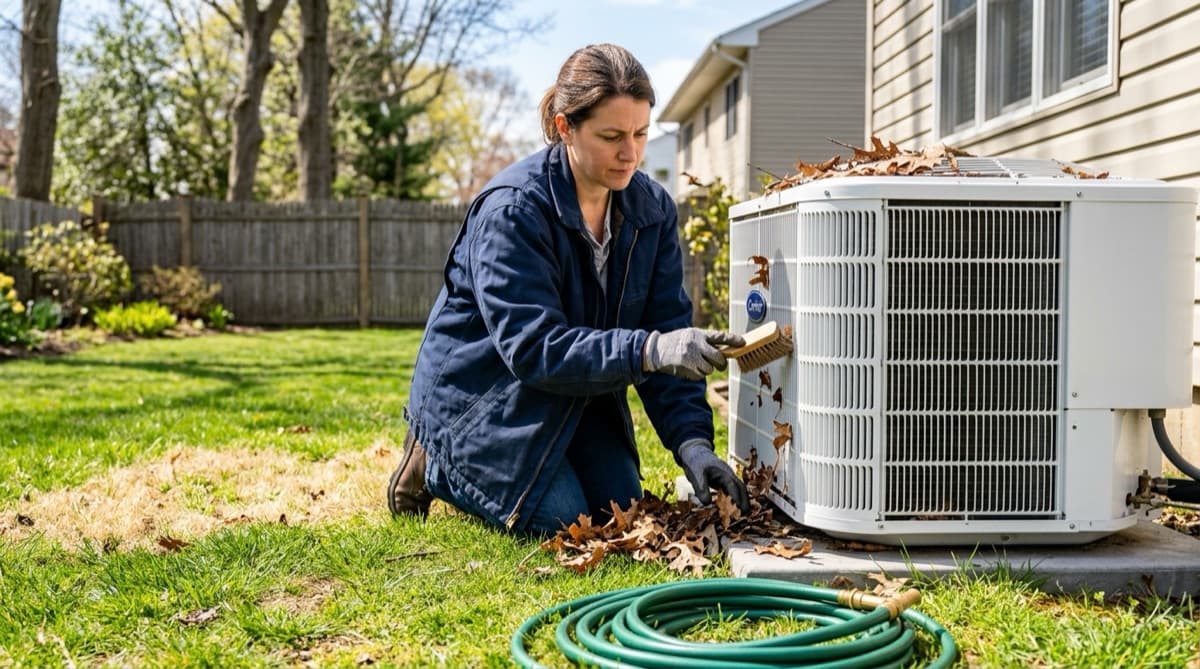
Go take a look at your condenser unit outside. After a Long Island winter with leaves, nor'easters, and whatever else blew through your yard, there's a good chance it's surrounded by debris. Dead leaves, grass clippings, twigs, maybe a garbage can that migrated over during a storm.
Clear everything at least two feet around the outdoor unit on all sides. Good airflow around the condenser is how it rejects heat. Block that airflow and your system runs longer, works harder, and your energy costs go up.
While you're out there, look at the fins on the unit. If they're bent or clogged with dirt, you can gently rinse them with a garden hose from the inside out. Don't use a pressure washer. You'll flatten the fins and make things worse. Also check for any signs of refrigerant leak around the line set connections. Oil stains or hissing sounds mean you need a professional.
Flush the Condensate Drain Line
This is the one that catches homeowners off guard. Your AC produces condensation when it runs, and that water drains out through a small PVC condensate drain line, usually to the outside of your house or into a floor drain. Over time, algae and gunk build up inside that line and clog it.
When it clogs, water backs up into the drain pan and eventually overflows. That means water damage to ceilings, walls, or floors depending on where your air handler sits. On Long Island, a lot of HVAC systems are in the basement, so you might get lucky with just a wet floor. But if your air handler is in the attic, a clogged drain line can cause a serious leak before you even notice.
Pour a cup of white vinegar down the drain line opening (usually near the indoor unit) every spring. For a more detailed walkthrough, check out our condensate drain line cleaning guide. It kills the algae and keeps things flowing. Some homeowners use a wet/dry vac on the outdoor end of the line to clear it out. Either way, takes five minutes and can save you a repair call.
Check Your Thermostat and Heating-to-Cooling Switchover
Switch your thermostat from heating to cooling and make sure it actually kicks on. You'd be surprised how often people wait until the first 85-degree day in June to find out something's wrong with their air conditioning.
If you've got a programmable or smart thermostat, update your schedule for the warmer months. No sense cooling an empty house all day while everyone's at work. A simple setback of 5-7 degrees while you're away can cut your energy costs by 10-15% over the summer.
If you're still running a manual thermostat, this is a good time to think about upgrading. A basic programmable unit runs about $30-$50 and takes 15 minutes to install. An ecobee or Honeywell Home smart thermostat runs $150-$250 but pays for itself within a year or two for most families. Either way, a good thermostat is the easiest HVAC upgrade you can make.
Inspect Your Vents, Registers, and Ductwork
Walk through the house and make sure all your supply and return vents are open and unblocked. Furniture gets rearranged over the winter, rugs get shifted, and suddenly a couch is sitting right on top of a floor register.
Blocked vents throw off the airflow balance of your HVAC system. Some rooms get too cool, others stay warm, and the system runs longer trying to satisfy the thermostat. Open everything up and make sure air can flow freely.
While you're at it, pop off a few vent covers and look inside the duct openings. If you see a thick layer of dust or debris, it might be time for a duct cleaning. Dirty ductwork hurts your indoor air quality, especially if anyone in the house has allergies or asthma. Most Long Island homes should have ducts cleaned every 5-7 years, more often if you have pets or respiratory issues in the family.
Check Your Furnace or Boiler Before You Forget
Spring feels like the wrong time to think about your furnace or boiler, but that's exactly why you should. Once heating season is over, most homeowners forget about it until October. If your furnace made any strange noises this winter, or your boiler was slow to fire up, now is the time to schedule a repair before HVAC companies are slammed with fall demand.
Also, if you have an oil furnace and you're thinking about switching to a heat pump, spring and early summer are the best times to get quotes. Contractors are less busy and you'll have more leverage on pricing. Getting homeowners off oil and onto a heat pump is what we do, and it is the path the PSEG Long Island rebate money actually follows. We don't do oil-to-gas conversions.
Know When to Call a Pro
Everything above is stuff you can handle on your own. But there are a few things that need a trained HVAC technician.
If your system short cycles (turns on and off repeatedly without running a full cycle), makes unusual noises, blows warm air, or smells off when it kicks on, don't try to diagnose it yourself. Refrigerant leak issues, electrical problems, and compressor failures are not DIY territory.
A professional spring cooling tune-up is a flat $149 with us, no trip fee, and covers things you can't easily check yourself: refrigerant levels, electrical connections, capacitor testing, and a full system performance evaluation. It's cheap insurance against a breakdown on the hottest day of the year when every HVAC company on the island has a two-week wait list. If you'd rather not think about scheduling it every year, one of our residential HVAC maintenance plans bundles both spring and fall tune-ups with priority scheduling so you don't get stuck on that wait list. Not sure a plan pays off? We broke down whether an HVAC maintenance plan is worth it on Long Island so you can decide for yourself.
If you want to get ahead of it, give us a call at 631-209-7090 or text us. We'll get your heating and cooling system checked out before the summer rush hits.
Related Articles
7 AC Maintenance Tips for Long Island Summer Heat
Get your home ready for summer on Long Island with these 7 practical AC maintenance tips Suffolk County homeowners can tackle before the cooling season.
How to Clear Your AC Condensate Drain Line
How to clear a clogged AC condensate drain line yourself, and how to keep it clear. Prevent water damage, mold, and shutdowns in your Long Island home.
Fall Furnace Tune-Up: Why September Is the Best Time to Schedule
Schedule a furnace tune-up in September for first pick of dates and time to fix what we find. What the checklist covers and what it costs on Long Island.