7 AC Maintenance Tips for Long Island Summer Heat
Get your home ready for summer on Long Island with these 7 practical AC maintenance tips Suffolk County homeowners can tackle before the cooling season.
The calls all sound the same
Every July we hear the same sentence from homeowners in Medford, Sayville, and Patchogue: "It was fine last year, and now my air conditioner just can't keep up." The system didn't break overnight. It had been quietly losing ground for a couple of seasons, and nobody noticed until the first real heat wave rolled through Suffolk County.
You don't want to be making that call at 4pm on a 97-degree Saturday. A few hours of maintenance, done ahead of the heat rather than during it, is what keeps you off that list.
Here are seven things you can work through on your own system.
Schedule your HVAC maintenance before the rush
This is the single most impactful thing on the list. A professional tune-up covers everything from refrigerant levels to electrical connections to cleaning your evaporator coil and condenser coil, and it catches problems when they're small and cheap to fix. If you want to know exactly what goes into one, we wrote a full breakdown in our post on what an AC tune-up actually includes.
Every shop on Long Island fills its cooling-season calendar early, so the further ahead of the heat you book, the more say you have in the day and time. A professional cooling tune-up is a flat $149 with us, no trip fee, and takes roughly an hour. If you're on one of our maintenance plans, your preventive maintenance visit is already included. Regular maintenance is the foundation of keeping any air conditioning system healthy long-term.
Clean or replace your air filter
This sounds basic because it is. But we pull air conditioner filters out of systems all the time that look like they haven't been touched in a year. A clogged air filter restricts airflow, makes your air conditioner work harder, drives up your PSEG energy bills, and can actually cause your evaporator coil to freeze up.
Swap it out and set a reminder for 30 to 60 days from now. If you have pets or anyone in the house with allergies, stay at the short end of that. Standard 1-inch filters are $5-$10 at any hardware store. There's really no excuse to skip this one. We covered the full process and why it matters more than most people think in our filter change guide. Adopting a seasonal maintenance routine for your filter alone can prevent a lot of problems down the line.
Clean the condenser coil and clear the outdoor unit
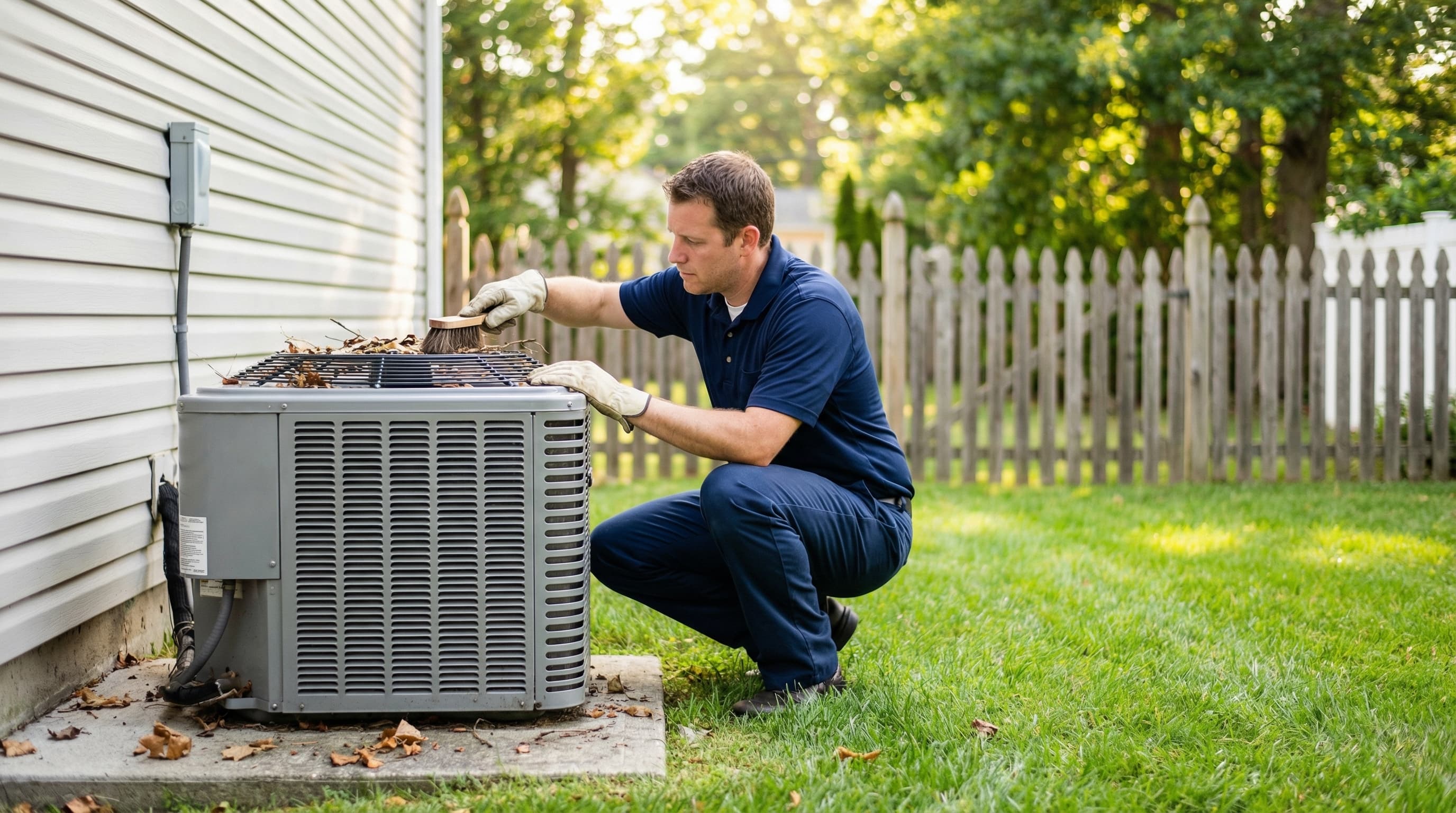
Go outside and inspect your condenser unit. If it's surrounded by overgrown shrubs, leaves, grass clippings, or anything else within about two feet of it, clear it out. Your condenser needs airflow to dump heat. When it's blocked, the air conditioning system runs longer and harder to hit the same temperature, which means higher energy bills and more wear on the compressor.
While you're out there, check the fins on the outdoor unit. If they're bent or matted with debris, you can gently rinse them with a garden hose to clean the condenser coil. Don't use a pressure washer. The fins are thin aluminum and they bend easily. Keeping the outdoor unit and condenser clean is one of the simplest air conditioner maintenance tips that makes a real difference in peak performance and efficiency.
Check your thermostat settings and battery
If you have a programmable or smart thermostat, now's a good time to update your summer schedule. A lot of homeowners still have their winter furnace heating schedule active and forget to switch it over. Set your cooling schedule so the central air conditioner isn't running full blast when nobody's home.
If your thermostat runs on batteries, replace them. A dead thermostat battery in the middle of a heat wave is a surprisingly common call we get, and it's an easy one to avoid. For homes still running an old mercury thermostat, upgrading to even a basic programmable model can save you 10-15% on cooling costs over a summer and increase energy efficiency noticeably. An Ecobee or similar smart thermostat gives you even more control and can learn your schedule over time.
Clear the condensate drain line
Your air conditioner pulls moisture out of the indoor air as it cools, and that water drains through a condensate drain line. Over time, algae and debris can clog that drain line, and when it backs up, you're looking at water damage to ceilings, walls, or floors depending on where your indoor unit is installed.
You can flush the condensate drain with a cup of white vinegar to break up any buildup. Use vinegar, not bleach. Bleach corrodes the aluminum and copper in the drain pan, and mixing it with vinegar releases chlorine gas. If the line is already clogged and water is pooling around your indoor unit, call a technician before the water damage gets worse. This is one of those preventive maintenance steps that takes five minutes but can save you thousands in repair costs. It's a critical part of any ac maintenance routine that too many homeowners overlook.
Inspect your ductwork and test the cooling system early
You don't need to crawl through your entire attic, but take a quick look at any exposed ductwork you can see in basements, crawl spaces, or utility closets. Inspect for disconnected sections, visible holes, or duct tape that's dried out and peeling off. Yes, duct tape is actually terrible for ducts.
Leaky ductwork can waste 20-30% of your cooled air before it ever reaches the vents in the rooms you're trying to cool. That's like paying for your central air to cool the attic. Sealing and insulating ducts is one of the highest-ROI improvements you can make for summer comfort, especially in those 1960s and 70s ranch homes that are all over Suffolk County.
Once you've looked at the ducts, test the system before you actually need it. Pick a mild afternoon, run the air conditioner for 20 to 30 minutes, and walk the house. Every vent should be blowing cold, nothing should be making a noise it didn't used to make, and the system should cycle off cleanly when it hits the set temperature. Finding a problem on a 72-degree day means you get to schedule the fix. Finding it on a 97-degree day means you get whatever slot is left.
Think about whether your ac unit is actually sized right
This one's more of a long-term consideration, but if your air conditioner has always struggled to keep up on the hottest days, the ac unit might not be the right size for your home. An undersized cooling system will run constantly without ever reaching temperature. An oversized one will short-cycle, turning on and off too frequently and leaving the house humid and uncomfortable.
If your system is past 12 to 15 years and you're thinking about replacing it before it quits on you, plan that in the off season. You get to collect quotes, compare options, and pick your install date instead of taking whatever is available during a heat wave. And if you're considering a heat pump as your next system, the PSEG Long Island heat pump rebate makes it worth a serious look. It is one flat program set by income tier, not a PSEG rebate plus a separate NYSERDA one.
Get ahead of the heat
Most of these air conditioner maintenance tips are things you can knock out in a weekend. The hvac maintenance visit is the one that needs a professional technician, and that's the one worth scheduling first. Regular maintenance keeps your cooling system running at peak performance and helps you avoid expensive breakdowns when you need it most.
If you want to get your air conditioner checked out before the rush, give us a call or text at 631-209-7090. We serve Patchogue, Medford, Bellport, Sayville, and most of Suffolk County, and we'd rather catch a small problem now than a big one in August.
Related Articles
Spring HVAC Maintenance Checklist for Long Island
A practical HVAC maintenance checklist for Long Island homeowners. Covers filters, condensate lines, outdoor units, thermostats, and when to call a pro in.
Fall Furnace Tune-Up: Why September Is the Best Time to Schedule
Schedule a furnace tune-up in September for first pick of dates and time to fix what we find. What the checklist covers and what it costs on Long Island.
End-of-Summer AC Maintenance: What to Do Before You Shut It Down
End-of-summer AC maintenance for Long Island homes. What to test, clean, and check on your air conditioning system before you shut it down for the winter.