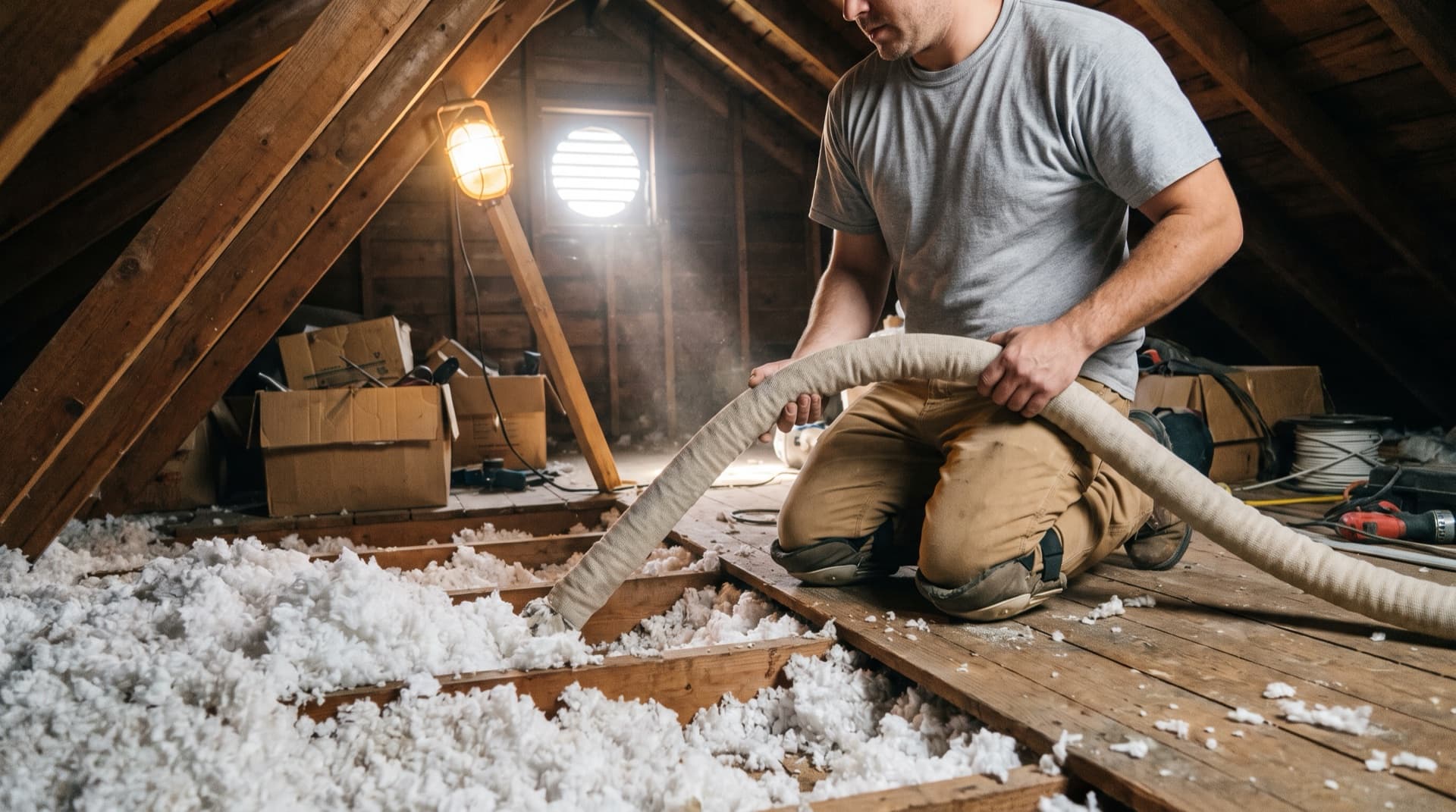
Attic Insulation
Attic Insulation in Suffolk County
Sealed first, then insulated, then measured again so you can see what changed. PSEG rebate paperwork handled start to finish.
Reviewed by Andrew Blom, HVAC pro since 2007, including nine years at Daikin
Attic Insulation in Suffolk County: Key Facts
- Cost
- Blown-in attic insulation on Long Island runs about $1.00 to $2.80 per square foot installed. A 1,200 square foot attic typically lands around $1,700 to $3,400 before rebates.
- Rebate
- The PSEG Long Island Home Performance program pays up to $2,500 toward insulation, and up to $4,000 for a full envelope package at market rate, with higher amounts for qualifying households.
- Target R-value
- Suffolk County is climate zone 4, where the Department of Energy recommends R-38 to R-60 in the attic. Most pre-1990 Long Island homes measure well below that.
- Air sealing is included
- Every attic insulation job starts with blower-door-assisted air sealing. It is required for the rebate and it is what makes the insulation actually work.
- Time on site
- Most attics are a one-day job. Add a day if old material has to come out first or access is difficult.
- Service area
- Attic insulation is installed across PHA's Suffolk County South Shore service area, from West Islip east to Bellport and north to Ronkonkoma, seven days a week from 7am to 7pm.
How It Goes
Five Steps, In This Order
The order matters more than most homeowners are told. Insulating before sealing is the most common way this work gets done wrong.
Assessment
We measure what is up there now, run a blower door test, and find where the house is actually leaking. You get a written report, not a verbal sales pitch.
Scope and rebate approval
We put together the work scope and submit it to PSEG for approval before anything starts, so the rebate is locked in rather than hoped for.
Air sealing
Attic plane, top plates, chases, penetrations, recessed lights, and the hatch. This is the first several hours of the job and the part that makes the rest work.
Insulation
Blown-in cellulose or fiberglass to the target depth, with baffles at the eaves so the soffit vents stay clear and the roof keeps breathing.
Verification
A second blower door reading so you can see the before and after number, plus depth markers left in the attic showing what was actually installed.
How Much Is Enough
R-Value for Long Island Attics
| What You See | Roughly | Where You Want to Be |
|---|---|---|
| Joists clearly visible | R-11 to R-19 | R-38 to R-60 |
| Level with the joists | R-19 to R-26 | R-38 to R-60 |
| Several inches above the joists | R-30 to R-38 | Top up to R-49 or better |
| A foot or more, even coverage | R-38+ | Air sealing is the better spend |
A rough field guide, not a substitute for measuring. Settled depth, material type, and coverage gaps all move the real number.
The PSEG Rebate on Attic Insulation
The PSEG Long Island Home Performance program pays up to $2,500 toward insulation and up to $1,000 toward air sealing, with a full envelope package capped at $4,000 for market rate households. Homes in a Disadvantaged Community or at moderate income can reach $5,000, and income-qualified households can reach $8,000.
Two conditions matter. Insulation only qualifies when it comes with blower-door-assisted air sealing, and the work scope has to be approved before the job starts. Both are handled on our end.
Your tier is set by PSEG based on household income and your address, not by us, so we do not put a rebate number on a proposal until they have confirmed it. See the full picture on the insulation and air sealing guide or start with a home energy assessment.
Common Questions
Attic Insulation FAQ
Blown-in attic insulation runs roughly $1.00 to $2.80 per square foot installed, which puts a typical 1,200 square foot Long Island attic somewhere around $1,700 to $3,400 before rebates. The spread comes from material, target depth, how much air sealing the attic needs first, and whether existing insulation has to be removed. We price it after we have been in the attic and measured, not from the driveway.
Suffolk County sits in climate zone 4, and the Department of Energy recommends R-38 to R-60 for attics here. In blown fiberglass that is roughly 13 to 20 inches of settled depth, and in cellulose roughly 10 to 16 inches. If you can see the tops of your ceiling joists when you look across the attic, you are almost certainly under R-19 and there is a lot of room to improve.
Blown-in for almost every attic we see. Batts have to be cut and fitted around every joist, wire, pipe, and brace, and any gap left behind is a hole in your insulation. Blown-in material flows into those irregular spaces and covers evenly, including over the top of the joists, which stops the framing itself from acting as a thermal bridge. Batts still make sense in a few spots, mainly knee walls and accessible floored areas where you need the insulation to stay put.
Usually, when it is done with air sealing. Ice dams form because heat escaping into the attic melts snow on the warm part of the roof, and that water refreezes when it hits the cold overhang. The fix is keeping heat out of the attic in the first place, which means sealing the leaks and then insulating, and making sure the soffit vents are not blocked. Insulation alone, blown over an unsealed attic floor, often does not solve it.
Yes, and on Long Island capes they are usually the problem. The little triangular spaces behind knee walls are frequently uninsulated, unsealed, and open straight into the floor cavity of the room next to them. That is why the upstairs bedrooms in a cape are cold in winter and unbearable in summer. It takes more care than blowing a flat attic, but it is often the single biggest comfort improvement in the house.
Yes. An uninsulated, unweatherstripped attic hatch is a two by three foot hole in the top of your house. It is one of the cheapest fixes on the list and one of the ones almost every home we look at still needs.
It is a fair question and the honest answer is that we measure rather than guess. Part of the assessment is a blower door test that tells us exactly how leaky the house is now, and BPI standards set a minimum ventilation level we do not seal below. If a house does get tight enough to need mechanical ventilation, we tell you that up front rather than after the fact. In practice, almost no house on Long Island built before 1990 is anywhere near that threshold.
Yes. We run the assessment, submit the work scope for approval before the job starts, and file the rebate paperwork afterward. PSEG sets your rebate tier based on income and address, so we do not quote you an amount until they have confirmed it, and we put the confirmed numbers in writing before you sign.
Other Services
More Ways We Can Help
Spray Foam Insulation
Open and closed cell foam, specified by assembly rather than sold by default.
Heat Pump Installation
Ductless, ducted, and hybrid systems with full rebate handling.
Oil-to-Electric Conversion
Full oil-to-heat-pump conversions with rebate handling.
Maintenance Plans
Tune-ups, waived service fees, and repair discounts starting at $19/month.
Ready to Get Comfortable?
Text or call us today. No pressure, no surprises. Honest HVAC service from your Patchogue neighbors.