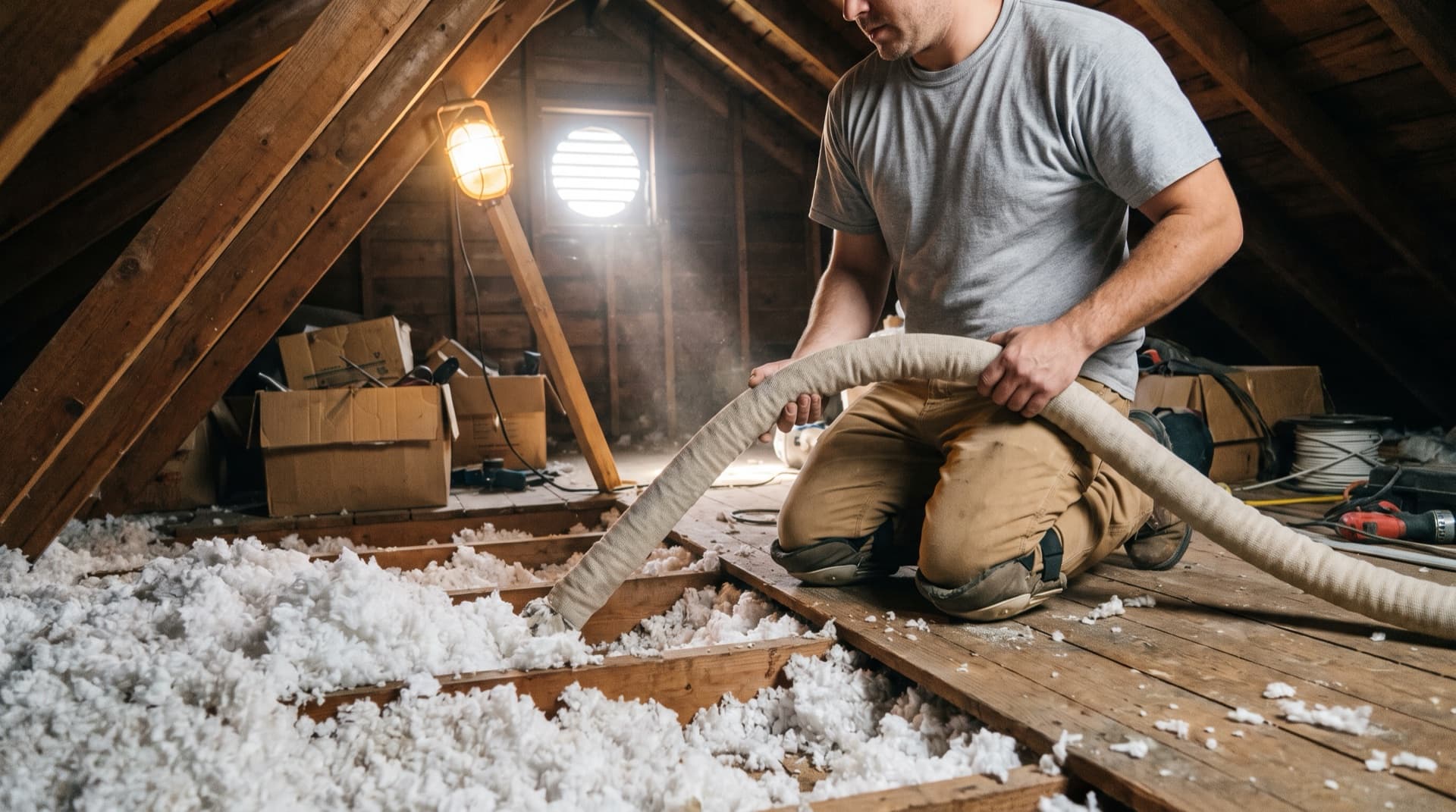
Insulation & Air Sealing
Attic Insulation and Air Sealing on Long Island
The cheapest energy you will ever buy is the energy you stop losing. We seal and insulate Long Island homes, and we handle the PSEG rebate paperwork so you are not chasing it yourself.
Reviewed by Andrew Blom, HVAC pro since 2007, including nine years at Daikin
Attic Insulation on Long Island: Key Facts
- What attic insulation costs here
- Blown-in attic insulation on Long Island runs about $1.00 to $2.80 per square foot installed, so a typical 1,200 square foot attic lands around $1,700 to $3,400 before any rebate.
- PSEG envelope rebate
- The PSEG Long Island Home Performance program pays up to $2,500 toward insulation, $1,000 toward air sealing, and $500 toward duct sealing, with a whole envelope package capped at $4,000 at market rate and higher for qualifying households.
- Insulation and air sealing go together
- PSEG requires insulation to be paired with blower-door-assisted air sealing per BPI standards. Insulating a leaky attic without sealing it first is the most common way homeowners waste money on this work.
- Where insulation qualifies
- The program covers attic, wall, floor, band joist, and basement crawl space insulation on single-family homes in PSEG Long Island territory.
- Fuel type no longer matters
- The 2026 program dropped the old natural gas exclusion, so homes heated with oil, natural gas, propane, or electricity all qualify at market rate.
- R-value for Long Island attics
- Suffolk County sits in climate zone 4, where the Department of Energy recommends R-38 to R-60 in the attic. Most homes here built before 1990 come in far below that.
- Service area
- Insulation and air sealing work is quoted across PHA's Suffolk County South Shore service area, from West Islip east to Bellport and north to Ronkonkoma, seven days a week from 7am to 7pm.
Why It Matters
Fix the House Before You Fix the System
Most Long Island homes were built before anybody thought hard about air leakage. You can put a brand new system in a leaky house and it will still feel drafty, still cost too much to run, and still leave the back bedroom cold.
A smaller system
Seal and insulate first and the house needs less heating and cooling capacity. A smaller heat pump costs less to buy and less to run, every year, for twenty years.
Comfort you can feel
Air sealing usually does more for how a house feels than any equipment change. Drafts stop, floors stop being cold, and rooms stop fighting each other.
Rebates that stack
The envelope rebate is separate from the heat pump rebate, so a whole-home project can capture both.
Six Signs
Does Your House Need This?
You do not need a diagnostic to spot most of these. If two or more sound like your house, an assessment is worth doing.
You can see the joists
If the wood framing on the attic floor is visible above the insulation, you are likely under R-19 in a climate zone that calls for R-38 to R-60.
Some rooms never get comfortable
Bedrooms over a garage, rooms at the end of a run, and second floors that cook in summer are usually an envelope problem, not an equipment problem.
Ice dams every winter
Ice at the roof edge means heat is escaping into the attic, melting snow from below, and refreezing at the cold overhang.
Drafts you cannot find
Cold air rolling across the floor usually comes from gaps you cannot see, at the rim joist, top plates, and around chases. A blower door finds them in an hour.
Bills out of line with the block
Same size house, similar system, much higher bill. The difference is almost always the envelope.
The house is dusty and dry all winter
Dry winter air and persistent dust are symptoms of air moving through the house from the attic and crawl space, not a humidifier problem.
Air Sealing: The Half Everybody Skips
Insulation slows heat moving through a surface. It does nothing about air moving around it. Those are two different problems and they need two different fixes, which is why PSEG will not rebate insulation unless it comes with blower-door-assisted air sealing.
Air sealing means finding and closing the paths air actually takes: open wall cavities and chases, gaps at top plates, the attic hatch, recessed light housings, plumbing and wiring penetrations, and the rim joist down in the basement. Most of them are invisible from inside the house.
That is what the blower door is for. We put a calibrated fan in an exterior door, depressurize the house, and then the leaks announce themselves. It turns guesswork into a measurement, and it gives you a before-and-after number rather than a promise.
PSEG Long Island
What the Envelope Rebate Actually Pays
These are the 2026 Home Performance program amounts. Which column applies to you depends on household income and your address, and PSEG is the one who decides it.
| Measure | Market Rate | DAC or Moderate Income | Income Qualified |
|---|---|---|---|
| Insulation | $2,500 | $3,125 | $5,200 |
| Air sealing | $1,000 | $1,250 | $2,000 |
| Duct sealing | $500 | $625 | $800 |
| Envelope package total | $4,000 | $5,000 | $8,000 |
Rebate amounts are set by PSEG Long Island, depend on eligibility, and can change. Insulation must be paired with blower-door-assisted air sealing to qualify. We confirm your actual numbers in writing before you sign anything.
The Work
What We Insulate and Seal
Attic insulation
Blown-in cellulose or fiberglass over a properly sealed attic floor, brought up to the R-38 to R-60 range Long Island calls for. This is the highest-return surface in almost every house.
Air sealing
Blower-door-guided sealing at the attic plane, rim joist, chases, and penetrations. Required by the rebate program and usually the biggest comfort change.
Crawl space and band joist
Cold floors over a vented crawl space are one of the most common complaints we hear, and one of the easier ones to fix.
Insulation removal
When existing material is wet, moldy, rodent-contaminated, or old vermiculite, it comes out before anything new goes in. Quoted separately so you can see the cost.
Insulation Contractor in Suffolk County
Patchogue Heating and Air Conditioning works across Suffolk County, with deep coverage in Patchogue, Medford, East Patchogue, Bellport, Sayville, Blue Point, Holbrook, North Patchogue, Ronkonkoma, Bohemia, and Bayport. We know the housing stock here, from the 1950s ranches with four inches of settled fiberglass to the capes where the knee wall attics were never touched.
Common Questions
Insulation and Air Sealing FAQ
Blown-in attic insulation runs roughly $1.00 to $2.80 per square foot installed depending on material, depth, and how much prep the attic needs. A typical 1,200 square foot Long Island attic lands somewhere around $1,700 to $3,400 before rebates. Older homes usually need air sealing first, and homes with damaged, wet, or rodent-contaminated insulation need the old material removed, both of which add to the job. We give you a written number after we have actually been in the attic, not over the phone.
PSEG Long Island runs a Home Performance program that pays up to $2,500 toward insulation and up to $1,000 toward air sealing, with the full envelope package capped at $4,000 for market rate households. Households in a Disadvantaged Community or at moderate income can qualify for $5,000, and income-qualified households can qualify for $8,000. Your tier depends on income and address and PSEG verifies it, so we do not promise an amount until they confirm it in writing.
Because insulation slows heat moving through a surface, but it does nothing about air moving around it. If your attic has open wall cavities, gaps around recessed lights, an unsealed attic hatch, and leaky top plates, warm air escapes straight through the new insulation you just paid for. PSEG requires blower-door-assisted air sealing alongside insulation for exactly this reason. It is also the part most homeowners have never had done, and it is usually the bigger comfort improvement of the two.
A few reliable signs: you can see the tops of the ceiling joists when you look across the attic floor, which usually means you are under R-19 and should be near R-38 or better. Rooms over the garage or on the second floor run cold in winter and hot in summer. Ice dams form on the roof edge. Your heating bill is out of line with your neighbors. The only way to actually know is to measure the existing depth and check for gaps, which is what the assessment is for.
For most Long Island attics, blown-in cellulose or fiberglass. It fills irregular spaces and gets into the corners and around obstructions the way batts cannot, and it covers far more attic per dollar than foam. Spray foam has its place, usually at a roof deck or a rim joist, and we can spec it when a job genuinely calls for it. But on a fixed rebate, the cheaper material per R-value covers more of your attic and more of your project cost, so blown-in is what makes sense for most homes.
Usually no. Most of the time new blown-in goes right on top of what is already there, as long as the existing material is dry, uncontaminated, and evenly distributed. Removal becomes necessary when insulation is wet, moldy, has rodent contamination, or is old vermiculite. We tell you which situation you are in during the assessment, and removal is quoted separately so you can see exactly what it costs.
Most attics are a one-day job. Air sealing takes the first several hours, then blowing in the insulation takes a few more. Larger homes, jobs that need old material removed first, or attics with difficult access can run into a second day. We tell you which one yours is before we start.
Before, or at the same time, if you can. A tighter, better insulated house needs a smaller heat pump, and a smaller heat pump costs less to buy and less to run. If we size a system for a leaky house and you insulate the following year, you have paid for capacity you no longer need. When both are on the table we sequence the envelope work first and then size the equipment to the house you will actually have.
Related Guides
Helpful Reading
Rebates
PSEG Long Island Heat Pump Rebates 2026: $4,000-$7,500
What the PSEG Long Island heat pump rebate pays in 2026, how your tier gets decided, and where Rate 580 and the boiler bonus fit for Suffolk County homes.
Read the guideEnergy Savings
8 Ways to Lower Your PSEG Bill This Summer
Cut your PSEG summer bill on Long Island without sweating it out. 8 ways to run a power efficient AC and keep your Suffolk County home cool for less.
Read the guideBuying Guide
Is an Oil-to-Heat-Pump Conversion Worth It?
Thinking about an oil to heat pump conversion on Long Island? We compare real costs, savings, rebates, and payback periods so you can decide if it makes sense.
Read the guideBuying Guide
How to Size an AC System for Your Long Island Home
A plain-English guide to AC sizing on Long Island: how tons and BTUs work, why online calculators are a starting point, and what a Manual J gets right.
Read the guideReady to Get Comfortable?
Text or call us today. No pressure, no surprises. Honest HVAC service from your Patchogue neighbors.