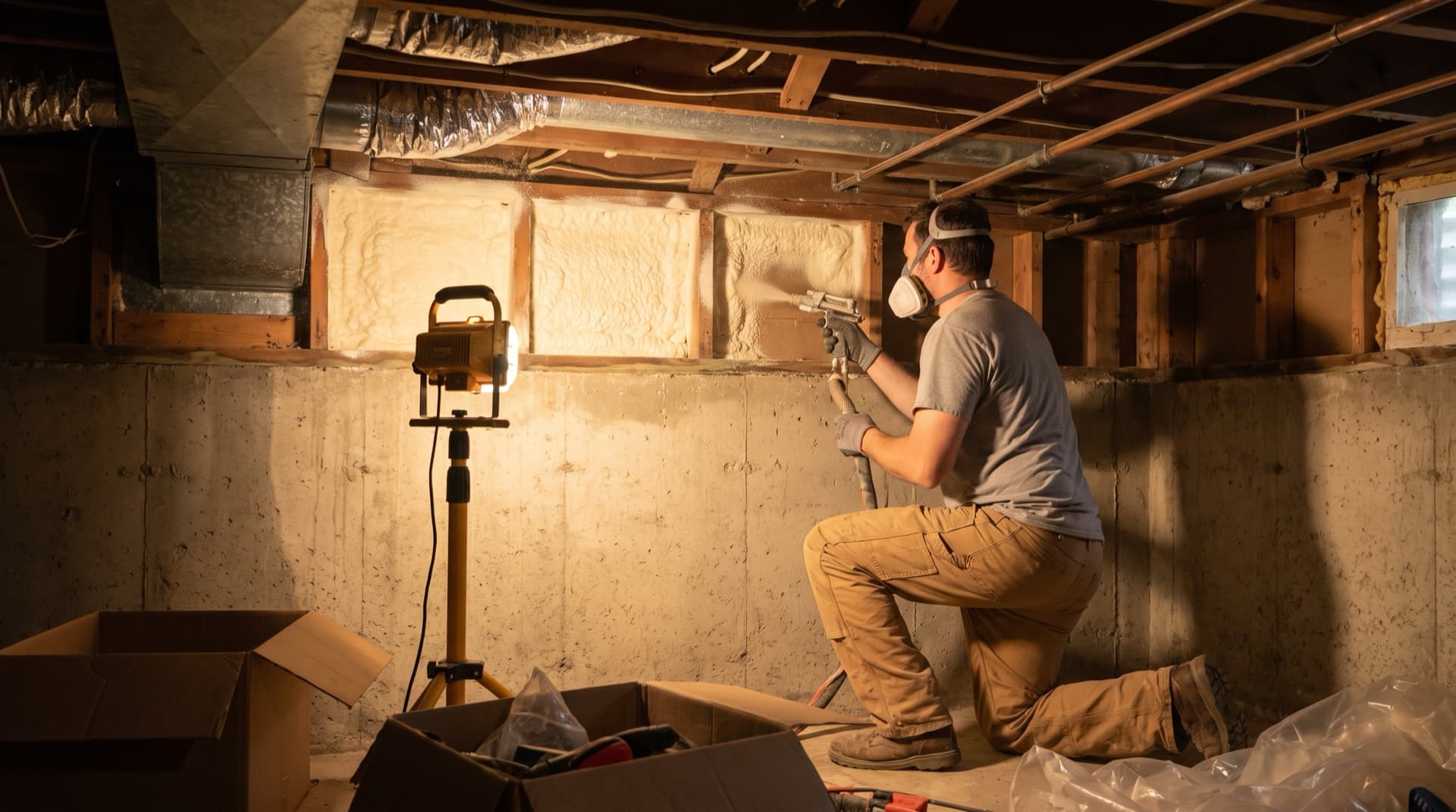
Spray Foam Insulation
Spray Foam Insulation on Long Island
The right material in the right assembly. We spec foam where it genuinely pays and tell you when it does not, which is more often than most people expect.
Reviewed by Andrew Blom, HVAC pro since 2007, including nine years at Daikin
Spray Foam Insulation: Key Facts
- Cost
- Spray foam runs roughly $3 to $7 per square foot installed depending on open or closed cell and applied thickness, which is several times the cost of blown-in for the same area.
- Where it earns its price
- Rim joists, cathedral and low-slope roof assemblies, knee wall backs, overhangs, and crawl space walls. Places where you need insulation and an air barrier in one pass and there is no room for anything else.
- Where it usually does not
- A standard open attic floor. Blown-in covers far more square footage per dollar there, and the rebate is a fixed amount, so cheaper material per R-value covers more of your project.
- Open cell vs closed cell
- Open cell is lighter, cheaper, about R-3.7 per inch, and vapor permeable. Closed cell is denser, about R-6.5 per inch, adds structural rigidity, and acts as a vapor retarder. Different jobs, not better and worse.
- Rebate treatment
- The PSEG Long Island Home Performance program does not specify insulation material. Spray foam qualifies as insulation the same as blown-in, against the same rebate caps.
- Service area
- Quoted across PHA's Suffolk County South Shore service area, from West Islip east to Bellport and north to Ronkonkoma, seven days a week from 7am to 7pm.
Straight Talk
Where Foam Is Worth It, and Where It Is Not
Foam is a great product sold badly. It gets pitched as the premium answer to every insulation question, and it is not.
Worth it
- Rim joists. Insulation and air barrier in one pass, in a spot that leaks badly and is awkward to seal any other way.
- Cathedral and low-slope roofs. No attic to blow, limited depth, and a real need for air control.
- Knee wall backs. The triangular spaces in a cape that let bedrooms cook in summer.
- Crawl space walls. Closed cell against masonry, where moisture would ruin fibrous insulation.
- Overhangs and cantilevers. Floors over open air, which are almost always both uninsulated and leaky.
Usually not worth it
- Open attic floors. Plenty of depth available, so blown-in buys far more R-value across far more square footage per dollar.
- When the rebate is the budget. The insulation rebate is a fixed amount, so a pricier material covers a smaller share of your project.
- Roof decks without a plan. Turning a vented attic into a conditioned one changes how the whole assembly dries. It can be done well, and it is often done badly.
- As a substitute for air sealing. Foam in one spot does not seal the twenty other paths air is taking through your house.
Side By Side
Spray Foam vs Blown-In
| Spray Foam | Blown-In | |
|---|---|---|
| Cost per sq ft installed | $3 - $7 | $1.00 - $2.80 |
| R-value per inch | R-3.7 open / R-6.5 closed | R-2.2 to R-3.8 |
| Air barrier on its own | Yes | No, needs separate air sealing |
| Fills irregular cavities | Yes, expands in place | Yes, flows and settles |
| Best surface | Rim joists, roof decks, knee walls, crawl walls | Open attic floors |
| House occupied during work | No, needs cure time | Yes |
Most whole-house projects use both: foam at the rim joist and the hard assemblies, blown-in across the attic floor. See insulation and air sealing for how the pieces fit together.
Common Questions
Spray Foam FAQ
In the right spot, absolutely. In the wrong spot it is an expensive way to buy R-value you could have had for a third of the price. Foam earns its cost where you need insulation and an air barrier in the same pass and there is no depth to work with: rim joists, cathedral ceilings, the back of knee walls, overhangs, crawl space walls. On an open attic floor with plenty of headroom, blown-in gets you more R-value across more square footage for less money. We will tell you which situation your house is in, including when the answer is that you do not need foam.
Closed cell where you need the vapor control, the higher R-value per inch, or the structural stiffness: rim joists, crawl space walls, roof decks, anywhere against masonry or exposed to moisture. Open cell where you have depth to fill and want the assembly to stay vapor permeable, like interior wall cavities or a vented cathedral bay. Closed cell is roughly R-6.5 per inch against open cell's R-3.7, but it also costs meaningfully more, so filling a deep cavity with closed cell is usually money spent on performance you cannot use.
Roughly $3 to $7 per square foot installed, driven by whether it is open or closed cell and how thick it goes. That is a wide range because foam is almost always priced by board foot, meaning square footage times inches of thickness, so the depth the assembly needs matters as much as the area. We measure the assembly and quote the actual board footage rather than working off a rule of thumb.
Yes. The PSEG Long Island Home Performance program lists insulation by location, attic, wall, floor, band joist, and basement crawl space, and does not specify a material. Spray foam counts as insulation the same as blown-in against the same caps, up to $2,500 at market rate. Worth knowing though: because the rebate is a fixed dollar amount rather than a percentage, a more expensive material covers less of your total project. On a big open attic that difference is significant.
Once it is cured, yes. During installation and while curing it needs the house unoccupied and properly ventilated, and the crew works in supplied-air respirators. Cure time depends on the product and conditions, usually 24 hours before reoccupancy for most residential jobs. Any installer who tells you that you can stay in the house during a foam job is cutting a corner you do not want cut.
It can, when the wrong type goes in the wrong assembly. Open cell foam on the underside of a roof deck in our climate can let moisture through to the sheathing where it has nowhere to dry, and that is a real failure mode we have seen. This is why the assembly matters more than the product. Getting it wrong is expensive to undo, which is a good part of why we assess before specifying rather than defaulting to foam everywhere.
We assess the house, specify the assembly, run the rebate paperwork, and supervise the job. The foam itself is installed by a rig and crew who do it every day. That is deliberate. Foam is unforgiving of inexperience and we would rather put a specialist on it than learn on your rim joist.
Other Services
More Ways We Can Help
Attic Insulation
Blown-in insulation and air sealing, R-38 to R-60, with PSEG rebate handling.
Heat Pump Installation
Ductless, ducted, and hybrid systems with full rebate handling.
Oil-to-Electric Conversion
Full oil-to-heat-pump conversions with rebate handling.
Maintenance Plans
Tune-ups, waived service fees, and repair discounts starting at $19/month.
Ready to Get Comfortable?
Text or call us today. No pressure, no surprises. Honest HVAC service from your Patchogue neighbors.