How to Get the Most Out of Your Pool Heat Pump This Summer
Improve pool heat pump efficiency on Long Island: covers, pump timing, and pool heating settings that cut what your pool heater costs to run each month.
August is when the pool heating bill catches up with you
The pool has been open since Memorial Day, the water has been comfortable all summer, and then the PSEG bill lands higher than you remember. Pool heat pump efficiency is not something most homeowners think about until that moment, which is a shame, because nearly everything driving that number is a habit you control, not a defect in the equipment.
We service swimming pool heat pumps all over Suffolk County, and two identical units on two identical pools in Patchogue can run a hundred dollars a month apart. The difference is never the brand on the cabinet. It is the cover, the temperature setting, the run schedule, and whether anybody has cleaned the thing since spring.
How your pool heat pump actually heats the water
Worth thirty seconds, because the efficiency tips only make sense once you know the mechanism. A gas heater burns propane or natural gas to create heat. An electric heat pump does not create heat at all. A fan pulls outside air across a coil, the refrigerant absorbs heat from the surrounding air, the compressor concentrates it, and a titanium heat exchanger hands it off to your pool water on the way back from the filter.
That is heat transfer instead of combustion, and it is why the operating costs are so different. For every unit of electricity drawn, a pool heat pump delivers three to five units of heat. Gas pool heating gives you less than one. It also means the whole system is only as efficient as the air it is breathing and the water flowing through it, which is exactly what the next few sections are about.
Use the pool cover every single night
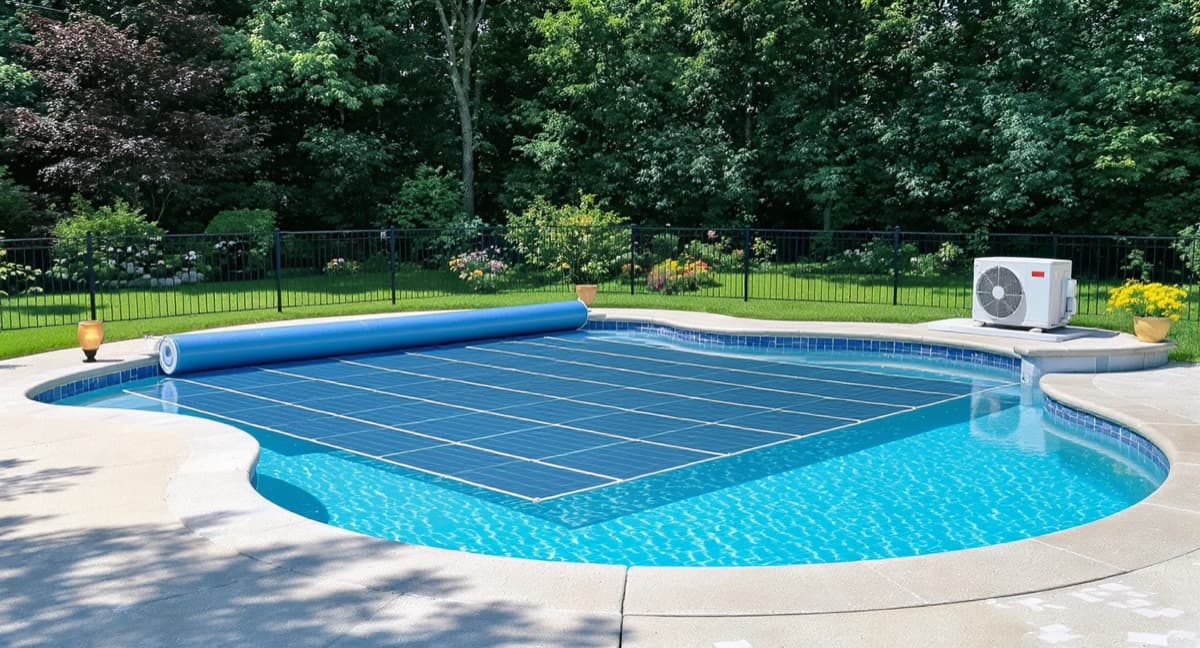
If you do one thing on this list, do this. Most heat loss in a pool is evaporation off the surface, and a solar cover shuts it down. Homeowners who use one consistently cut pool heating cost by 40 to 70 percent.
Without a cover, your heat pump spends the overnight hours replacing heat that walked off into the air over Long Island. On a 500-square-foot pool held at 84 degrees, that is easily $100 a month in wasted energy costs. Covers are a hassle, and nobody enjoys rolling one on at eleven at night, but a reel turns it into a two-minute job. It is the cheapest energy-efficient upgrade available for pool heating, full stop.
Pick a pool temperature and leave it alone
Set the water where you actually swim, usually 80 to 84 degrees, and stop touching it. Every degree above that costs roughly 10 to 15 percent more to hold, because the wider the gap between pool temperature and air temperature, the faster the heat escapes.
The bigger mistake is the sawtooth: dropping the setting to 76 during the week, then cranking it to 86 Friday for the weekend. This is steady heating technology, not on-demand heat. A heat pump is built to hold your desired pool temperature, not to blast a pool up six degrees in a day. Making it try means long hours at full draw. That is the one place a gas heater still wins, and it is why some homeowners with a spa keep gas on the spa and put a heat pump on the pool.
Run the heat pump when the air is warm
Most people get this backwards. Because a heat pump pulls heat from the surrounding air, its efficiency rises and falls with air temperature. Running from ten in the morning to six at night, when Suffolk County air is in the 80s, delivers noticeably more heating per kilowatt than running overnight when the air drops into the 60s.
Set your pool pump timer so the bulk of the heating happens in the warm part of the day. In August that is easy. It matters more in September, when daytime air is still fine but overnight lows dip and the unit works much harder for the same result. Inverter heat pumps handle this better than older single-speed units, since they modulate output instead of slamming on and off.
Keep air and water moving freely
A pool heater needs two things: air across the coil and water through the exchanger. Choke either one and efficiency drops well before anything actually breaks.
On the air side, give the unit clearance. Two feet on all sides and open sky above. We show up to plenty of units in Bellport and Sayville with a hedge grown in around them, so the unit is breathing its own exhaust. Hose the coil off gently a couple of times a season to clear cottonwood and grass clippings.
On the water side, the filter and pump baskets are the whole story. A dirty filter means less flow through the titanium heat exchanger, which means longer heating runs for the same temperature. Backwash on your normal schedule and empty the baskets. If the unit is throwing a flow fault rather than just running inefficiently, our guide to pool heat pump error codes explains what each one is telling you.
When it is the equipment, not the habits
Some efficiency loss is not fixable with a cover and a timer. If energy costs jumped hard with no change in how you use the pool, or the unit runs constantly and never reaches your setting, that points at the machine.
The common failures on Long Island: a fouled heat exchanger from unbalanced water chemistry, a slow refrigerant leak, or a failing fan motor. Salt systems and lots near the bay are hard on this equipment, and corrosion cuts into the usual ten-to-fifteen-year lifespan. AquaCal, Hayward, and Pentair units all age the same way out here.
There is also the chance the unit was never right for the pool. An undersized heat pump runs nonstop and still cannot hold temperature on a windy week, which reads as an efficiency problem but is really a BTU problem. Our pool heat pump sizing guide covers matching output to pool size and surface area.
Extend the swimming season instead of chasing it
The real payoff shows up in September and early October. Our climate keeps the air mild well past Labor Day, and a maintained heat pump with a cover on it will hold 82 degrees into the second week of October without punishing energy bills. A neglected one gives up in early September, and you lose a month of swim season you already paid for.
If your pool heating is not performing the way it did in June, get it looked at before you close rather than discovering it next May. We handle pool heat pump service across Suffolk County, and a late-summer appointment is far easier to get than an opening-week one.
Give us a call or text at 631-209-7090 and we will get you on the books.
Frequently Asked Questions
Between 80 and 84 degrees for most Long Island swimming pools. Every degree above that costs roughly 10 to 15 percent more to hold, because heat loss off the surface climbs as the gap between pool water and air temperature widens. Set your pool heat pump once and leave it there rather than adjusting up and down.
It is the single biggest lever you have. Most of a pool's heat loss is evaporation off the surface, and a pool cover stops it. Homeowners who use one consistently cut their pool heating cost by 40 to 70 percent, which on Long Island is often $100 or more a month in season.
Usually restricted water flow from a dirty filter or basket, a blocked air intake, or a refrigerant issue in the heat pump. The unit runs longer to deliver the same units of heat, so energy costs climb before anything actually breaks. A jump with no change in habits is worth a service call.
Related Articles
Solar and Heat Pumps: A Match Made in Heaven, With One Winter Catch
Solar and a heat pump pair well on Long Island, but solar panel output bottoms out in December when heating load peaks. The honest math on sizing both.
Keeping Your Home Cool in a Long Island Heat Wave
Practical ways Long Island homeowners keep the house cool in a heat wave without blowing up the PSEG bill or burning out the air conditioner outside.
Best Thermostat Settings for LI Summer Efficiency
What temperature should you set your thermostat in summer? The right settings cut cooling costs and take real strain off your Long Island system.