The Daikin Altherma, Explained for Long Island
The Daikin Altherma 3 H HT is an all-in-one air-to-water heat pump that replaces your boiler, AC, and water heater. Here's what it is and how it works.
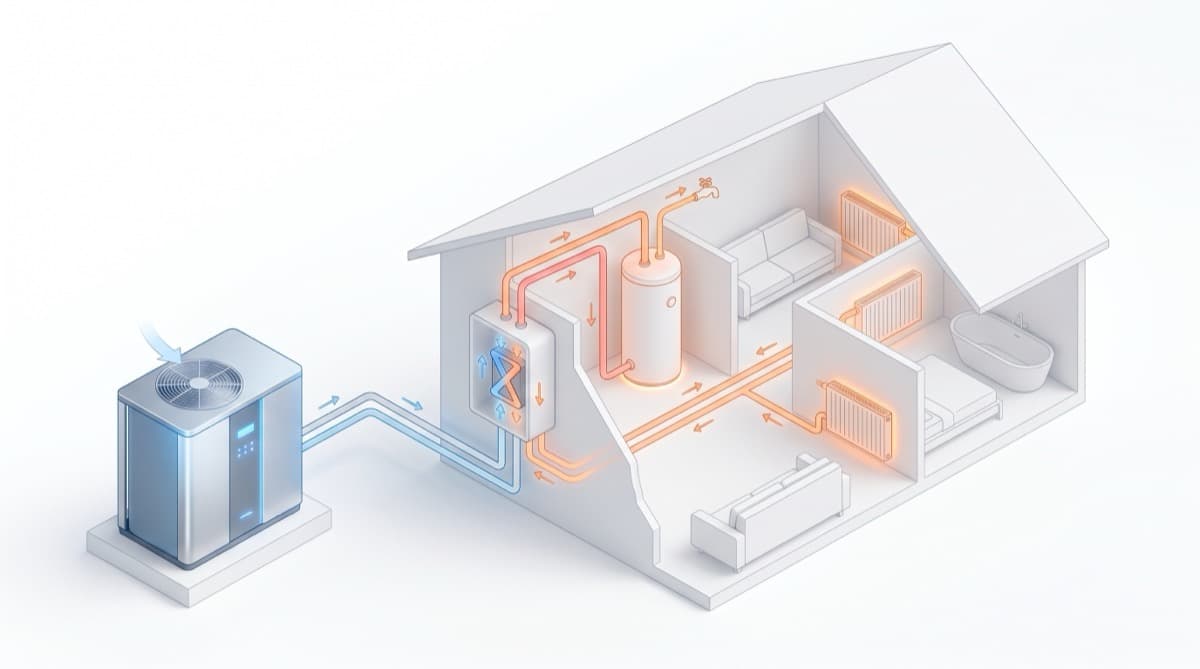
If you have been reading about air-to-water heat pump systems and stumbled across the name Daikin Altherma, you are not alone. Maybe a contractor mentioned it. Maybe you found it in a forum. Either way, you probably noticed that almost nobody is explaining what this thing actually is in plain English. This post fixes that.
It is an all-in-one air-to-water heat pump system that handles heating, cooling, and hot water from a single outdoor unit while keeping your existing emitters. Lose the old heating equipment. Keep the rads. That is the short version. Here is the rest.
Why You Have Not Heard of It
Daikin is the largest HVAC manufacturer in the world. They make more heating and cooling equipment than anyone, but most of their residential name recognition in the US comes through Goodman and Amana, which are Daikin subsidiaries. Daikin Europe has sold the Altherma platform as their flagship residential product for over a decade. Millions of units installed across the UK, Germany, Scandinavia, and the rest of the continent.
The US is a different story. American homes were built with ductwork after World War II, so the air-to-air system became the standard here. Europe built homes with hydronic emitters and underfloor heating, so they needed equipment that could make hot water instead of blowing conditioned air. Daikin technology and innovation produced the Altherma as their answer to that market, and it has been the dominant product in its category ever since.
What changed in 2026 is that Daikin released the third generation, the Daikin Altherma 3 H HT. This is the first version rated for both cold climates and high-temperature water output at the same time. That combination is what makes it work for Long Island homes with cast iron rads and baseboard. Earlier models could do one or the other, not both. This one can produce water at 70°C (158°F) while running at full capacity down to 5 degrees outside. That covers every winter day Long Island has ever had. Only a handful of contractors on Long Island are authorized to install it. We are one of them.
The Four Pieces of the Daikin Altherma System
The Daikin Altherma system has four main components, and understanding what each one does takes about 60 seconds.
The outdoor unit sits outside your home, usually where your AC condenser lives now or next to where your oil equipment used to be. It extracts energy from the outside air using a refrigerant cycle and a compressor. The Daikin Altherma 3 uses R-32 refrigerant as part of its Bluevolution technology platform, which has a lower environmental impact than the R-410A used in most older systems. At 35 dBA in low sound mode, the low operational noise means it can blend into surroundings easily without disturbing you or your neighbors, quieter than a traditional outdoor unit for central AC.
The indoor unit is a wall mounted hydrobox, roughly the size of a small medicine cabinet, that transfers heat between the refrigerant circuit and the water loop in your home. It replaces your old heating equipment as the brains of the system and includes an intuitive user interface controller for adjusting temperature setpoints, scheduling, and switching between modes. The excellent design of Daikin indoor units, which has won an award-winning design recognition from international HVAC panels, keeps the footprint compact while housing the controls, sensors, and flow management in one enclosure. The system can also integrate with thermal solar panels if you have them, using the solar input to preheat the water loop and reduce electricity draw further.
The domestic hot water tank is a dedicated insulated vessel, typically 80 gallons (about 300 liters, compared to the 230L standard common in Europe), that the system heats using a priority valve. When your home calls for hot water at the tap, heating capacity diverts to the vessel first. You get domestic hot water without a separate water heater, without a gas line, and without an electric element burning energy in the basement.
Your existing emitters are whatever is already in your house. Cast iron radiators, fin tube baseboard, radiant floor loops, or fan coil units on existing ductwork. The system sends hot or chilled water through the same pipes you already own. Nothing downstream needs to change.
How One Machine Does Three Jobs
This is the part that surprises most homeowners. The Altherma is a single unit that handles space heating, cooling, and water heating from one system. Here is how each mode works.
In heating mode, the system extracts energy from the outside air and the hydrobox transfers it into the water loop through a heat exchanger. That hot water circulates through your emitters at the right temperature for efficient heating. The system modulates output based on outdoor temperature using a weather compensation curve, so it runs gently most of the time and ramps up only when it needs to. That gentle modulation is inverter technology at work, the same idea we cover in our guide on inverter vs single-speed heat pumps. Compared to other heating systems like fossil fuel boilers or traditional heating with oil, the Altherma delivers significantly lower energy consumption because it moves heat rather than creating it through combustion.
In cooling mode, the process reverses. The equipment pulls heat out of the water loop and rejects it outside, sending chilled water through fan coils or a hydronic air handler to provide cooling and air circulation throughout your home. If you have rads and no ductwork, you would add a convector unit in the rooms where you want cooling. If you have existing ducts with an air handler, the Altherma can tie into those.
For water heating, a priority valve inside the hydrobox diverts heat to the storage vessel whenever the temperature drops below its setpoint. This happens automatically. You do not notice it. Recovery is fast because the system can push significant thermal energy into the water, especially at moderate outdoor temperatures when energy efficiency is highest. At low temperature supply conditions like floor heating, the coefficient of performance can climb above 4, meaning every unit of electricity moves four units of heat.
Three jobs, one outdoor unit, one set of monthly utility costs. That is the all-in-one advantage, and it is why this air-to-water heat pump is generating so much interest among homeowners who want to replace their boiler with one unit that does heating, cooling, and hot water.
What It Replaces and What It Keeps
This is where the Altherma makes the most sense as a furnace and equipment replacement. Here is the line by line.
It replaces your old heating equipment, whether oil fired or gas. The Altherma takes over the job of making warm water for your home. Heat pumps extract energy from the outside air instead of burning fuel, which is why the energy savings add up quickly.
It replaces your central AC. If you have an existing condenser and air handler, the Altherma's cooling mode handles that job. If you have window units, you can finally get rid of them.
It replaces your water heater. Gas, electric, or indirect, the dedicated tank takes over domestic hot water production. The heater function uses the same inverter technology and compressor as the space heating side, so there is no second appliance to maintain.
It keeps your existing emitters. Rads stay. Baseboard stays. Underfloor loops stay. Ductwork stays if you have it. The Altherma works with whatever distribution system is already in your home. That is the entire point of an air-to-water heat pump system.
Is the Daikin Altherma Right for Your House?
The Altherma fits best in a specific kind of home, and that home is extremely common on Long Island. The ideal climate for this system is exactly what we have here, cold enough in winter that you need a heat pump that still puts out real capacity when it is in the teens and single digits outside, warm enough and humid enough in summer to get genuine use out of the cooling mode.
You have oil or gas equipment feeding hydronic emitters. You have no central ductwork, or you have ducts but also have rads in part of the house. You are thinking about getting off oil or reducing your gas dependence. Your water heater is aging and you would rather not replace it separately. You want cooling but you do not want mini split heads in every room. You care about insulation and energy-efficient upgrades that actually pay back over time.
If two or three of those describe your house, the Altherma is probably worth a serious look. It is not the right answer for every situation. Homes with existing high efficiency gas furnaces and ductwork may be better served by a conventional air source system. Homes that need only one or two rooms cooled may do fine with a mini split. We do a Manual J heat load calculation and a full site visit before we recommend anything, because the wrong system sized wrong is worse than no system at all.
Why PHA
We are not just another HVAC company that added a product line. Our founder spent eight years inside Daikin working on commercial systems before starting Patchogue Heating and Air Conditioning, learning from Daikin engineers who designed heat pump systems like the Altherma platform. We know the engineering, we know the controls, and we know what it takes to commission these systems correctly. As an authorized installer, we have access to the Daikin Altherma 3 H HT and the training to configure it for your home's specific heating range and emitter setup.
The full system breakdown, cold weather specs, and technical details are on our Altherma page. If you want the radiator-specific deep dive, read how existing rads work with a modern system. And if you want to understand the broader category before you look at the specific product, start with what an air-to-water heat pump actually is.
Where to Start
If you have been told your house cannot work with modern heating technology because of your rads, that advice was probably correct when you heard it. It is not correct anymore. The Daikin Altherma is the all-in-one, energy-efficient system that changes the math for hydronic homes on Long Island.
The first step is a site visit. We look at your existing piping, your emitter sizing, your electrical panel, and your hot water setup. We run the Manual J so the system is sized right. Call or text us at 631-209-7090 and we will walk you through what it would look like for your home.
Related Articles
What Size Heat Pump Do You Need for a Long Island Winter?
Heat pump size on Long Island: what size heat pump do you need for your home, and why BTUs at 17 degrees matter far more than the ton printed on the label.
Your Heat Pump Is Rated at 47 Degrees. Long Island Winters Are Not.
A cold climate heat pump loses heating capacity as it gets colder. What Long Island homeowners should check at 17 degrees before signing any proposal.
17 Degrees in Patchogue, 10 in Westhampton: The Long Island Heating Design Temperature
The Long Island heating design temperature is not one number. Brookhaven 16F, Farmingdale 17F, Gabreski 10F, and Suffolk County HVAC design conditions differ.