Fall Furnace Tune-Up: Why September Is the Best Time to Schedule
Schedule a furnace tune-up in September for first pick of dates and time to fix what we find. What the checklist covers and what it costs on Long Island.
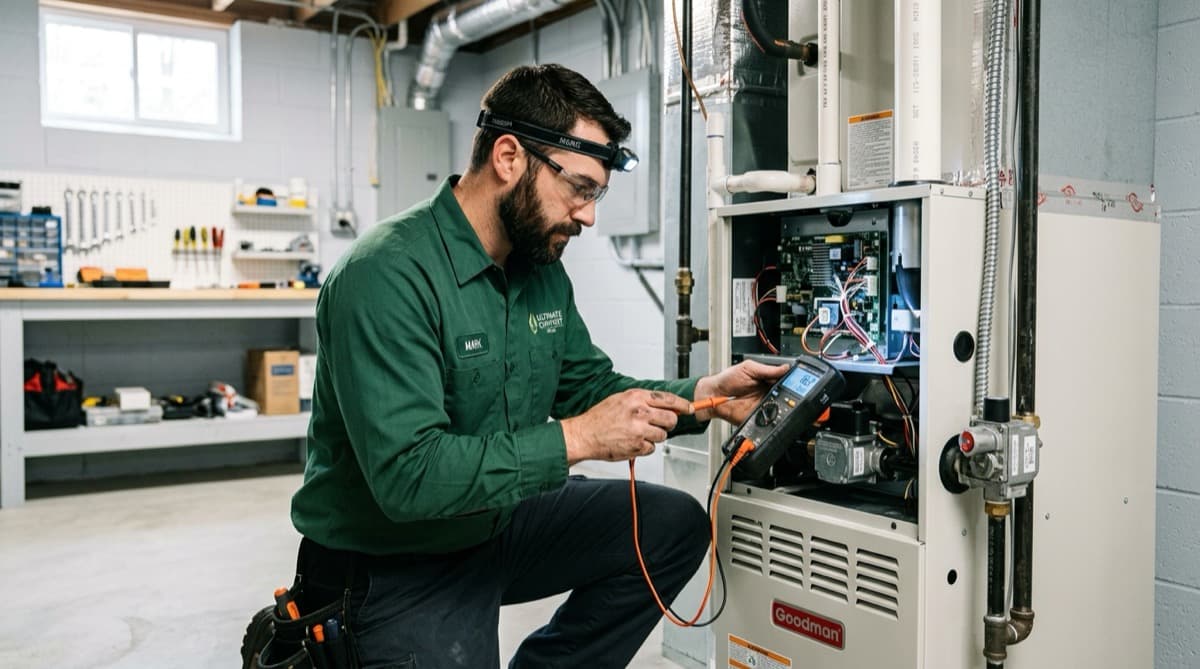
September is the best time to schedule a furnace tune-up
Book a furnace tune-up in September and you get first pick of appointment slots plus four to six weeks of mild weather to fix anything we find before you actually need heat. Call with the same furnace problem in November and you are choosing between a cold house and whatever part we can source overnight.
Every year on Long Island it goes the same way. The first real cold night lands, usually mid to late October, and the phone does not stop. A good half of those furnace repair calls are systems that sat idle all summer and failed on the very first ignition cycle. Almost every one of them was preventable with routine furnace maintenance.
What actually breaks on the first cold night
Three things, over and over.
Flame sensor. A thin rod in the burner flame that tells the control board the gas lit. It films over with oxide, the board stops seeing flame, and the furnace lights and shuts down in a loop. Five-minute clean during a tune-up. No-heat call in January.
Hot surface igniter. Brittle silicon carbide with a finite number of cycles in it. A technician can read resistance on one and tell you it is drifting out of spec before it snaps. Swapping a $60 to $90 part on a Tuesday in September is a very different experience than finding it cracked at eleven at night.
Pressure switch and inducer. Anything that blocks flue draft, a bird's nest, a corroded inducer wheel, a cracked sensing hose, locks the furnace out on safety. Annoying on its own, but it is also the failure homeowners most often try to fix by cycling the breaker again and again, which is how a lockout turns into a real repair.
None of the three is expensive in September. All three are miserable in December.
What a furnace tune-up checklist actually includes
A professional furnace tune-up runs about ninety minutes and it is not just furnace cleaning. A twenty-minute furnace check is a filter swap with a receipt.
On the gas side, the furnace tune-up checklist covers burner inspection and cleaning, flame sensor cleaning, igniter resistance, manifold gas pressure checked against the rating plate, a leak check at the gas connections, limit and pressure switch operation, and a full combustion analysis on a meter. That last one is the piece most homeowners never see and the actual reason to have a technician out. We read carbon monoxide in the flue and combustion efficiency off an instrument instead of guessing from the color of the flame.
On the air side we inspect the heat exchanger, the blower wheel and motor amp draw, the electrical connections, airflow at the supply plenum, and the duct connections, then calibrate the thermostat and install a fresh furnace filter.
You get all of it in writing within 24 hours. An Equipment Health Report with the real carbon monoxide numbers, a verdict on the heat exchanger, and flat-rate pricing on anything that needs attention. Not a verbal "looks alright" at the door.
How much does a furnace tune-up cost on Long Island
Ours is $149 flat, no trip fee and no diagnostic fee stacked on top. Most Suffolk County HVAC companies land between $99 and $200 for a basic furnace tune-up.
Compare that against what annual furnace maintenance prevents. A no-heat service call starts at $129 for the trip and first hour of diagnostic, before parts. An inducer motor runs $400 to $700 installed. A control board is $500 to $900. A furnace replacement is $5,000 and up.
The energy side matters too. A furnace with a dirty blower, a clogged filter, and restricted airflow has to work harder to hit the same setpoint, which shows up on your winter energy bills. Regular furnace tune-ups improve energy efficiency by holding the system near its rated numbers, instead of letting energy costs drift up five percent a winter while nobody notices. That is real money on your energy bills, and the system runs quieter.
Why September and not October
Capacity is the honest answer, and it is why we tell people to book before the heating season begins. In September we can usually get you on the schedule inside a week and you pick a morning or an afternoon. By the third week of October we are running no-heat calls, those take priority, and preventive visits get pushed. By Thanksgiving the calendar is a mess and distributors are picked over on the common parts.
The bigger reason is the fix window. If the heating tune-up turns up a cracked heat exchanger, and it happens more than people expect in the 1960s and 70s housing stock around Patchogue, Medford, and Bellport, you suddenly have a replacement decision in front of you. Making that call in September, with time to get quotes and look at whether a heat pump conversion and the PSEG rebate beat another gas furnace, is nothing like making it the week before Christmas with the house at 55 degrees. If you are looking at the whole heating system, our fall prep walkthrough covers the rest of your heating and cooling equipment.
DIY furnace prep before the technician arrives
Run the heat now. Push the thermostat above room temperature and let the furnace complete a full cycle. Better to hear the bang or smell the burn-off dust on a mild afternoon than at two in the morning.
Clear a path. Three feet of working room around the furnace and access to the flue.
Check the air filter. If you cannot remember the last change, it is due, and a loaded filter drags down both airflow and indoor air quality. A standard 1 or 2 inch pleated filter comes with the tune-up. If you run a 4 or 5 inch media cabinet, give us the size when you book so we bring the right one.
Test your carbon monoxide detectors. Every level of the house, fresh batteries. Do it whether or not the furnace passes.
Get your furnace tune-up on the books
One professional furnace tune-up a year is the whole ask. Reliable heating through a Long Island winter mostly comes down to that one visit. It is the cheapest thing you will do to keep your furnace running, on a system that costs several thousand dollars to replace, and out here in Suffolk County the heating season runs hard from October through March. Regular furnace tune-ups extend the life of your furnace, often the difference between 18 years and a furnace system that quits at 11. Small issues caught in September stay small.
If you would rather not think about scheduling at all, our maintenance plans start at $19 a month for one annual tune-up, and the $39 Comfort plan covers both the heating and the cooling visit. Either way, we do the reaching out. Whether that math works for your house is something we went through in our breakdown of maintenance plans.
Otherwise, give us a call or text at 631-209-7090 and we will get you a September slot while there are still good ones left. Or reach us here and we will follow up the same day.
Related Articles
End-of-Summer AC Maintenance: What to Do Before You Shut It Down
End-of-summer AC maintenance for Long Island homes. What to test, clean, and check on your air conditioning system before you shut it down for the winter.
HVAC Preventative Maintenance: Prep Your System for Fall
HVAC preventative maintenance for Long Island homes. What to check on your heating and cooling system before fall, and what a visit costs in Suffolk County.
Are HVAC Maintenance Plans Worth It? The Numbers
We ran the numbers on HVAC maintenance plans for Long Island homes. Here's the real ROI math, breakeven point, and when a service agreement actually pays off.