End-of-Summer AC Maintenance: What to Do Before You Shut It Down
End-of-summer AC maintenance for Long Island homes. What to test, clean, and check on your air conditioning system before you shut it down for the winter.
By Labor Day most people out here are done thinking about air conditioning. That is the problem, because AC maintenance is cheapest and easiest right now, while the system is still running and still willing to show you what is wrong with it. Shut the cooling system down cold in October and every fault it has hibernates with it, then shows up on the first 88-degree afternoon in May when we are booking three weeks out.
Your last few weeks of runtime are diagnostic gold
There is no way to test central air in January. The compressor should not even be running at 30 degrees, so any technician who claims to have evaluated your air conditioning in the middle of winter is guessing.
So use September. Long Island gives us warm afternoons through the end of the month. Turn the AC unit on, drop the thermostat five degrees below room temperature, and let it run twenty minutes while you walk the house.
Three things to watch for. Rooms that never keep up with the rest of the house, which usually means an airflow or duct problem. Any noise at startup that is new since June, particularly a hum and a click before the fan spins, which is a capacitor going. And water anywhere near the indoor unit, which is a drain issue and the leading cause of water damage we get called out for.
Find any of those now and you fix it in September at a normal price. Find it next Memorial Day weekend and you wait.
The twenty-minute test worth more than any maintenance checklist
Buy a $12 digital thermometer. Measure the air at a return vent, then at the supply vent closest to the air handler. Subtract.
A healthy system gives you a 16 to 22 degree drop. Under 14 usually points to low refrigerant or a dirty evaporator coil. Over 25 usually means restricted air flow, which is a loaded air filter, a failing blower, or a duct problem. If it is barely cooling at all, our guide on why an AC runs but does not cool covers the rest of the causes.
That one number tells you more than any visual inspection. If your split is off, write it down and tell us when you call. It changes what we bring on the truck.
One caution. Do not run the AC if it is under 60 degrees outside. Oil migrates out of the compressor in cold weather, and testing on a cool October morning is a real way to damage it.
Proper maintenance of an AC system does not stop at the air filter
Once you are satisfied with how it ran, close the system out properly. These are DIY tasks, no technician required.
Change the air filter even if it looks usable. A one-inch pleated filter runs $8 to $15 and it has been pulling humid Suffolk County air since May. A loaded filter sitting in the unit all winter is how people start next season with restricted airflow and worse indoor air quality they never trace back.
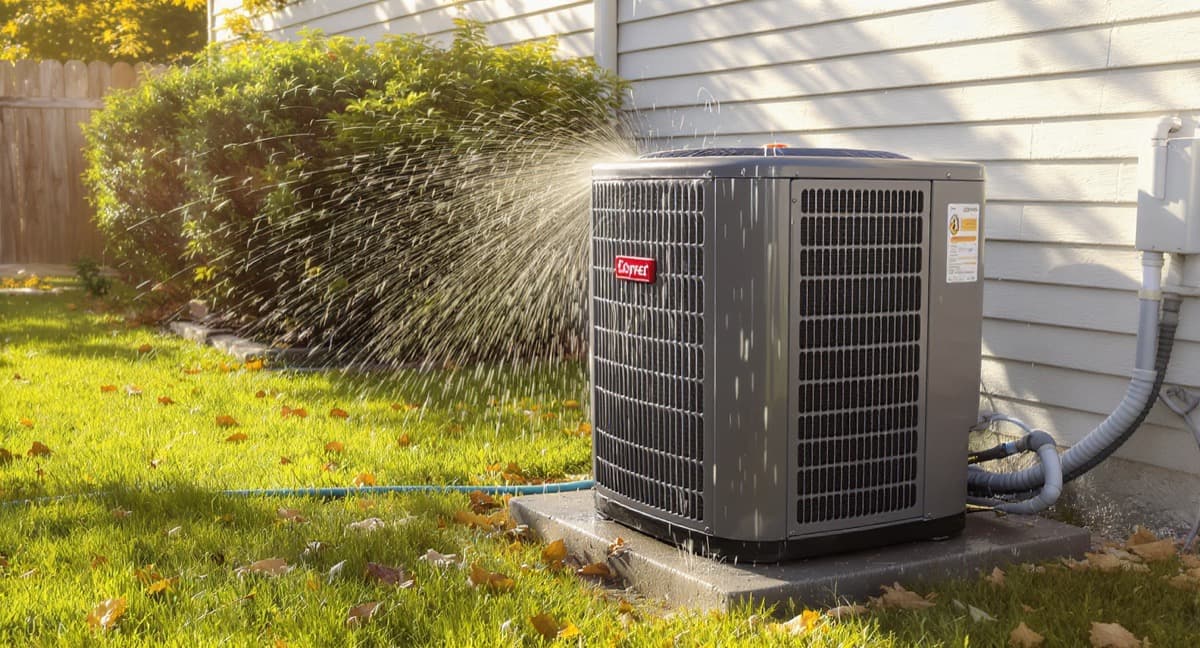
Rinse the outdoor unit with a garden hose on low pressure, spraying from inside the condenser coil outward so debris goes out the way it came in. Cottonwood, grass clippings, and road dust pack those fins tight by September, and a dirty condenser is a direct hit to system efficiency and your PSEG energy bills.
Flush the condensate drain. A cup of distilled vinegar down the access port clears the slime that builds up over a humid summer. A drain line that clogs and sits wet all winter is how somebody finds standing water on a finished basement floor in June. Our condensate drain line guide walks through it.
Look at the insulation on the larger copper line while you are out there. Ten years of Long Island sun turns that foam brittle, and missing insulation quietly costs you cooling capacity every summer.
What professional AC maintenance covers that you cannot
Routine maintenance you do yourself handles the air filter, the fins, and the drain line. The rest needs an HVAC technician with gauges and a meter.
A real tune-up means checking refrigerant charge against the manufacturer spec and finding the leak if it is low rather than topping it off. It means testing the electrical components, the capacitor, and compressor amp draw under load, because a capacitor 20 percent under spec still works in September and fails in July. It means cleaning the evaporator coil and calibrating the thermostat.
It also protects your warranty. Most manufacturers require documented annual maintenance on air conditioners, and we have watched homeowners lose a compressor claim over it.
Our end-of-season air conditioner maintenance visit is a flat $149, no trip fee, no diagnostic fee.
Do not wrap the outdoor unit
Every year somebody shrink-wraps their condenser like a boat. Do not. A full cover traps moisture against the coil and rusts it, and it gives mice a warm dry place to spend the winter chewing your wiring. We open covered units in April and find nests and $400 in damage.
A piece of plywood weighted on top keeps ice and branches off the fan. Leave the sides open.
One note on power. Shutting the outdoor disconnect off for the winter is fine on a straight air conditioner. It is not fine on a heat pump, which runs all winter and needs its crankcase heater energized. Not sure which you have? Watch the outdoor unit when the heat is on. If it runs, leave it alone.
Write it down now, because you will not remember in May
Two minutes in your phone. Model and serial off the outdoor unit data plate, install year, your temperature split, and anything that sounded or felt wrong this summer.
That note is worth money. "It is not cooling" tells us nothing. "2011 Carrier, 14 degree split, hums for a second before the fan starts" tells us to bring a capacitor and gauges, and you are fixed in one visit instead of two.
Age matters too. Most central air conditioners we service in Suffolk County are 12 to 20 years old. A maintained system reaches the top of that lifespan and a neglected one does not. If yours is past 15 and gave you a weak split this year, price a replacement this winter instead of in an emergency. Central air runs $8,000 to $14,000 installed out here, and going to a heat pump instead opens up PSEG rebates a straight AC swap does not.
Schedule service in September, not April
We are easier to reach right now. From mid-April our cooling calendar fills, and by the first heat wave we are a week or more out. If you are thinking about the heating side too, our fall HVAC prep guide covers that, and we can do both systems in one visit.
Give us a call or text at 631-209-7090 and we will get you on the books. Not sure whether your HVAC system needs a full visit or just a look? Tell us the age and what it did this summer and we will tell you straight.
Related Articles
Fall Furnace Tune-Up: Why September Is the Best Time to Schedule
Schedule a furnace tune-up in September for first pick of dates and time to fix what we find. What the checklist covers and what it costs on Long Island.
HVAC Preventative Maintenance: Prep Your System for Fall
HVAC preventative maintenance for Long Island homes. What to check on your heating and cooling system before fall, and what a visit costs in Suffolk County.
Are HVAC Maintenance Plans Worth It? The Numbers
We ran the numbers on HVAC maintenance plans for Long Island homes. Here's the real ROI math, breakeven point, and when a service agreement actually pays off.