HVAC Preventative Maintenance: Prep Your System for Fall
HVAC preventative maintenance for Long Island homes. What to check on your heating and cooling system before fall, and what a visit costs in Suffolk County.
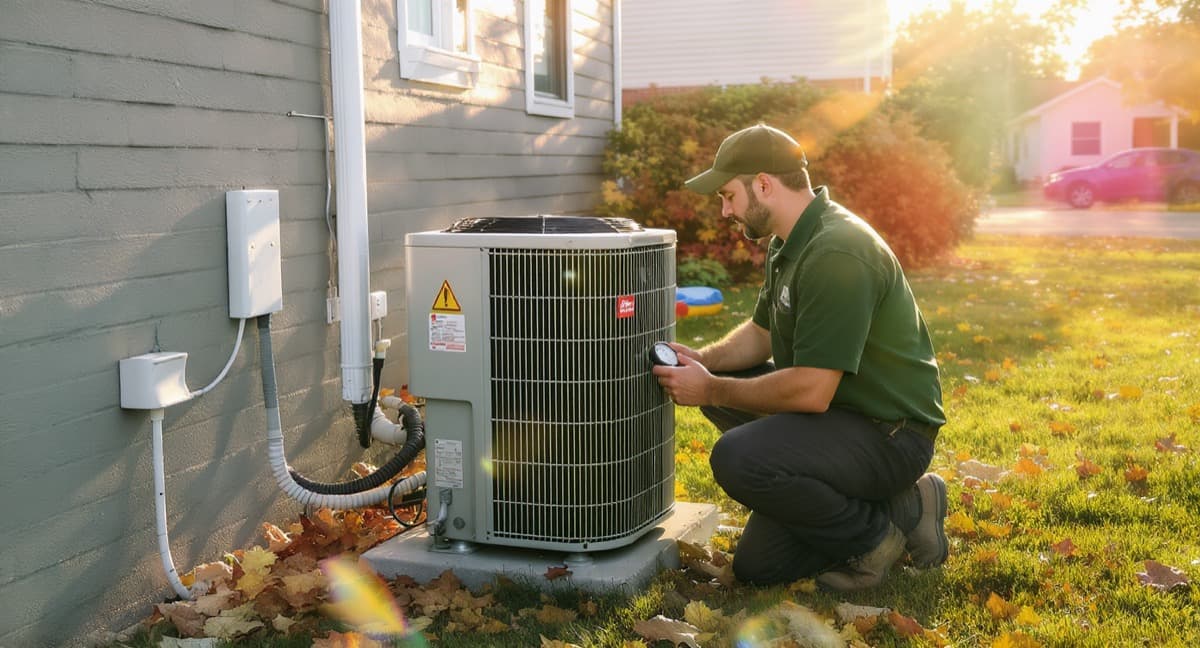
The window nobody uses
It is late August on Long Island. Your air conditioning is still running most afternoons, the furnace has not been touched since March, and fall feels like somebody else's problem. That gap right there, between the last real heat wave and the first cold night, is the best window all year for HVAC preventative maintenance.
We say that for a boring reason: we are not slammed yet. Once the first 45-degree night hits in October, our phones do not stop. Nobody wants to be the house waiting three days for a no-heat call in November when the fix could have been a $180 visit in September.
What HVAC preventative maintenance actually buys you
Preventative maintenance is work you do on an HVAC system that is not broken, so that it does not break at the worst possible moment. Most Suffolk County homeowners run the opposite play, which is to ignore the system until it makes a noise.
Four things regular maintenance actually delivers, and we can back all four up.
Lifespan. A well-maintained HVAC system operates 18 to 20 years out here. A neglected one dies around 12. That is not a marketing number, it is the difference in wear and tear on a compressor that has been running against restricted airflow for a decade.
Lower energy costs. Dirty coils and low refrigerant levels make a system burn more energy for the same output. Getting refrigerant back to spec and the coils clean typically pulls 10 to 15 percent off your heating and cooling utility bills.
Fewer breakdowns. Regular maintenance helps identify minor issues before they become $1,100 repairs. A technician catching a weak capacitor in September is a $200 part, not a Saturday emergency call in the cold.
Indoor air quality. Clean air filters, a clean blower wheel, and a dry drain pan are most of what determines the air quality in a closed-up Long Island house from October through April.
The cost math is not complicated either. A fall tune-up runs $150 to $250 per system out here. A no-heat emergency call on a December Saturday runs $250 to $400 before any parts. A blower motor is $600 to $1,100 installed. A cracked heat exchanger on a 20-year-old furnace means shopping for a new system in the coldest week of the year with no time to compare quotes or line up a PSEG rebate.
Close out the air conditioning side first
Before the AC goes quiet for six months, spend an hour on it. Pull the filter and replace it even if it looks passable. Air filters get loaded at the end of a humid Long Island summer, and leaving a dirty one sitting in the unit all winter is how you start next May with restricted airflow.
Rinse the outdoor condenser with a hose, inside out and top down, on low pressure. Cottonwood, grass clippings, and the dust off Sunrise Highway all pack into those fins. Cut back anything growing within two feet of the cabinet.
Then deal with the drain. A clogged condensate line that sat wet all summer turns into a slime-packed mess over the winter, and you find out when there is water on a finished basement floor next June. A cup of distilled vinegar down the access port handles it.
Do not shrink-wrap the outdoor unit. A full cover traps moisture and gives mice a warm place to chew wiring. A piece of plywood weighted on top to keep ice off the fan is plenty.
The heating inspection is the one that matters
Homeowners skip this because a furnace that worked fine in March feels like it will work fine in November. Usually it does. When it does not, the failure was almost always visible back in September.
A heating inspection is not a filter change. Our technician is testing carbon monoxide at the flue, checking the heat exchanger for cracks, testing the flame sensor and igniter, verifying gas pressure, checking the limit and pressure switches, and confirming the safety shutoffs actually shut off. We run a combustion analysis too, to see how much fuel is going up the chimney instead of into your house.
Carbon monoxide is the one that matters most. A hairline crack in a heat exchanger does not announce itself. If your CO detectors are more than seven years old, replace them this fall regardless of what the test button says.
If you run a heat pump, your system handles heating and cooling year-round and the maintenance tasks are different. Reversing valve operation, defrost cycle, refrigerant charge, and auxiliary heat staging all get tested before the system has to work in the cold.
The ten-minute list you can do yourself
Some of this needs an HVAC technician. A lot of it does not.
Turn the heat on for fifteen minutes on a mild September day. You want the burned-dust smell and the startup sequence now, in daylight, with time to react. If it does not fire, you found your problem on your schedule instead of on a Tuesday night in November.
Open every supply and return vent, including the ones you closed in July to push more cold air upstairs. Closing vents does not save money. It raises static pressure and shortens the life of the blower.
Bleed the radiators if you have hydronic heat. Switch the thermostat from cool to heat, check the schedule against how you actually live now that school is back in, and replace the batteries.
Check the two PVC pipes coming out the side of the house on a high-efficiency furnace. Leaves, nests, and snow drifts block them, and a blocked intake shuts the system down cold.
Whether a maintenance plan is the right call
We sell maintenance plans, so take this with the appropriate grain of salt. They are worth it for some houses and not for others. We ran the actual numbers on maintenance plan ROI rather than just asserting it. The short version: if you have two systems, or one system past twelve years old, the plan pays for itself in priority scheduling and repair discounts alone. If you have a five-year-old system and you are comfortable changing your own air filters, a straight annual maintenance visit is the better buy.
Either way, the visit is what matters, not the subscription.
Book it while there is still room
We are scheduling fall heating tune-ups now, and the calendar fills from mid-September forward. If you want a morning slot in October, the time to grab it is before Labor Day.
Give us a call or text at 631-209-7090 and we will get you on the books. If you are not sure whether your HVAC system needs a full tune-up or just a look, tell us the age and the make and we will tell you straight.
Related Articles
5 Signs Your Central Air Needs a Tune-Up
Catch AC problems while they are still cheap. Five warning signs your central air needs a tune-up, and what Long Island homeowners should expect from one.
What Does an AC Tune-Up Actually Include?
What's actually included in an AC tune-up and is it worth the cost? Here's what Long Island HVAC techs check, clean, and test during a proper visit.
How to Clear Your AC Condensate Drain Line
How to clear a clogged AC condensate drain line yourself, and how to keep it clear. Prevent water damage, mold, and shutdowns in your Long Island home.