What Happens When It Gets Colder Than Your Heat Pump's Rated Temperature?
At what temperature does a heat pump stop working? It does not. Here is what balance point, defrost and backup heat do to your heating on Long Island.
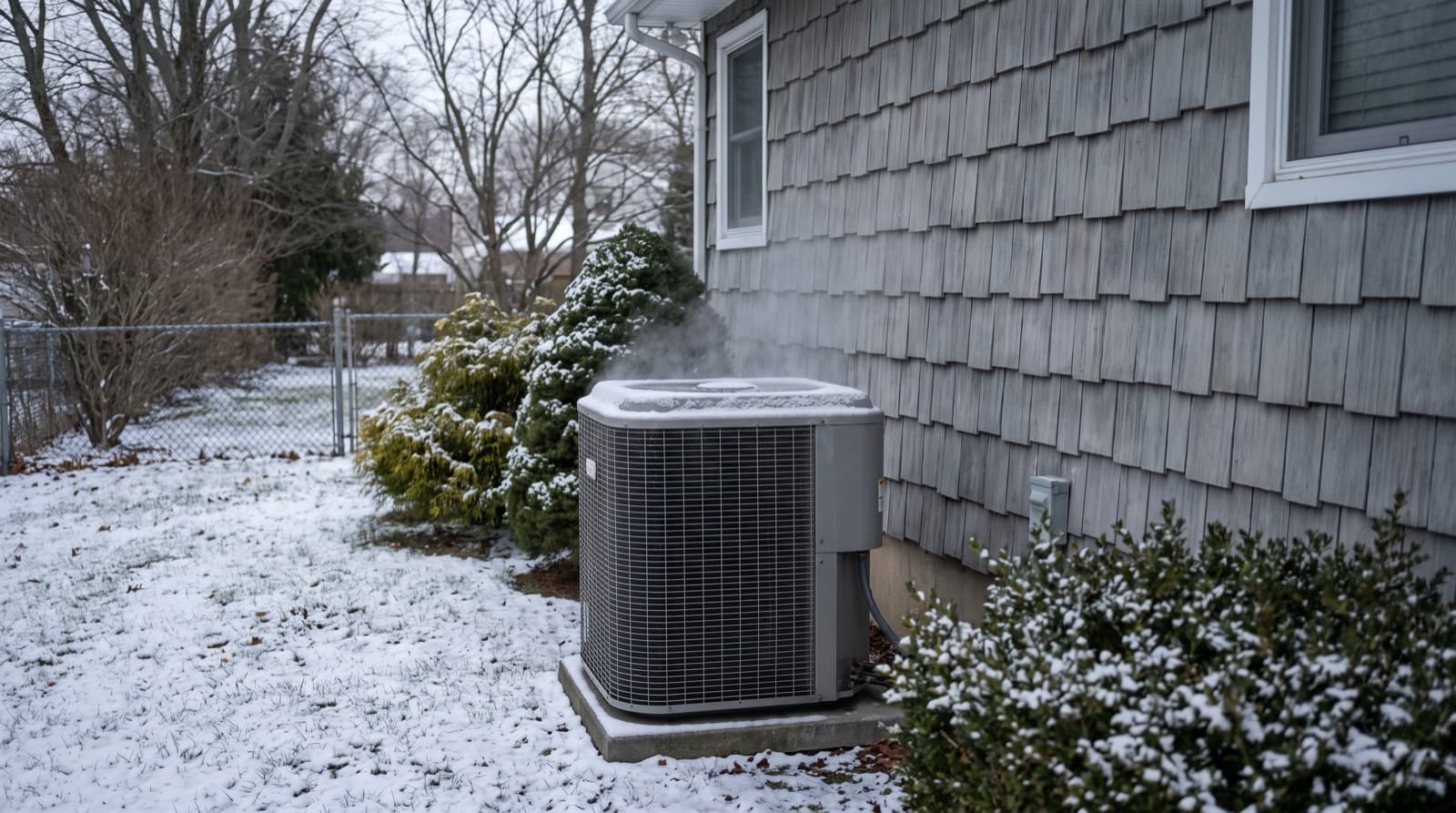
At what temperature does a heat pump stop working?
It does not stop. Modern cold climate equipment runs past 5 below zero, and many models are rated for temperatures as low as 13 below, which Long Island does not produce in a normal winter. What changes as it gets colder is capacity, meaning how many BTUs per hour the machine can deliver to heat your home, and capacity slides down gradually along a curve, even in extreme cold. Heat pumps don’t quit at a number.
Everything people fear about a heat pump in cold weather traces back to four different temperatures quoted on the same machine, and only one of them is a hard stop.
How a heat pump works, and the four numbers in that temperature range
It works by using refrigerant to extract heat from the outside air and move it indoors. That is heat energy which already exists out there, and it keeps pulling heat from the air well below freezing. Every temperature on the spec sheet describes how well it is doing that.
The 47 degree rating is the headline number, a mild-day rating, which is why it tells you close to nothing about January.
The 17 degree rating is the one that matters here, because 17 degrees Fahrenheit is roughly the heating design temperature across the middle of Long Island. Two units both sold as three tons can be 19,000 BTU apart in heating capacity at that point, which is why we size against it. More on that in rated at 47 versus real capacity at 17.
The minimum operating temperature is the only genuine cliff in the set. It is the lowest temperature the controls will let the compressor run at, commonly listed around 13 below on cold-weather equipment. Brookhaven has not been near that in decades.
The balance point is the fourth, and the one nobody brings up on a sales call.
Balance point is the number that decides your home heating
Your balance point is the outdoor temperature where the equipment's output and the house's heat loss are exactly equal. Above it, the system carries the whole house on its own. Below it there is a gap, and something has to cover it.
If the equipment was selected against its 17 degree capacity and the heating load calculation used the right design temperature for your town, the balance point usually lands in the teens. Design temperature is not one number out here either, and the design temperatures by weather station run from 16 in Brookhaven to 10 on the east end.
Here is the proportion. Design temperature is the 99 percent number, not the record low. Patchogue designing to 16 means the outdoor air sits above that for about 99 percent of the hours in a year, which works out to roughly 80 to 90 hours below it across an entire winter. Not 80 days. About 80 hours, on a handful of January and February nights. We do not get the harsh winters northern New England does, which is why the sizing question for a Long Island winter really comes down to where your balance point lands.
When the temperature drops below it, supplemental heat fills the gap
Nothing shuts down. The compressor keeps running at full output and the electric strips cover only the shortfall. On a modern thermostat that is staged and proportional. At 14 degrees it might bring on a single strip heater for part of the cycle, and closer to zero it brings on more.
Compared to traditional heating systems, that is a different rhythm than people expect. A gas furnace is all or nothing, full fire or off. An electric heat pump with a backup heat source is a sliding scale, where the machine does the bulk of the work and the strips trim what is left.
Backup is never capacity you can count on during sizing, which is why heat strips are not capacity is worth reading before somebody talks you into a smaller condenser. Those strips are electric resistance heaters, the same idea as baseboard, and they land on your energy bills accordingly.
The HVAC system setup mistake that hands your house to the strips
Here is what actually causes cold weather complaints in Suffolk County, and it is not the equipment. It is a low ambient compressor lockout left at 30 or 35.
A lockout tells the thermostat to stop using the compressor below a set outdoor number. On a 1990s system that made sense. On cold climate equipment it is backwards. On a mild 40 degree afternoon, or at 25 degrees on an October morning when the machine has capacity to spare, the aux light comes on and the house runs on resistance heat that costs roughly three times as much for the same BTUs. Your winter heating bill shows it. Many homeowners see that, assume the system failed, and call us about a machine that was working fine.
Check your thermostat installer settings for compressor lockout, aux lockout and droop. Anything above roughly 10 is almost certainly wrong for cold climate equipment. We check it on every heat pump installation and every maintenance visit, and still find it set wrong on systems other people commissioned. Same goes for ductless heat pumps on their own controls.
Defrost is not a malfunction on cold climate heat pumps
On a raw day in the 30s with moisture in the air, frost forms on the outdoor coil. The unit reverses briefly, sends warm refrigerant outside to melt it, then goes back to heating. You get a cloud of steam and a few minutes of cooler air at the registers, and then it is done. It is one machine for heating and cooling, the same box that runs your air conditioner in July, working backwards.
Neighbors call us about the steam every winter thinking something is burning. It is water vapor. A defrost cycle runs five to fifteen minutes and happens a few times on a damp day. What is not normal is constant defrosting, a block of ice on the coil, or a cycle that never completes. A well-maintained unit defrosts cleanly, and that is part of what our maintenance plans look at every fall.
So the honest picture is this. A correctly sized air source heat pump can provide heating for your house on its own through nearly the entire heating season, leans on a little backup for a few dozen hours when temperatures plummet, and will not quit working at any temperature Long Island produces. Does a heat pump lose efficiency at colder temperatures? Yes, and that is a separate post. The failures we actually get called about are sizing shortcuts and thermostat settings, not extremely low temperatures.
If you are shopping for a new heat pump and want the 17 degree capacity and the balance point in writing before you sign, or your aux light keeps coming on while the house is holding 70 degrees, give us a call or text at 631-209-7090. We cover the south shore of Suffolk County and we will tell you straight whether your setup is right or just set up wrong.
Frequently Asked Questions
Not at any temperature you are likely to see here. Cold climate equipment commonly lists a minimum operating temperature around 13 below zero, and the Long Island heating design temperature is 16 to 17 degrees. What changes at cold temperatures is capacity, not operation. The machine keeps running and keeps making heat, it just makes less of it, and the drop is gradual along a curve rather than a cliff.
The balance point is the outside temperature where your equipment's output exactly equals your home's heat loss. Above it the compressor covers the whole house by itself. Below it there is a gap, and the electric backup fills the difference. A correctly sized heat pump system on Long Island usually lands at a balance point somewhere in the teens, which adds up to a very small number of hours a year.
Almost always a thermostat setting, not broken equipment. Many thermostats ship with a compressor lockout or an aux droop set far too warm, often 30 or 35, which shuts the compressor off and hands the whole house to electric strips on a mild night. Check the installer settings for compressor lockout, aux lockout and droop. This is the most common cold weather complaint we correct, and it costs nothing to fix.
Yes. That is a defrost cycle. Frost builds on the outdoor coil in cold damp weather, so the unit briefly reverses, melts the frost, and produces a cloud of steam outside. Indoors you may feel cooler air at the registers for five to fifteen minutes unless the backup strips temper it. It happens a few times on a raw day and it ends on its own.
No. Correctly sized cold climate equipment with electric strips handles a Suffolk County winter on its own. Keeping existing combustion equipment as a dual fuel backup is a reasonable choice when it is newer and still has life in it, but it is not a requirement, and it is never a fix for a system that was sized too small in the first place.
Related Articles
Heat Pump vs Gas Furnace on Long Island: Pros, Cons, and Which Is Right for You
Heat pump vs gas furnace on Long Island: operating cost, comfort, cold-weather performance, and rebates compared, plus when a gas furnace still makes sense.
Best Pool Heat Pumps for Long Island (2026): Hayward vs Pentair vs AquaCal vs Raypak
The best pool heat pump brands for Long Island in 2026, compared by techs who service all four: Hayward, Pentair, AquaCal, and Raypak. Match the brand to your pool.
Ductless Mini Split vs Central Heat Pump: Your Next System Probably Is Not Ductless
Ductless mini split vs central air heat pump on Long Island? If your Suffolk County home has radiators, there is a third option most contractors never quote.