Your Heat Pump Is Rated at 47 Degrees. Long Island Winters Are Not.
A cold climate heat pump loses heating capacity as it gets colder. What Long Island homeowners should check at 17 degrees before signing any proposal.
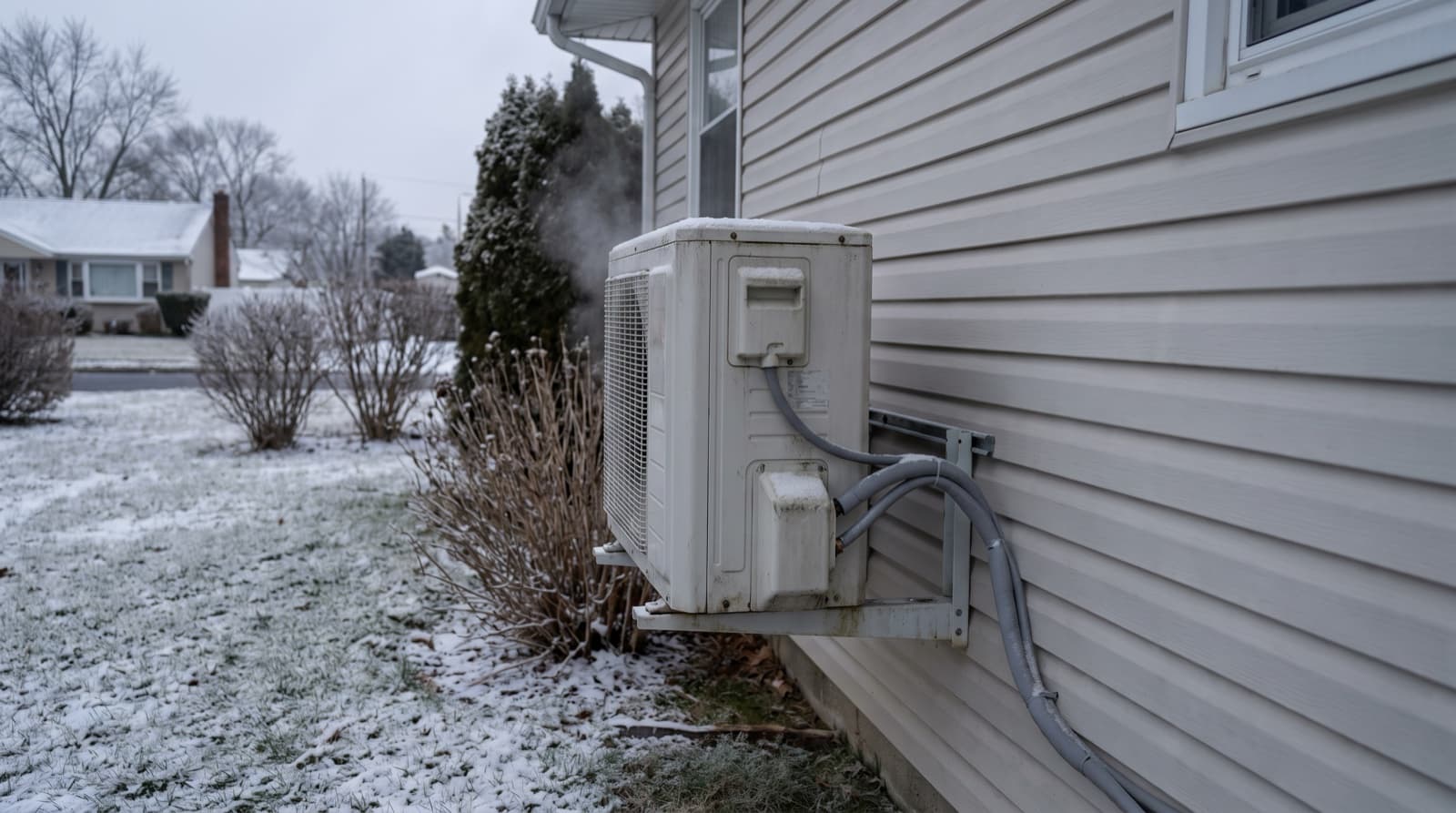
A 3 ton heat pump does not make 36,000 BTU of heating at 17 degrees. Depending on the model it makes anywhere from 24,000 to 43,000 BTU, and the spec sheet is the only way to know which one is going on your house.
That is because a ton is a cooling number, taken at 47 degrees outdoor air. Forty-seven degrees is a nice April morning in Patchogue. It is not a Long Island winter. Every cold climate heat pump loses heating capacity as the outdoor air drops, and how much it loses is the biggest difference between two units that both say 3 ton on the box.
Nameplate tons are a summer number, not a heating number
One ton means 12,000 BTU per hour of cooling. The rating conditions behind it are a summer test, and the heating side of the same air source heat pump gets its headline rating at 47 degrees. That convention is a holdover from central air conditioning, back when the summer load picked the tonnage and a gas furnace did the heating on its own. Heat pumps work in both directions off one outdoor unit, so that same heat pump carries a heating capacity curve that the ton on the box never describes.
On Long Island homes that is backwards. In Suffolk County the heating load is almost always the bigger of the two, so heating is what sets equipment selection, not the air conditioning side. We cover why in our guide to picking the right heat pump for a Long Island winter, and the design temperature that heating load gets calculated against is in 17 degrees in Patchogue, 10 in Westhampton.
If the question you are really asking is whether the technology holds up out here at all, that is settled separately in do heat pumps work in cold weather. This post is narrower: not whether it works, but how much it makes. Shopping a new heat pump by tons is shopping on a number that was measured in weather you do not need help with. The heating and cooling capacities of the same machine are two separate curves, and only one of them matters in January.
The NEEP listing is where real heating capacity lives
The Northeast Energy Efficiency Partnerships cold climate list is the reference everyone in this region uses. It publishes heating capacity for a specific AHRI match, meaning one outdoor unit paired with one exact indoor coil or air handler, at 47 degrees, 17 degrees, 5 degrees, and often below zero.
At 17 degrees there are two numbers, and homeowners get tripped up here constantly. Rated heating capacity is what the unit produces at the compressor speed it was tested at. Maximum heating capacity is what that variable speed compressor can actually push at full output when it is cold out. On some equipment the two are nearly identical. On other equipment maximum is thousands of BTU higher.
Both numbers are legitimate. They answer different questions. Rated tells you where the machine likes to live. Maximum tells you how much heating it has left on Long Island's coldest nights, and maximum at 17 degrees is the number PSEG uses to decide whether the incentive gets paid.
Two 3 ton cold climate heat pumps, compared at 17 degrees
Here are two systems we actually quote.
The Amana AZV9SA361CA is listed at 34,200 BTU rated heating capacity at 17 degrees, with a maximum of 43,200 at that same temperature. The Bosch IDS Ultra in the comparable model lists 36,600 at 17 degrees, and its rated and maximum figures are the same.
Both of those are sold as 3 tons. Neither makes 36,000 BTU of rated heating at 17 degrees, and the spread between them at full output is roughly 6,600 BTU. That is more than half a ton of heating capacity separating two pieces of equipment that look identical on a line item.
Put a 40,000 BTU heating load under them and they behave differently. One clears it at full output with heating capacity to spare. The other does not get there, and the difference gets covered by electric heat strips instead of by the heat pump. Same nominal ton, same refrigerant, two different machines. Nobody can tell you which one fits your house without opening the listing.
Why the 17 degree heating number decides the whole install
This single figure cascades through everything else on the proposal. It decides whether the house holds temperature through a cold snap on the heat pump alone, or hands the load over to backup heat. Strips are a safety net, not capacity, and counting them as capacity is one of the most expensive shortcuts in this trade. That is its own post: backup heat strips are not capacity.
It also decides the money. The PSEG Long Island rebate tests NEEP maximum heating capacity at 17 degrees against the Manual J heating load, and the result has to land between 100 and 120 percent. Undersize the heat pump and you miss the floor. Oversize and you blow through the ceiling, which is why an oversized heat pump fails the same test. The rebates and savings page has the current tiers.
And it sets your balance point, the outdoor temperature where heating capacity finally falls below what the house needs. That is covered in what happens below the rated temperature.
How to make a contractor put it in writing
Ask for four things before you sign a heat pump proposal, and ask for them in writing on the proposal rather than in a text message.
First, the AHRI reference number for the exact match being installed, outdoor unit and indoor unit together. A model number for the condenser alone is not enough, because capacity changes with the coil it is paired to.
Second, the NEEP maximum heating capacity at 17 degrees in BTU for that match. Not tons. BTU.
Third, the design heating load for your house in BTU, from a room by room Manual J load calculation, not from the label on the old furnace or the square footage.
Fourth, those two divided into each other, as a percentage.
Any HVAC contractor specifying a cold-climate heating system for Long Island winters has those numbers already. They come out of the same lookup that picks the model. If the answer is that the unit is 3 tons and 3 tons is plenty, that is a rule of thumb wearing a spec sheet costume, and it is how people end up cold in February. Air source is what nearly every Long Island home ends up with anyway, since geothermal needs yard most of us do not have.
We are happy to walk through the 17 degree numbers on any quote you are holding, including one that is not ours. Call or text 631-209-7090, or reach us through heat pump installation or the contact page, and we will show you where the heating capacity actually lands.
Related Articles
Heat Pump vs Gas Furnace on Long Island: Pros, Cons, and Which Is Right for You
Heat pump vs gas furnace on Long Island: operating cost, comfort, cold-weather performance, and rebates compared, plus when a gas furnace still makes sense.
Best Pool Heat Pumps for Long Island (2026): Hayward vs Pentair vs AquaCal vs Raypak
The best pool heat pump brands for Long Island in 2026, compared by techs who service all four: Hayward, Pentair, AquaCal, and Raypak. Match the brand to your pool.
Ductless Mini Split vs Central Heat Pump: Your Next System Probably Is Not Ductless
Ductless mini split vs central air heat pump on Long Island? If your Suffolk County home has radiators, there is a third option most contractors never quote.