Heat Pump Cost on Long Island (2026): Real Install Prices, Rebates, and Monthly Payments
What a heat pump actually costs to install on Long Island in 2026: prices by job type, the add-ons that move the number, who qualifies for the PSEG rebate, and what it comes to per month financed.
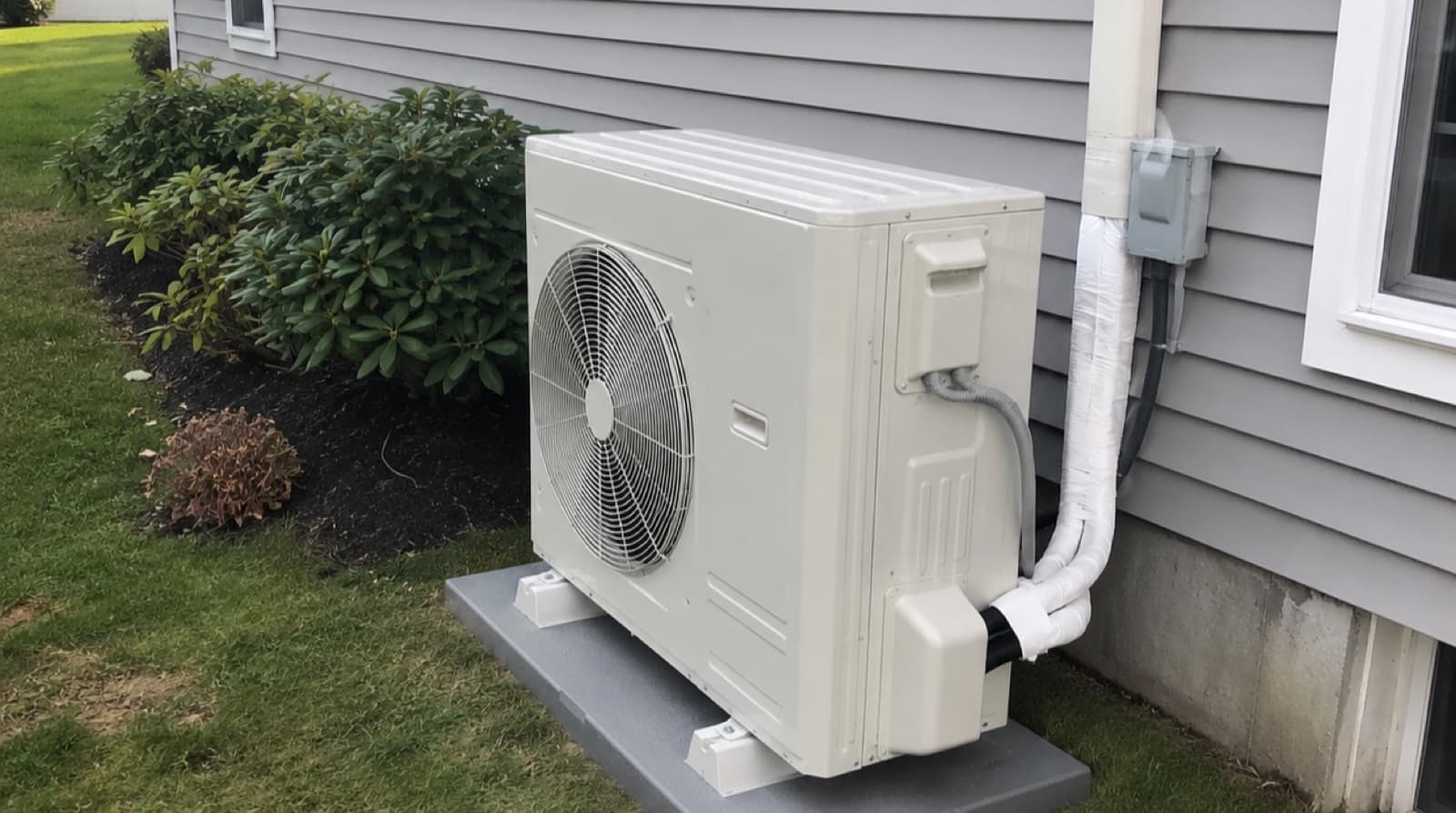
If you are pricing a heat pump for your Long Island home, you want a real number, not a marketing range. This guide breaks down what we actually quote in Suffolk County in 2026: what drives the price up or down, which systems qualify for the PSEG rebate, and what it comes to per month if you finance it. It's the same breakdown we walk homeowners through when we quote a job.
A heat pump uses electricity to move heat instead of burning fuel, which is more energy-efficient than oil or gas heat and lowers your energy bills. One outdoor unit can heat your home in winter and cool it in summer, handling both heating and cooling from a single piece of equipment.
How much does a heat pump cost on Long Island?
The average cost for Long Island homeowners lands between $12,000 and $30,000 for a ducted heat pump, installed. The low end assumes your home already has usable ductwork from central air or a forced-air furnace, so it's largely an equipment swap; a full conversion from a boiler with no ducts, where a duct system or multiple ductless zones go in, sits at the top of that range. After the PSEG rebate, that is roughly $121 to $392 a month financed.
That is a wide spread because a heat pump installation is not an off-the-shelf product with a fixed price. What you pay depends on what heating or cooling system you are replacing, your home's size, what shape your ductwork and electrical panel are in, and whether there is an oil tank in the yard. Below is the honest breakdown.
What heat pumps cost by job type
| What you have now | Installed | PSEG rebate | Your cost after rebate |
|---|---|---|---|
| Ducts already in place (central AC or forced-air furnace) | $12,000 to $18,000 | $4,000 | $8,000 to $14,000 |
| No ducts, boiler with radiators or baseboard | $18,000 to $30,000 | $4,000 | $14,000 to $26,000 |
| No ducts, 3 zones ductless | $10,000 to $15,000 | $4,000 | $6,000 to $11,000 |
| No ducts, 2 zones ductless | $7,500 to $10,000 | $4,000 | $3,500 to $6,000 |
| No ducts, 1 zone ductless | $5,000 to $8,000 | Does not qualify | $5,000 to $8,000 |
Coming off central air is the cheapest path because the existing ductwork and air handler are already in place, so the heat pump installation there is largely a swap of the outdoor unit and coil. Coming off a gas furnace still uses that existing ductwork, but replaces your HVAC system's furnace and AC pair with one piece of equipment. Coming off oil is the most expensive because there is usually a tank to deal with, and oil-heated Suffolk County homes, often with an oil furnace or boiler, frequently have no ductwork at all.
Ductless systems skip ducts entirely. Refrigerant lines run from the outdoor unit to each indoor head through a small wall penetration, which is why zone count, not job type, drives the ductless price.
The rebate amounts above assume the market-rate tier of the PSEG Long Island rebate. Homes in a disadvantaged community get $5,000, and income-qualified households get $7,500. That is covered further down.
The add-ons that actually move your quote
This is where two quotes for the same house end up thousands apart. The equipment is rarely the difference. These are:
| Add-on | Typical cost |
|---|---|
| Underground oil tank removal | $3,500 |
| Above-ground oil tank removal | $1,200 |
| Oil tank decommissioned in place | $800 |
| Panel upgrade, 100 amp to 200 amp | $2,500 |
| Panel upgrade, 150 amp to 200 amp | $1,800 |
| New 60 amp circuit for the outdoor unit | $650 |
| Ductwork, minor repairs to whole new system | $500 to $4,000 |
| Town permit (Brookhaven, Islip, Patchogue Village) | $100 to $150 |
A quote that comes in noticeably under everyone else usually has one or two of these missing. They do not disappear, they show up as a change order once the job is open. Electrical panel upgrades are especially common on Long Island's older housing stock, where a lot of homes are still wired for 100 amp service. When you compare quotes, ask any local HVAC contractor to show the add-ons as separate line items rather than folding them into one number.
Which systems qualify for the PSEG rebate
The rule is simpler than most contractors make it sound. A system qualifies when it can supply full heat for your house without an auxiliary heat source. A modern cold-climate heat pump can do that even on Long Island's coldest days, without a backup furnace.
That means every whole-home ducted conversion qualifies. A whole-home heat pump installed with two or more ductless zones qualifies too. A single-zone ductless mini-split heating one room does not qualify, because it cannot carry the house on its own.
The rebate is a flat amount by income tier, not a percentage:
- $4,000 at market rate
- $5,000 for homes in a disadvantaged community, decided by address
- $7,500 for income-qualified households
Two things worth knowing, because they get misrepresented a lot. First, PSEG Long Island administers the NYS Clean Heat program here, so the PSEG rebate is the NYSERDA money. It is one rebate, not two stacked. Second, the federal 25C tax credit expired on December 31, 2025 and is not available for 2026 installs. If someone quotes you PSEG plus NYSERDA plus a federal credit, they are adding up money you will not receive.
You never float the rebate. With PSEG's direct-pay option, the rebate comes to us, so it comes off your project instead of you waiting on a check. The honest caveat: PSEG deducts any past-due balance on your account from the rebate first.
What heat pumps cost per month
Most people do not pay the full installation cost out of pocket, and the monthly number is usually what decides the job. Financing turns a large upfront cost into a monthly payment. Here is what each tier comes to financed over 7 years, after the rebate comes off.
| What you have now | Cost after rebate | Estimated monthly |
|---|---|---|
| Ducts already in place (central AC or forced-air furnace) | $8,000 to $14,000 | $121 to $211 |
| No ducts, boiler with radiators or baseboard | $14,000 to $26,000 | $211 to $392 |
| No ducts, 3 zones ductless | $6,000 to $11,000 | $91 to $166 |
| No ducts, 2 zones ductless | $3,500 to $6,000 | $53 to $91 |
| No ducts, 1 zone ductless | $5,000 to $8,000 | $75 to $121 |
Look at the last two rows again, because this surprises people. A two-zone ductless system costs less per month than a single-zone system, even though it is a bigger job. The two-zone can heat the whole house, so it clears the rebate bar and takes $4,000 off. The single zone cannot, so it does not. If you were planning on one unit for one room, adding a second zone often costs you less every month than the smaller system would have.
Those payments assume an illustrative 6.99 percent APR over 7 years. That is an example rate, not a quote. Your actual rate comes from a pre-qualification through Hearth that does not affect your credit, and it takes about a minute. Financing gets you started now, and any rebate that comes through can go toward the balance.
There is also an ongoing savings piece beyond the monthly payment. Under PSEG's Rate 580, homes where the heat pump is the primary heat source get 45 percent off electric usage above 400 kWh a month, October through May, every year they live in the home. It is a rate discount, not a rebate, so it does not change the installed cost above, but it lowers what you pay to run the system every heating season after that.
Check your rate without affecting your credit
Getting a real number for your house
Everything above is a planning range for the overall cost, not a fixed number. The firm price for your new heat pump comes from seeing the house, because the panel, the ducts, and the tank are what decide the final cost. We give a written quote with the add-ons itemized, walk you through equipment options, and handle the PSEG rebate paperwork as a participating contractor.
Text or call us at 631-209-7090 and we will get you on the schedule.
Related reading:
Frequently Asked Questions
It depends on whether your home already has ductwork. Dropping a ducted heat pump in where you already have ducts, from central air or a forced-air furnace, runs about $12,000 to $18,000 installed. Coming off a boiler with radiators or baseboard, where there are no ducts, runs $18,000 to $30,000, because a duct system or multiple ductless zones go in and oil adds a tank to remove. Ductless systems run $5,000 to $8,000 for one zone, $7,500 to $10,000 for two, and $10,000 to $15,000 for three. Most of those qualify for a PSEG rebate of at least $4,000.
On a 7 year term at an illustrative 6.99 percent APR, a ducted heat pump where you already have ducts comes to roughly $121 to $211 a month after the $4,000 PSEG rebate. A no-ducts conversion off a boiler runs about $211 to $392 a month. A three-zone ductless system runs about $91 to $166. Those are illustrative figures, not a quoted rate. Your actual rate comes from a pre-qualification that does not affect your credit.
A system qualifies when it can supply full heat for your house without an auxiliary heat source. Every whole-home ducted conversion qualifies. Ductless qualifies at two zones and up. A single-zone ductless mini-split heating one room does not qualify, because it cannot carry the whole house. The rebate is a flat amount per home: $4,000 at market rate, $5,000 for a disadvantaged community address, and $7,500 for income-qualified households.
Almost always the add-ons rather than the equipment. Removing an underground oil tank is about $3,500. Upgrading a 100 amp panel to 200 amp is about $2,500. Ductwork ranges from $500 for minor repairs to $4,000 for a whole new system. A quote that looks low often has those items missing, and they surface later as a change order. Ask any contractor to show the add-ons as line items.
No. PSEG Long Island administers the NYS Clean Heat program here, so the PSEG rebate is the NYSERDA money, not a second rebate on top of it. The federal 25C tax credit expired on December 31, 2025 and is not available for 2026 installs. Anyone quoting you a stack of all three is adding up money you will not receive.
No. With PSEG's direct-pay option we handle the paperwork and the rebate comes to us, so it comes off your project instead of you fronting the money and waiting on a check. One honest caveat: if you carry a past-due balance with PSEG, they deduct those arrears from the rebate before it reaches the project.