Radiant Floor Heating Cost With a Heat Pump: The All-in-One Altherma Option
Radiant floor heating cost comes down to what heats the water. How a heat pump cuts radiant floor running costs in Long Island homes, and what drives install.
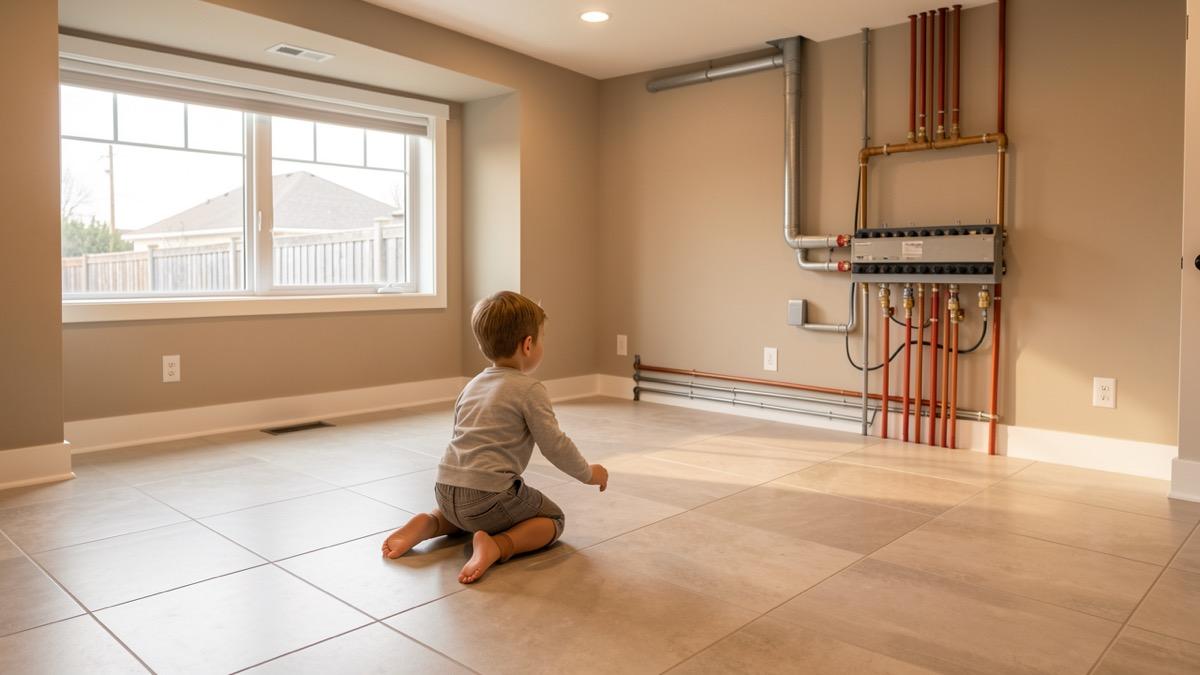
Radiant floor heating costs less to run with a heat pump than with almost anything else, because a hydronic radiant floor only needs 95 to 105 degree water, and that is exactly where a heat pump is most efficient. On the Daikin Altherma 3 H HT, Daikin's own performance curve puts low-temperature radiant at a coefficient of performance of roughly 5 to 6 in mild weather.
Every contractor who has ever pitched you radiant floors made the same speech. Warm floors, even heat, no cold corners, no air blowing dust around. Then came the asterisk: it is the most luxurious heat you can buy, and it is expensive to run. That second part is the one that has changed.
Why Radiant Floor Heat Got a Reputation for High Operating Cost
The floor was never the problem. The boiler was.
Almost every hydronic radiant floor heating system on Long Island is fed by an oil or gas boiler. A boiler is built to make 150 to 180 degree water for radiators and baseboard. Radiant floor heat does not want that. Water that hot would cook the floor covering and make the floor uncomfortable to stand on, so the installer adds a mixing valve to blend it down to around 100 degrees before it goes into the tubing.
So you have a boiler burning fuel to make hot water, then mixing it with cooler return water to throw most of that temperature away. And radiant runs long, slow cycles to keep a big mass of concrete or subfloor warm. Long run times on an oil boiler in a Suffolk County winter add up fast, and that is where the reputation for high radiant floor heating operating costs came from.
What a Heat Pump Changes About Radiant Floor Heating Cost
A heat pump works the opposite way from a boiler. It does not burn anything. It moves heat out of the outdoor air and into water, and the lower the water temperature you ask for, the less work it does and the more efficient it gets.
That makes radiant the perfect match. The Daikin Altherma can make water up to 158 degrees for cast iron radiators, but asking it for 100 degree water for a radiant floor puts it in its highest-efficiency zone. Here is how Daikin's published performance curve breaks down by emitter type:
Radiant floors (around 104 degree water): COP of roughly 5.3 to 6.4 in mild weather, about 2.3 at 5 degrees outside.
Convectors (around 113 degree water): roughly 3 to 4 in mild weather.
Cast iron radiators and baseboard (around 149 degree water): up to about 2.9 in mild weather, about 1.6 at 5 degrees.
COP 5 in plain English: one dollar of electricity moves about five dollars' worth of heat into your floor. No other emitter in the lineup comes close, and no boiler can, since even a high-efficiency boiler delivers less than one unit of heat per unit of fuel.
The Running-Cost Math for a Long Island Radiant Floor
Here is a rough comparison, per 100,000 BTU of heat delivered to the house. We used New York's statewide average residential electric rate of 28.6 cents per kWh (NYSERDA, March 2026). Long Island usually runs above the statewide average, so treat this as a starting point, not a bill.
Heat pump on radiant, mild day (COP 5.3): about $1.60
Heat pump on radiant, 5 degree design day (COP 2.3): about $3.65
Oil boiler at 85 percent efficiency, heating oil in the high $3 to low $4 range per gallon: roughly $3.10 to $3.60
On the coldest nights of the year, the heat pump on radiant runs about even with oil. On the much more common 30 and 40 degree days of a Long Island heating season it costs noticeably less, and on mild days roughly half. And if your home is on PSEG Rate 580, the heating rate that discounts winter usage above a monthly threshold, the heat pump numbers drop further. Our rebates and savings page has the current Rate 580 details.
That is the pitch line we keep coming back to: the comfort of radiant floors with the savings of a heat pump. You used to have to pick one.
Hydronic vs Electric Radiant Floor Heating
Quick but important distinction. There are two kinds of radiant flooring.
Electric radiant floor heating uses resistance cables or mats under tile, usually in a bathroom. It is cheap to install and expensive to run on a large area, because every kWh in becomes exactly one kWh of heat, a COP of 1. Fine for warming a bathroom floor on a timer. Not how you heat a house.
Hydronic radiant floor heating runs warm water through PEX tubing in a slab, under the subfloor, or in thin panels on top of it. That is the kind a heat pump drives, and the kind this post is about.
What Drives the Cost to Install Radiant Floor Heating
We are not publishing fixed Altherma prices until we have enough completed Long Island installs to quote real numbers instead of guesses. What we can tell you is what moves the price on any hydronic radiant floor heating project:
How the tubing goes in. Tubing poured in a concrete slab during new construction or a basement finish is the cheapest per square foot. Joist-bay installs with aluminum plates under an existing floor work well for retrofits but take more labor. Low-profile above-floor panels are the option when you cannot get underneath.
Square footage and zones. More floor, more tubing, more manifold ports, more zone controls and thermostats.
Flooring type. Tile and stone move heat best. Engineered wood works. Thick carpet and pad fight you.
Insulation. Insulating under the tubing or slab is not optional. Without it you are heating the dirt or the basement ceiling.
The heat source. Tying a few radiant zones into a heat pump that is already replacing your boiler costs a lot less than buying a dedicated system for one room. Our Altherma cost factors page walks through what moves that side of the project.
Where Radiant Floors Fit, and the Honest Caveats
The best fit is new construction, gut renovations, additions, basement finishes, and primary suites where comfort is the priority. If you are already opening the floor, adding radiant is a small increment.
Three things to know before you commit. Retrofitting under a finished floor is harder and costs more. Radiant is slow to respond, so it rewards a steady setpoint, not deep setbacks. And sizing matters more than with forced air, because a floor can only get so warm before it is uncomfortable to stand on, which caps how much heat each square foot can put out. A drafty, high-loss room may need a convector to help on design days. That is why we do a real room-by-room load calculation and do not guess. Radiant also does not cool the house, so plan on convectors or a hydronic air handler for summer.
The All-in-One Altherma Approach: Mix and Match by Zone
This is where the all-in-one Altherma earns its name. It is an air-to-water heat pump that can replace your boiler, add cooling, and make your hot water from a single outdoor unit, and it runs two water temperatures at once.
A layout that fits a lot of older homes in Patchogue and Sayville: existing cast iron radiators on the main floor, radiant in a finished basement or a new primary suite, convectors upstairs for heating and cooling, and the domestic hot water tank, all on one system. If that sounds like your house, start with how a heat pump works with radiators and the all-in-one heat pump breakdown.
Get a Straight Answer on Your Floors
If you are building, renovating, or living with a radiant floor on an aging oil boiler, we will look at your load, your floors, and your current heating system and tell you honestly whether the numbers work. Call or text Patchogue Heating and Air Conditioning at 631-209-7090, or check whether your home is a fit for the Altherma.
Frequently Asked Questions
They were, mostly because of the boiler behind them, not the floor. A hydronic radiant floor only needs 95 to 105 degree water. Run that from an oil or gas boiler and you pay for fuel by the gallon or therm. Run it from an air-to-water heat pump and you are feeding the heat pump the easiest job it can get. On the Daikin Altherma 3 H HT, low-temperature radiant runs at a coefficient of performance of roughly 5 to 6 in mild weather and about 2.3 at 5 degrees outside, which makes radiant the cheapest heat to run in the whole lineup.
An air-to-water heat pump. Radiant floors want warm water, not hot water, and a heat pump gets more efficient the lower the water temperature you ask for. That is the opposite of a boiler, which makes 150 to 180 degree water just as easily as 100 degree water and burns fuel either way. Pairing low-temperature radiant with a heat pump puts both pieces of equipment in their sweet spot.
Yes, if it is designed for it. The Altherma runs a main zone at a low water temperature for radiant and an additional zone at a higher water temperature for radiators or baseboard, from one outdoor unit. Radiant in the basement or primary suite and existing radiators on the main floor is a common Long Island layout, and the same system makes the domestic hot water.
Square footage, whether the tubing goes in a slab, under the subfloor in the joist bays, or on top of the subfloor in panels, the floor covering, insulation under the tubing, and how many zones and manifolds the layout needs. New construction and gut renovations are the cheapest time to add it. Retrofitting under a finished floor is possible but costs more per square foot.
Related Articles
What Size Heat Pump Do You Need for a Long Island Winter?
Heat pump size on Long Island: what size heat pump do you need for your home, and why BTUs at 17 degrees matter far more than the ton printed on the label.
Your Heat Pump Is Rated at 47 Degrees. Long Island Winters Are Not.
A cold climate heat pump loses heating capacity as it gets colder. What Long Island homeowners should check at 17 degrees before signing any proposal.
17 Degrees in Patchogue, 10 in Westhampton: The Long Island Heating Design Temperature
The Long Island heating design temperature is not one number. Brookhaven 16F, Farmingdale 17F, Gabreski 10F, and Suffolk County HVAC design conditions differ.